

If you pronounce “Yiddish” to rhyme with “skittish,” then Ken Blady would like a word with you.
To give it the full Galitzianer oomph, one must say “Yeedish.” Otherwise you sound like a vilde chaya (that’s “wild animal” for all you yankels out there).

Blady will discuss the finer points of Galitzianer vs. Litvak Yiddish, and other aspects of the Mamaloshen, during a two-part workshop at this year’s Yiddish Culture Festival.
A presentation of KlezCalifornia, the festival takes place Feb. 12 to 15 at Palo Alto’s Congregation Etz Chayim. It’s like a Disneyland for Yiddish lovers, complete with singing, dancing, Yiddish language cram sessions and all around freilach-making.
Blady calls himself “an authentic Jewish dodo bird,” having grown up in a Yiddish-speaking Chassidic home in Brooklyn. He didn’t become a regular English speaker until his teens, so Yiddish is deep in his bones and blood.
No longer Chassidic, the Berkeley resident has taught Jewish history and Yiddish culture at colleges, synagogues and JCCs for more than 35 years. He is also a translator. For the Yiddish Cultural Festival, he will team up with Zachary Baker of Stanford University’s Judaica Library to explore the role of Yiddish in the Chassidic world, past and present.
“I will try to pack in the attitude of the Chassidim toward Yiddish,” Blady says. “Yiddish is the most soulful of languages. I’m not being a Yiddish chauvinist when I say this.”

The Yiddish soul has a counterpart in klezmer music, and the upcoming festival always makes music a centerpiece. Some of the musicians performing this year include trumpeter-composer Frank London and the noted klezmer trio Veretski Pass.
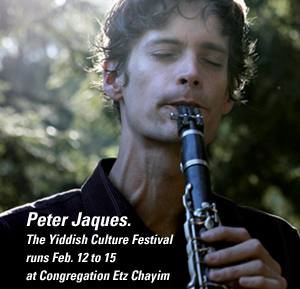
Another is Peter Jaques, a Bay Area klezmer clarinetist who will make a joint presentation with a German counterpart, Christian Dawid, on the topic of Jewish music and its crosscurrents with Balkan and Turkish styles.
Jaques’ specialty is Jewish music from Greece, Turkey and the former Yugoslavia. Dawid has a thing for the klezmer music of Ukraine, Romania and the colder climes of Eastern Europe.
“We’ll focus on how klezmer music and Jewish musicians interacted with both kinds of music,” Jaques says. “I’m working to present different tunes that had made it across different genres. There’s a lot of common repertoire.”
That means that over the centuries, strains of Arab, Roma and Balkan music collided with the ancient Hebrew and Ladino melodies of the Jews. The result is the delicious stew of European Jewish music reborn in the klezmer revival.
As much as Yiddish music has flourished since the klezmer revival began about 30 years ago, the Yiddish language has not fared quite as well, at least as a spoken idiom.
Blady doesn’t think much can be done about that, especially since Yiddish lives on only in Chassidic communities, and the Ellis Island generations are becoming distant memories. His own Galitzianer dialect is nearly extinct because most of the Orthodox Jews who spoke it refused to emigrate and perished in the Holocaust.
What emerged in America, according to Blady, was “a white bread kind of Yiddish mostly derived from Litvish” dialects. But even that is fading as a living language.
“You have to live in a Yiddish ghetto to perpetuate Yiddish,” Blady says. “It doesn’t quite work any other way. You have to work at it every day.”
Meanwhile, he’s happy that some people — like attendees at the Yiddish Cultural Festival — remain interested in Yiddish, even if fluency seems out of reach. As for him, he has all too few Galitzianers who speak his language.
“For the most part there’s no one to talk to,” he says. “I have to talk to myself.”
The Yiddish Culture Festival runs Feb. 12 to 15 at Congregation Etz Chayim, 4161 Alma St., Palo Alto. Registration is required. Program passes: $100-$180. Single workshops: $15-$25. Information: (415) 789-7679 or www.klezcalifornia.org.