
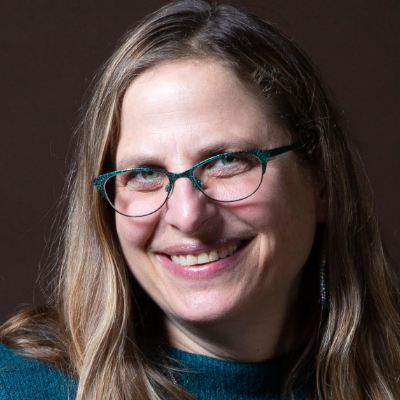
Rabbi J.B. Sacks is many things: a Conservative rabbi, a father, a student. But he has also been called an activist or agitator, which “is a badge I wear proudly.”
“‘Justice, justice you shall pursue,’ does not mean maintaining the status quo at all costs, especially when the quality of life of human beings are at stake,” he said.
Sacks was the first openly gay Conservative rabbi in the country.
At a time when the Conservative movement is considering whether to ordain members of the lesbian, gay, bisexual and transgender community, Sacks will spend the weekend as a scholar-in-residence at San Francisco’s Congregation Beth Sholom beginning Friday, April 28.
Sacks grew up in a Conservative household in rural Michigan. While he says he knew he was different in some way as early as the fifth grade, being in the rural Midwest gave him no opportunity to think about what that might mean. In high school he threw himself into every club and activity around. It was only late into college that he began allowing himself to realize that he was attracted to men.
When he first applied to the University of Judaism, he was barely out to himself. The U.J. did not ordain rabbis then, so he then had to attend the Jewish Theological Seminary in New York. It was the mid-’80s, at the same time when the Conservative movement began ordaining women. It was in New York that he began exploring the fact that he was gay, but the fact that he was at JTS meant that he did so in secrecy.
“I was very big on women’s issues and concerns,” he said, adding, “I’m sure there was a piece of it that all liberation struggles are connected, and if there’s progress on women’s issues in Judaism, there will be progress on gay issues in Judaism.”
Talk of gays and lesbians at JTS did not exist.
By the time he was ordained, Sacks was not only regularly attending the gay and lesbian synagogue in New York, but he was in a relationship with a man.
He later found out that one of his closest friends was asked point blank whether Sacks was gay, because the leadership of JTS were considering not ordaining him. The friend responded, “J.B. has never told me he is gay,” which allowed Sacks to be ordained.
At his first pulpit in Jersey City, he stayed in the closet until he had been there for almost six years; he only came out when he had to tell his congregants that his partner was dying of AIDS, and that he may be a bit distracted for a few months.
He thought he’d be fired at once, or at least after shiva. But it never happened. Even when he resigned, they wanted him to stay.
Before his partner died, they had a commitment ceremony. When some rabbis at JTS got wind of it, they tried to bring him up on charges to get him thrown out of the Conservative movement.
His Jersey City congregation didn’t want him to go, but he wanted to get back to California. And at that point, there was no going back. He became the first person to apply for a pulpit at a non-LGBT Conservative synagogue as an openly gay man.
“I was comfortable putting my life into HaShem’s hands,” he said. “I wasn’t going to hide a major component of who I was from a congregation, and there were 10 congregations who took me seriously.”
Sacks stayed there another seven years, and for the past four years he has worked part-time for a congregation in Riverside County while he completes his Ph.D. He is in the midst of legally adopting his current partner’s son, who was adopted from Guatemala.
Sacks speaks and teaches as much as he can, as he will do here, including about the passages in Leviticus that are often cited in condemning homosexuality.
“People say that these passages are the reason why the Conservative movement cannot be compassionate or change tradition, so I’m going to debunk its relevance to the current discussion,” he said.
Sacks’ goal is to teach this same workshop at a Rabbinical Assembly conference for his colleagues, but despite applying numerous times, his proposal has yet to be accepted.
J.B. Sacks will be speaking four different times throughout the weekend of April 28 through April 30 at Congregation Beth Sholom. Information: www.bethsholomsf.org or (415) 221-8736.