
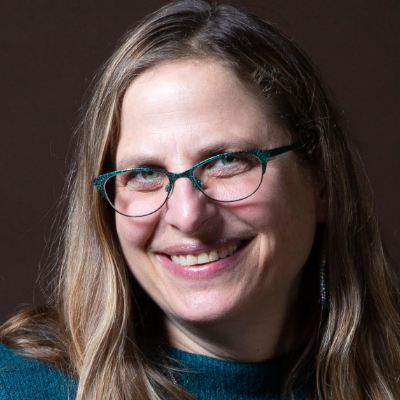

Tedrick Greer Sims Jr. has observed Passover many times inside San Quentin State Prison over the years, but this time he could easily answer why this night was different from all other nights.
“I’m getting out in 13 days,” he told me at the first-night seder. “This one is the best because it’s my last one here.”
Sims learned in November that he will be released on parole after serving 36 years.
Asked how he observed the freedom-focused festival in past years when his potential release was only theoretical, he said, “You just try to be as joyful as you can. You take the meaning of it to heart.”
After two years without seders in 2020 and 2021 due to the pandemic and then a very small in-person seder last year, the decades-long tradition returned on April 5, the first night of Passover, inside the walls of the state’s oldest prison.
Calling it a “highlight that many of the men look forward to all year,” Rabbi Paul Shleffar, a San Quentin chaplain since 2015, said the seder was attended by around 70 incarcerated men and a small number of outside guests. Another 80 holiday meals — a chicken breast, salad, vegetables and mashed potatoes from Oakland Kosher — were boxed and brought to those on death row and in other parts of the Marin County prison that overlooks San Francisco Bay.
The seder, which included the same meal as well as seder staples like matzah, haroset and horseradish, took place in one of the prison’s chapels. On the wall were scenes of Jesus, but there was also art placed in the front of the room of the Israelites fleeing Egypt and of the Red Sea parting, drawn and painted by the men of San Quentin.
Since its founding in 1901, Sinai Memorial Chapel, the Bay Area’s only Jewish funeral home, has practiced “ma’ot chitim,” Hebrew for “wheat money,” in which a small surcharge from each funeral is collected for burial of the poor, kosher meals for seniors and the homebound, and prison seders. “Wheat money” is a reference from the Jerusalem Talmud that originally specified that poor Jews should be given money to buy wheat to make matzah.

Two Sinai board members, three Sinai employees, including retiring executive director Sam Salkin, and some of their partners were among about 15 guests who joined the ritual meal at the medium-security prison. Among the others attending were Kat Morgan, senior director of people and operations at Urban Adamah, Berkeley’s Jewish organic farm, who regularly led Shabbat services at San Quentin before the pandemic; Kiki Lipsett, young adult programs director at Urban Adamah; and Essence Goldman, who teaches music at San Quentin.
Salkin believes that Sinai has been helping to underwrite the San Quentin seder since at least 1990, but he is unaware of any previous year that a group from Sinai was invited to attend. This year’s seder also had financial support from others in the Jewish community, Urban Adamah and a few family members of the incarcerated men.
The music for the event came from a group of incarcerated men who play together as a band for Shabbat, mostly Sephardic melodies introduced by Shleffar.
The rabbi said he feels a strong affinity for Ladino music, the language of Jews expelled from Spain in 1492, and many of the songs he chooses are in Ladino. He brings them to the band practices a few times a week.
“It’s all grown out of the Shabbat service, and it’s so sweet and beautiful,” Shleffar said. He noted that the singer, Moises Ramos, comes from a Latino background.
“Every time I hear him singing these songs in Ladino,” Shleffar said, “it brings tears to my eyes. This is a spiritual path for them, and I think for the folks that are of Latino heritage, they really connect to the Ladino.”
John Zeretzke, who leads the prison band, later told me that “playing this music has literally saved some of these guys.”
The question of how one celebrates freedom behind bars was foremost on visitors’ minds, and it was clearly something the incarcerated men had thought a lot about.
One of them, Brian Asey, shared that he recently thought he was getting out but then learned he was not.
“For me, it’s more an opportunity to do some reflecting and think about, where did I lose sight?” he said.
The seder, which lasted about 2½ hours, included all the essential elements, with some adaptations. As a riff on tradition, Shleffar asked people to share something negative that had happened to them and the blessing that came out of it.
“I thought I lost everything when I came to prison,” said one man. “But the realization that my family would stand by me was such a blessing.”
“Coming to prison saved my life, health-wise,” said another.
“When I found out my daughter went into foster care, that connected us,” said another. “Now I’m trying to build a relationship with her for when I get out of here.”
Zackary Martinez, who sat next to me at the seder, told me that coming to prison was a blessing because “it got me closer to my Jewish heritage.”
Attending the seder for the first time was Oak Smith, the acting warden of San Quentin. Smith told the group that he had worked in the prison system for years but had never witnessed someone sentenced to life go free before he came to San Quentin in 2015.
“On my first day here, I had to sign the paperwork to let this lifer out,” Smith said, and he has seen numerous others leave since then. “It’s a blessing to be part of a place where we offer these opportunities.”
Berkeley therapist Catherine Metzger was part of the Sinai contingent with her husband, Marc Roth, who is on the board. As someone who has experienced severe trauma in her life, she said, she easily found common ground with the incarcerated men at her table.
“We spoke about how even when you’re trapped by physical circumstances, you can have freedom of mind and spirit,” she said. “I went in with that in my heart, and knowing that it’s possible to transcend what others have done to you or where your circumstances have led you.”
Martinez said that when he is released later this year he will introduce Judaism to his children. Several others at my table identified as Messianic Jews. They consider themselves Jewish and follow Jewish practices but believe that Jesus is the messiah.
Shleffar said there are some in the prison’s Jewish community who consider themselves Christians, too. The seder was open to anyone interested among the more than 3,000 men at San Quentin.
“We’re all on a journey, and it’s not a linear thing,” Shleffar said. “We all grow and change throughout our spiritual lives.”
He said what makes his rabbinate unique is the fact that the Jewish community inside San Quentin consists mostly of men who are interested in learning what Judaism has to offer and few who were actually born Jewish.
“People often think we should be insular,” he said. “I’m not saying we should proselytize, but we should be open and welcoming. If our instruction is to be a light unto the nations, that doesn’t always mean we should just be doing that for each other, but we should be sharing what’s beautiful about Judaism with anyone that’s interested.”
And clearly, those who participate in the prison’s Jewish community are finding meaning in it.
Loren Eric Crain, attending his first-ever seder, was one of those at my table who described himself as a Messianic Jew.
“Being Jewish is being part of a community,” he said. “You feel connection, love and shalom when you’re around each other.”