

This article originally appeared on Haaretz. Sign up here to get Haaretz’s free Daily Brief newsletter delivered to your inbox.
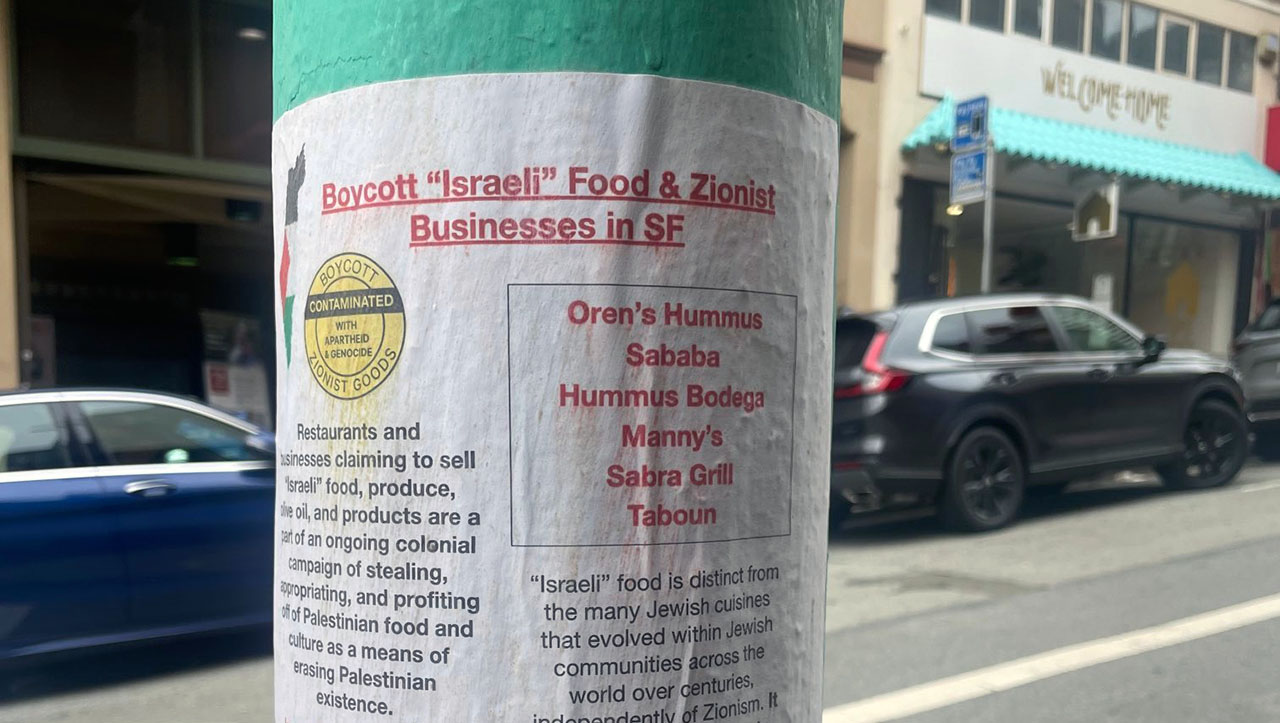
Fliers calling for a boycott of Israeli and Jewish eateries were found posted in commercial San Francisco areas of San Francisco on Jan. 12. It is unknown who hung the posters, although eyewitnesses reported a group of young people hanging them on utility poles.
The posters read, in part, “Restaurants and businesses claiming to sell ‘Israeli’ food, produce, olive oil, and products are a part of an ongoing colonial campaign of stealing, appropriating, and profiting off Palestinian food and culture as a means of erasing Palestinian existence.”
Six local San Francisco restaurants are listed on the flier: Oren’s Hummus, Sababa, Hummus Bodega, Manny’s, Sabra Grill, and Taboun.
Oren’s Hummus also discovered graffiti at two of their locations, with the words “Do you condemn hummus?” spray-painted on the ground near the entrance.
For Mistie Boulton, co-owner and CEO of Oren’s Hummus, the primary concern is keeping her staff safe. “It’s been really demoralizing for them,” she said in a phone interview. “They are wondering, ‘Is this going to get worse?’ We’ve put many plans in place, all of our managers are aware of how to handle specific scenarios.”
The Jewish Community Relations Council of San Francisco also issued a statement regarding the fliers: “Jews are being scapegoated for events overseas. And small business owners should not face collective punishment. This form of antisemitism is growing and deeply alarming to us.”
Notably, the text of the poster does not focus on the more typical accusations made by pro-Palestinian advocates since Oct. 7. It does not mention genocide or demand a cease-fire. Instead, it hones in on a flashpoint in the Israel-Gaza war that is playing out specifically in Jewish, Arab, Israeli, and Palestinian restaurants across America and Europe: Who has the right to claim the foods of the Middle East as their own?
This war over hummus (and falafel, pita and shawarma) isn’t new. For years, even as Israeli chefs have garnered praise and recognition for their culinary creations, they’ve faced criticism for appropriating dishes that have been eaten in Syria, Lebanon, Jordan, and Palestine for centuries. Arab and Palestinian chefs, in turn, are using their recipes as a way of resisting cultural erasure.
But if the argument over whom these dishes belong to has been kept on a low simmer until now, the Israel-Hamas war, fueled by nationalistic assertions on both Israeli and Palestinian sides, has caused the argument to boil over.
From coffee shops to fine dining establishments, restaurants that serve certain foods have suddenly found themselves at the center of attacks, with many facing acts of vandalism, calls for boycotts, an onslaught of negative reviews, and/or harassment from demonstrators.
In November, Knafeh Queens in Los Angeles, owned by a Palestinian-American, was subject to a spate of harassing phone calls, negative social media messages and anti-Islamic graffiti. Around the same time, the New York branch of popular Israeli bakery chain Lehamim was attacked by pro-Palestinian activists who sprayed anti-Israel messages and shattered a window of the building.
It is an issue Oren’s Hummus has been navigating long before the fliers went up calling for a boycott of their restaurant. “We consistently receive many angry posts as though we are claiming hummus originated from Israel,” Boulton says.
“We are not. Our view is the Middle East and the Mediterranean regions have a long history of a shared cuisine. Of course someone made it first, but every culture has their take on it… we serve our hummus in the same way one would enjoy it being served in Israel.”
Some restaurateurs are finding their own way to promote messages of peace and coexistence during this increasingly divisive time. Two weeks ago, when Abdul Elani opened the newest branch of his popular Palestinian restaurant, Ayat, in Brooklyn, New York, he suddenly found himself fending off accusations of antisemitism from two major media outlets.
The Daily Mail and the New York Post both honed in on one seemingly minor detail: a few years ago when designing his menu, he decided to call the seafood section, “From The River to The Sea,” not thinking much of it at the time. Death threats and bomb threats soon followed the newspapers’ reports, as did a flood of hateful and scary messages on Ayat’s Instagram page.
Elani, for his part, is determined not to let the storm of vitriol swirling around his restaurant isolate his loyal Jewish customers, many of whom immediately reached out with messages of sympathy and support. At the end of the month, he will be hosting a Shabbat dinner for anybody in the neighborhood who wants to come, free of charge.
In their invitation, posted both on the ‘Ayat.NYC’ Facebook and Instagram pages, Elenani and his wife Ayat Masoud wrote: “It’s not just about breaking bread; it’s about breaking barriers, fostering dialogue, and connecting on a human level. This evening is more than a meal; it’s an opportunity to share stories, embrace diverse perspectives, and celebrate our shared humanity.”