

Food coverage is supported by a generous donation from Susan and Moses Libitzky.
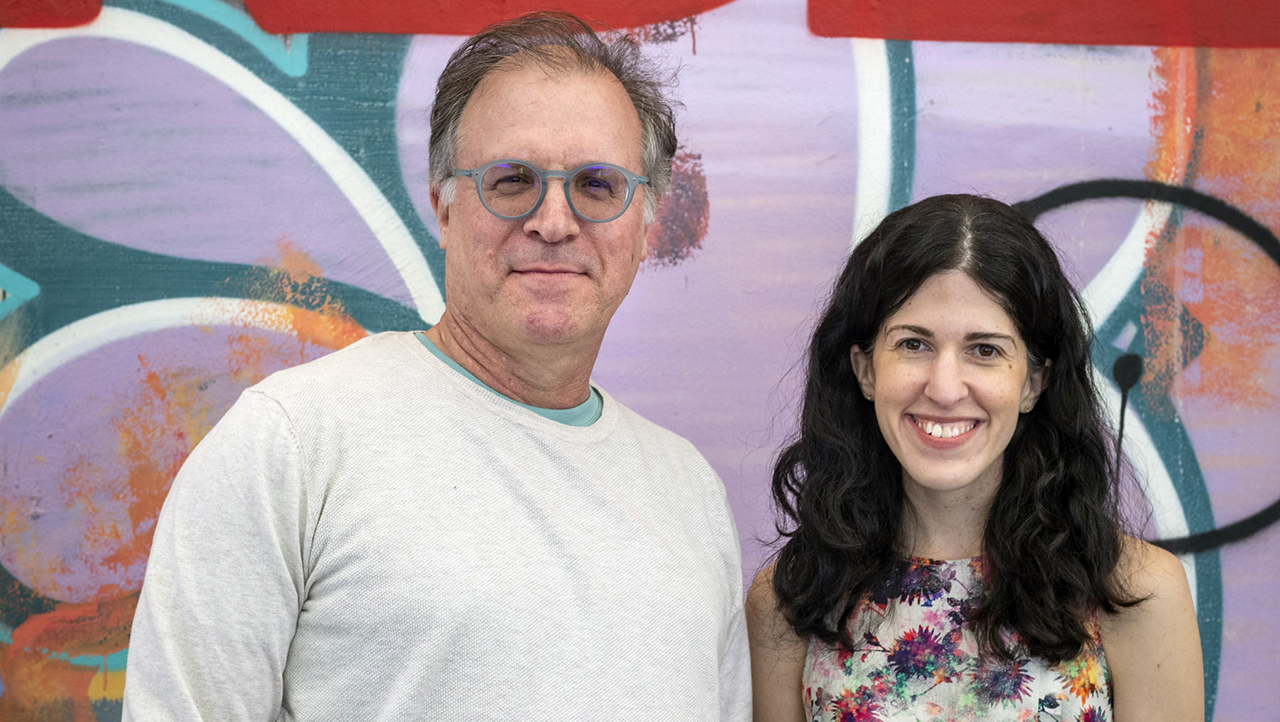
As academics focused on the history and cultures of the Spanish-speaking world, Ilan Stavans and Margaret E. Boyle have much in common. Stavans, a professor of humanities and Latin American and Latino culture at Amherst College, has written a biography of Colombian writer Gabriel Garcia Márquez and done in-depth studies of Latin Jewish culture, while Boyle, director of Latin American, Caribbean and Latinx culture at Bowdoin College, publishes on the language and culture of early Spain and women’s history in colonial Latin America.
But not long ago, they learned they had something else in common: a family matriarch in Mexico who had kept a handwritten notebook of favorite recipes. And each notebook had gone on to become a living document through the generations, with children and grandchildren adding their own versions of the recipes, marking up the pages with notes.
Once Stavans and Boyle connected over their treasured family documents, they began thinking more deeply about Jewish Mexican food and questions of authenticity: What does Jewish food borrow from the environment from which it emerges, and in what way does it transform it?

That question, and others like it — combined with a shared love of cooking and food — led the pair to co-author “Sabor Judio: The Jewish Mexican Cookbook,” published last month. While definitely more academic than many cookbooks, it is a thoughtful and mouthwatering representation of this hybrid cuisine. The authors will be doing an online talk hosted by the Jewish Community Library on Sunday, Oct. 27 at 2 p.m. The event is co-hosted by Jewtina y Co.
Sephardic Jews in Mexico arrived in the 1500s, when they fled the Inquisition in Spain and Portugal. Many were Crypto Jews and did not want to draw attention to themselves, yet some kept kosher in secret. At the end of the 19th century, Ashkenazi Jews arrived, fleeing the pogroms in Russia. When the Ottoman Empire fell apart, another wave of Sephardic Jews arrived.
As in many other places, the Ashkenazi and Sephardic Jews remained distant from each other, viewing the other with suspicion. Their diets remained distinct, too.
Today Jewish and Mexican cuisines have melded together seamlessly. In Mexico City’s Jewish neighborhood of Polanco, there are delis that serve gefilte fish with salsa, the authors write. Their own cooking styles reflect this, too. Even though both live in the U.S., Jewish favorites with Mexican accents are regularly served in their homes.
Their matriarchs, both from Eastern Europe, were named Miriam and Malka. “The similarity in their notebooks is uncanny,” the authors write. “Some of the same recipes appear in both collections.”
Stavans writes that each year at their Hanukkah parties, his wife makes latkes with mole sauce for their friends, while Boyle recalls her great-grandmother made the popular Mexican breakfast dish of chilaquiles, or eggs and tortilla chips smothered in chile sauce, but swapped in matzah for the tortilla chips.
While the cookbook is based on family recipes, the authors also solicited input from others in the Jewish Mexican community. Putting an ad in the Jewish newspaper of Mexico City yielded hundreds of letters, many with recipes.
Stavans writes that his grandmother was known for her Pescado a la Veracruzana, a popular Mexican fish dish that remains a staple of many Mexican restaurants today: a white fish in a tomato sauce with garlic, olives and capers. Asking for contributions from the community, they learned how nearly every Jewish grandmother had her own unique recipe for that dish.
The authors consulted some expert Jewish Mexican chefs, including James Beard Award winner Pati Jinich, who contributed her Mexican matzah ball soup recipe (among other variations, her chicken soup has jalapeños). As they write, “recipes are expressions of political, social, economic, religious, cultural, and emotional change.”
As someone who loves both Jewish and Mexican cuisine, I was fascinated to see how familiar dishes are tweaked with the substitution of ingredients more commonly found in Mexico. The first recipe in the book, challah french toast, a common staple in New York delis, is transformed with a topping of cajeta, a goats milk caramel, rather than maple syrup.
It’s also fun to read about how the taco — perhaps the most well-known yet humble item of the Mexican canon — is beloved by Mexican Jews, too. “Among Mexican Jews,” the authors write, “there are tournaments to see who can create the most delicious tacos — and who can eat the most. The trophy comes in the form of a taco-looking Torah.”
Small Bites
In other book news, September saw the release of “The Mac & Cheese Millionaire: Building a Better Business by Thinking Outside the Box” by Erin Wade of Oakland.
It’s essentially a memoir of how Wade, an Ivy League-educated corporate lawyer, found no gratification in her demanding but lucrative law career and left it to open a mac ’n’ cheese restaurant in Oakland. That restaurant, Homeroom, happens to be two blocks from my house, so I’ve watched it with interest. (There is also a catering and delivery kitchen nearby and a location in Berkeley.) Though mac n’ cheese is not my favorite dish, the restaurant has been packed ever since it opened in 2011. Major props to Wade for knowing exactly what kind of restaurant this neighborhood needed.

Wade sold the restaurant in 2020 to a venture-backed restaurant company. Hers is one of those almost-too-good-to-be-true stories. She writes about how in her business plan she projected a $40,000 salary for herself in her first year. The restaurant made $1.6 million in sales that first year, and by year 10 its revenue was just shy of $7 million.
Central to the book, though, is how Wade created a workplace that centers “meaning, purpose and connection” — one that all employees consider, in her words, “a more suckfree workplace.”
At the height of the #MeToo movement, with the toxicity of so many restaurant kitchens and the bad behavior of more than a handful of male chefs being exposed, Homeroom made national news for inventing a system for its employees to report incidents of sexual harassment.
Wade grew up Jewish in Los Angeles, with an Israeli mom whose parents were Holocaust survivors and a non-Jewish American dad whose family were pig farmers. She writes: “A chef is not a doctor, lawyer, or banker — the only three professions recognized by the Jewish religion.”
Similar Jewish anecdotes are sprinkled throughout the book. In one, Wade writes about getting to Princeton and thinking that the type of Jewish hospitality she grew up with was the norm. But when she was a guest at the homes of non-Jewish college friends, she recalls, sometimes she’d be offered only a glass of water — unlike her own home where her parents would ply guests with food.
“A lot of people think that Homeroom’s meteoric success was based on serving exceptional mac and cheese,” she writes, “but I believe it was largely rooted in our exceptional Jewish hospitality. While I had no experience as a server, I did have experience with a Jewish mother.”
Wade experienced gender discrimination while playing in a Jewish soccer league when she was young, something that would happen again in restaurant kitchens and law firms where she worked.
While Wade does become an expert in mac ’n’ cheese, the book is really about how she fell in love with business or, more specifically, creating a business with a unique, feminist workplace culture.