
J. is the media partner of the Z3 Conference at the Oshman Family JCC in Palo Alto on Nov. 17. This week, we are publishing a series of op-eds from speakers at this year’s conference, just a slice of the perspectives on the Israel-diaspora relationship that attendees will be able to hear at the event. They were solicited and edited solely by J.
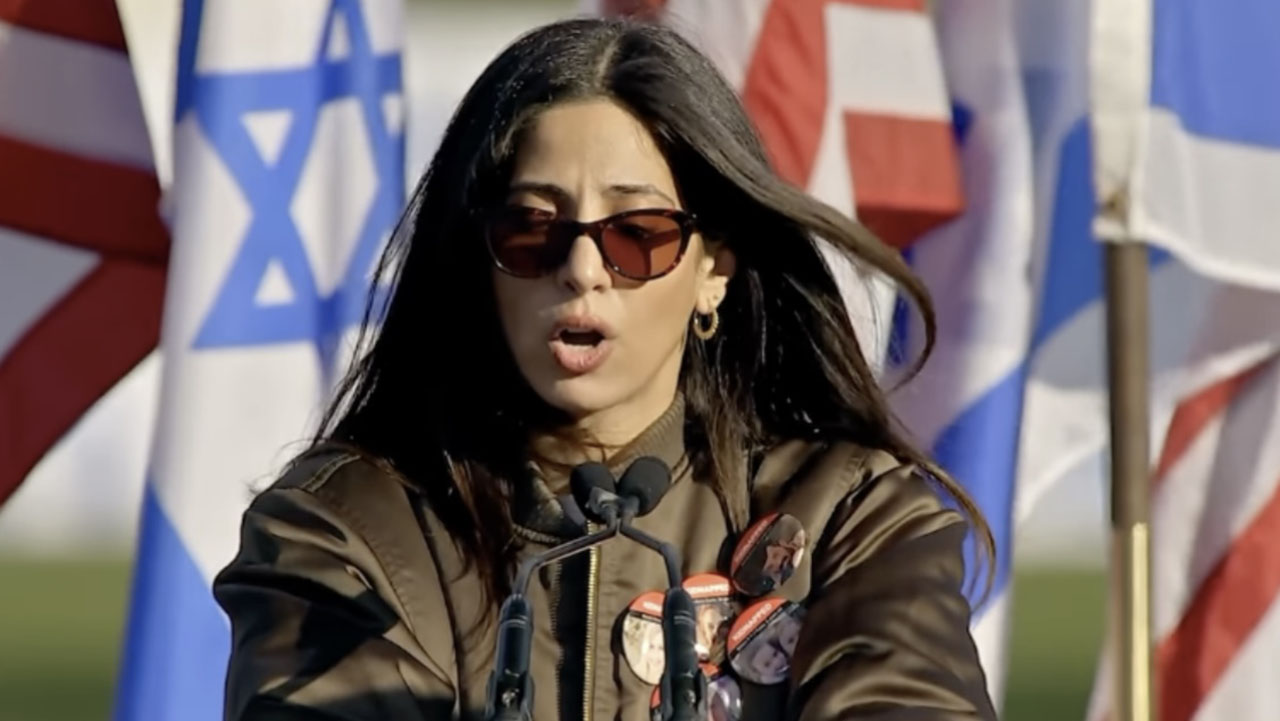
Last November I traveled to Washington, D.C., to speak at the March for Israel. The march was organized by the Jewish Federation of North America to stand in solidarity with the Jewish state and against rising antisemitism.
After six people in my family were taken hostage by Hamas on Oct. 7, 2023, I became their primary advocate here in the United States, and I thought the march would be a chance to feel comforted by my Jewish community. Instead, it was the first time I felt disillusioned with our institutional pro-Israel spaces.
On Oct. 7, 2023, my cousin Sharon Alony Cunio, her husband, David Cunio, and their 3-year-old twin girls, Emma and Yuli, as well as my cousin Danielle Alony and her 5-year-old daughter, Amelia, were stolen from Kibbutz Nir Oz in an act of barbaric violence.
Unlike my cousins, I have had the privilege of being born and raised in America where I have never felt the pang of fear from rocket sirens. So I felt it was my responsibility to access my privilege and power to fight for them.
Advocating for Israelis held hostage has not been easy. In fact, it has been one of the loneliest and most confounding experiences of my life. Early on, I was struck by the speed at which the progressive community turned its back on us. I live in Brooklyn and, like in the Bay Area, I am surrounded by a diverse group of people who share similar liberal values and political ideologies.
I was horrified by the justification of my family’s kidnapping as “resistance,” but I was not surprised. During Israel’s May 2021 war with Hamas, I had already seen how the Palestinian cause for self-determination, which is a righteous one at its core, had completely captivated many of my peers. What really surprised me was the frustration and loneliness I came to feel within the Jewish American community.
I had already been dismissed as less worthy by far-left Jewish activists, such as those who support the anti-Zionist group Jewish Voice for Peace, which I believe dangerously disregards the threat against Israelis. Then, at the march in D.C. last November, I began to feel alienated from pro-Israel spaces too.
Backstage I watched American influencers flit by smiling brightly while wearing an Israeli flag as a cape. I was feeling heavy with grief when someone presented me with a flag asking if I wanted to do the same. I politely declined, but inside I wanted to scream. I had fastened pins of my cousins’ faces to my jacket, and the idea of wearing any other national symbol or insignia felt like a betrayal.
It was clear to me that nobody, other than fellow hostage family members, understood that we were not only up against Hamas but also the current Israeli government. I took the stage and looked out upon a sea of Israeli flags. After my speech, people cheered “bring them home,” but the experience left me feeling empty instead of energized.
Israel’s military response in Gaza had already been brutal, killing many innocent Palestinians, including children. It had been reported that hostages were being kept in hospitals, not only in tunnels, and they could also be killed in the ongoing bombardments. I had been tirelessly advocating for the safe return of the hostages to be the only priority and knew it would take compromise and diplomacy, yet everyone around me balked at the notion of a cease-fire.
About two weeks later, a deal was struck. Sharon, Danielle and their three children were released in the one and only diplomatic deal of the war. It included a temporary cease-fire, a release of 105 hostages and 240 Palestinian prisoners, most of whom were not convicted of a crime. However, my cousin’s husband David Cunio was left behind and he remains captive today.
Shortly after the miraculous return home of the 105 hostages, three other hostages were killed by the Israel Defense Forces while holding white flags. The response from the greater Jewish community was one reminiscent of “thoughts and prayers” after a school shooting. I crumbled. Where would I find support if my community could not come together even in that moment?
The Jewish American narrative pushing solidarity felt suffocating, demanding that we be uniform under the banner of being united. I didn’t need solidarity — I needed allies who would speak out against anyone and everyone endangering the lives of the hostages.
It finally dawned on me that our entire community was too fractured to give me the support I needed. There was one group of anti-Zionist Jews revising our history to fit another people’s narrative — and another group unable to see that the war had gone too far and was harming our own people. Both of these realizations led me to ask myself an important question: If we can’t be allies to each other, then how can we ask others to stand with us?
I think it can be easy to look outside of ourselves and place blame upon those who have left us behind. But in truth I think now is the time to look inward and strengthen allyship from within. Now is the time to listen and cultivate respect for our fellow Jews. It is time to have challenging conversations across our political differences, reconnect to our peoplehood and recommit to the Jewish values we all hold dear. Our future depends on it.