

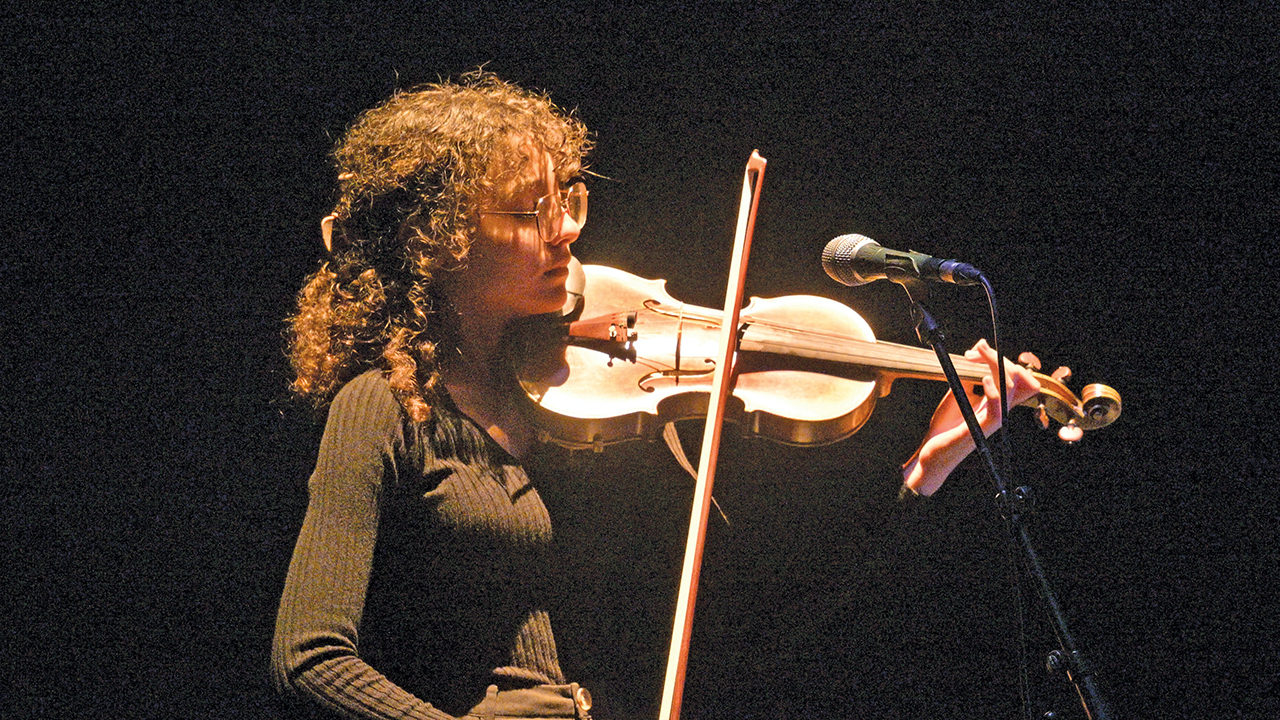
If the dream of Arab and Jewish Israelis making beautiful music together seemed idealistic two decades ago, just imagine that prospect today.
But that is exactly what Bay Area audiences will hear when the Nazareth-based Polyphony Ensemble performs two concerts in December, thanks in part to the foundations laid by the Arab Israeli violinist and educator Nabeel Abboud-Ashkar.
The concerts — set for Dec. 5 at the Oshman Family JCC in Palo Alto and Dec. 7 at Congregation Emanu-El in San Francisco — will feature Haydn’s String Quartet Op. 76, No. 2 (“Quinten”), arias by Vivaldi and Handel, and a selection of popular songs in Hebrew and Arabic sung by Israeli Jew Maya Belsitzman, who will accompany herself on the cello.
The ensemble is composed of a string quartet, two singers and guest harpsichordist Gordon Haramaki. All of the Polyphony performers are professionals, Abboud-Ashkar said, except for two “super talented” recent high school graduates. One of them is Arab Israeli Door Sassine, a classically trained opera singer now studying at the Jerusalem Music Academy.
“It’s very interesting when you have a mix of almost-professionals with professionals. There’s a special energy,” Abboud-Ashkar said, promising a “very high level” of musical performance.

The cultural harmony displayed in this and other Polyphony performances is the result of Abboud-Ashkar’s own journey growing up as an Arab child in Israel whose life was shaped by the power of music to bridge divides.
Ahead of the December concerts, the 46-year-old musician told J. about this path and why he remains committed to creating common ground, even in the wake of the Oct. 7, 2023 Hamas massacre in Israel and the ongoing war. He spoke over the phone from Cambridge, where he is working on a master’s degree in public administration at Harvard’s Kennedy School.
Abboud-Ashkar was born in Nazareth to Arab Israeli parents who were passionate about classical music. Saleem, his older brother, studied piano, while Nabeel showed talent in violin by the age of 8. They had to travel two hours to Tel Aviv for lessons and found few friends in their Nazareth neighborhood who understood the world they had entered.
“When I was 12, 14, 16 years old in Nazareth, it was a completely different reality than today,” Abboud-Ashkar recalled of the early 1990s. “The fact that I had music gave me the way to feel that I was part of something bigger than myself and my hometown. But the idea of traveling or studying abroad was rare. I was one of very few people from my hometown to do that. Music made that possible for me.”
Abboud-Ashkar earned degrees in music and physics at Tel Aviv University and a master’s degree at the Hochschule für Musik in Rostock, Germany. His brother studied professionally in London and Hanover, Germany, and is now a world-class concert pianist.
Abboud-Ashkar is also a celebrated performer. In 2006, however, he decided to return home from Germany to direct his career toward building a classical music community in and around Nazareth, the center of commercial and cultural life for Arab citizens of Israel.
“I took my musical knowledge and invested it into a social enterprise,” he said.
But there was more to his vision than providing musical training for Arab Israeli youth: He also believed that Arab and Jewish Israeli youth — as well as the broader society in which they lived — should study, play and hear classical music together.
Why classical music? What is the basis for his reverence for an art form rooted in Western Europe and a musical language developed centuries ago?
Abboud-Ashkar, particularly in his work as an educator, speaks to this question endlessly.
For one thing, he said, “classical music opens a window onto the world.”
Mozart, Mendelsohn, Bach and Brahms come from outside the Middle East, so when young people — Jewish, Arab or otherwise — study this music, he said, they find in it equal entry and affinity.
“This is why it has been so powerful when it comes to bringing Arab and Jewish people together,” he said. “It already provides a common ground.”
While learning to appreciate the aesthetic value of classical works, he explained, “students develop a strong sense of discipline and persistence.” And when you play in a string quartet or an orchestra, “it’s about how you are a member of a bigger group, how you communicate and work with others, how you listen to them and they to you, your responsibility toward the collective. It instills these values that are important for an individual and are very important for society to function.”
Argentinian Israeli pianist and conductor Daniel Barenboim and the late Palestinian American scholar Edward Said shared his aspirations. Their vision resulted in the founding of the Barenboim-Said Conservatory in Nazareth in 2006 and the West-Eastern Divan Orchestra, which is based in Spain and employs both Jewish and Arab musicians. Abboud-Ashkar was among the first members of the orchestra and played with it for a decade.
In 2012, American couple Craig and Deborah Cogut helped Abboud-Ashkar found the Polyphony Foundation in the U.S. and Polyphony Education in Israel. The Barenboim-Said Conservatory then became the Polyphony Conservatory.
Today, the “music teachers drive to meet students in Nazareth, so they can have the opportunity in their hometown. And that has created the community that I wish I’d had when I was growing up,” he said.
To date, Polyphony has brought classical musical education to thousands of students, trained hundreds of teachers and demonstrated the impact in countless musical concerts performed locally, nationally and internationally.
At the apex of Polyphony’s multiple educational and performance programs is the Galilee Chamber Orchestra, founded in 2012 as the first professional chamber orchestra in Israel composed of both Arab and Jewish musicians. Today, with equal numbers of Arab and Jewish artists, the orchestra performs in major festivals and venues in Israel and abroad.
“It’s important, the orchestra, for getting the message out, not only abroad, but within Israel itself,” Abboud-Ashkar said.
Because for him, music is the language of a higher vision: of equality and coexistence between Jewish and Arab Israelis.
“The mission of our work has been developing a shared society in Israel that is inclusive, based on respect and appreciation between minorities and majorities,” he said.
Since Oct. 7, 2023, sustaining that mission has been a profound challenge, he acknowledges.
The events that day “shocked us,” he said. “We said: ‘We have to get engaged. We have a role here to play. We are part of Israeli society.’ We started finding ways to bring our music and message to evacuees who were displaced. But things got more complicated as time went on. The number of people killed and injured in Gaza, the number of rockets flying into Israel, put everything into a different reality.”
For example, a Galilee Chamber Orchestra tour set for Europe this summer was canceled due to security concerns and the ongoing war, according to Polyphony’s website.
As Abboud-Ashkar witnesses the growing extremism and polarization in the region, as well as in the rest of the world, “I sometimes have the feeling that our ability to impact what is happening is very limited,” he said, “and that the scale of the problem is so large at this point, that stating what Polyphony does is small compared to the scale of the destruction.”
But the music community he helped build has so far revealed its strengths.
“What we have seen in our immediate community is that their commitment to each other and to the values we hold is remarkable,” he said. ”This is where we draw our hope from.”
All of this will add layers of meaning to the performances that the ensemble will bring to the Bay Area and beyond, he said.
“In the face of all that is going on, what we do today is even more important — not because we are able to fix things, but because of what we stand for,” he said. “Those little candles lit are very important because if they are turned off, I don’t see any way we can have hope in the future. Those values are essential for our continuity. It will enable us to live as humans with each other.”
Polyphony Ensemble
7:30 p.m. Thursday, Dec. 5. Oshman Family JCC, Bldg. F, 3921 Fabian Way, Palo Alto. $34.
7:30 p.m. Sat. Dec. 7. Performance, followed by conversation between Nabeel Abboud-Ashkar and J. Editor-in-Chief Chanan Tigay, at Congregation Emanu-El, 2 Lake St., S.F. $40. (415) 751-2535