

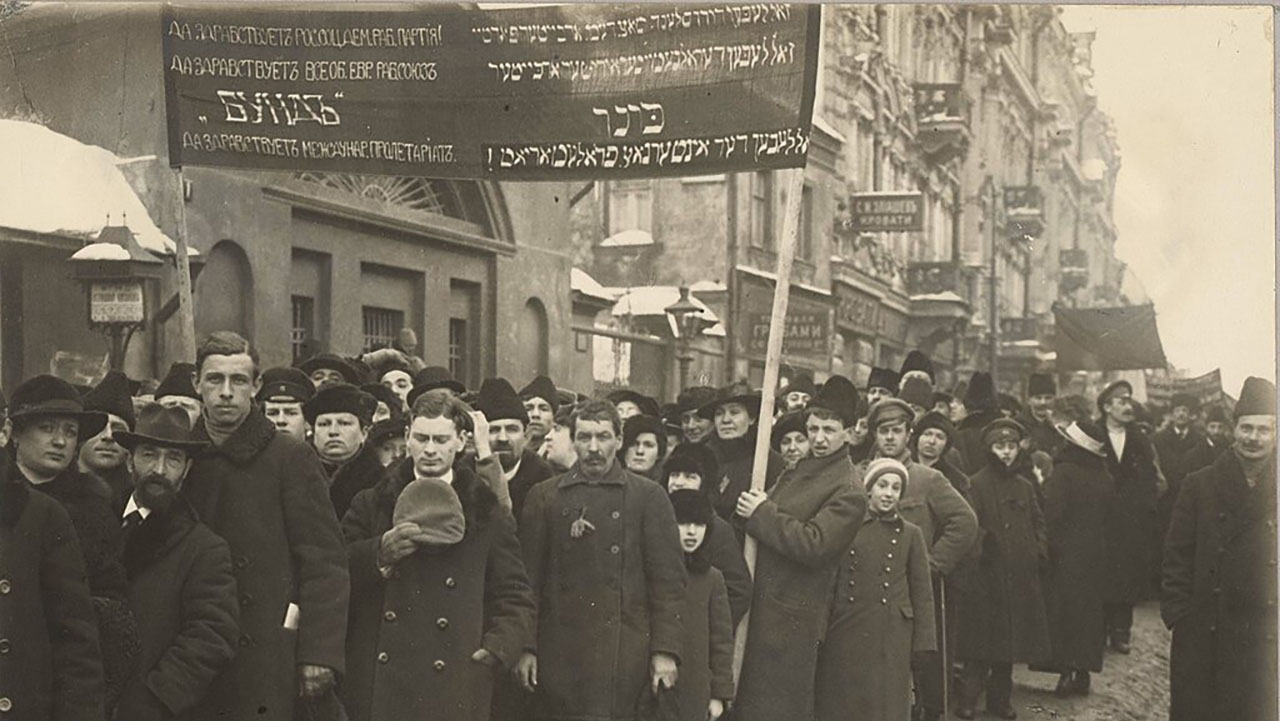
The Yiddish term “doykayt” has started to reappear in some progressive Jewish circles. It means “here-ness” and was coined by the Jewish Labor Bund, which was politically and culturally influential in Poland, Russia and Lithuania in the late 19th and early 20th centuries.
“Bund” means “to bond” or to “form an alliance” and is similar to the contemporary term “allyship.” It impacted life for diaspora Jews and opposed Zionism, which was a new political movement at the time. The term meant that one would work where one was — “here” — rather than create a new life “there.” The Bund offered a vision of secular Jewish cultural autonomy versus the nationalism that Zionism favored. It advocated internationalism, asserting that we can be for ourselves and fight for everyone else, too.
The Bund was founded at a time of great despair for the Jews of Eastern Europe. Today, at another time of great despair for Jews around the world, Bundist ideas like “doykayt” may again have relevance for those seeking a path forward.
The idea of here-ness means to work and focus on the problems that exist where one is — where one works, lives and engages with others. We must be rooted and active where we are in local politics and civic life. We must also remain rooted in our Jewish culture.
Unfortunately, much of our Jewish activist roots, such as the work of the Bund, has been forgotten by contemporary Jews who nonetheless inherited much of its social justice ethos. In the early 20th century, Yiddish was spoken and Ashkenazi culture was dominant among Jewish immigrants in the United States. The Hebraization of language and an increasing reliance on Israeli culture following the Holocaust, which had a monumental and devastating impact on Yiddish culture and language, contributed to the loss of some of the values and beauty of our Yiddish political roots. Yet the Bund’s ideas have not been lost to history, and now is the time to reclaim them.
Through grassroots organizing — youth movements, physical education, self-help groups and local political candidates — the Bund built wide support, with 40,000 members across Europe at its height.
It opposed assimilation, remaining a secular Jewish organization representing workers, laborers, artisans and intelligentsia. The focus was on Jewish culture, not a Jewish state or separate place for Jews. It also fought antisemitism by forming self-defense organizations and supported candidates for government offices. It argued for Jewish political and civic rights, made inroads into various labor movements and was active in the resistance during World War II. Often facing governmental opposition in Russia, Poland and Lithuania, the Bund continued to publish newspapers. It also criticized Zionism as escapism.
On Jan. 20, Donald Trump will be inaugurated again as president and will likely begin implementing many of the ideas contained in Project 2025, which promotes sweeping changes to economic and social policies and to how federal agencies are run.
Project 2025 seeks to alter the Justice Department, the FBI, the Federal Communications Commission and the Federal Trade Commission. It wants to dismantle the Department of Education, transferring or terminating its programs. The National Institutes of Health could lose its scientific independence, halting embryonic stem cell research. New environmental regulations could favor fossil fuels more than ever.
Medicare and Medicaid could be cut, abortion could be explicitly rejected as health care, and contraception access could be targeted through the Comstock Act. Project 2025 seeks to criminalize pornography, remove legal protections for sexual orientation and gender identity, terminate diversity programs, deport mass numbers of undocumented immigrants, deploy the military domestically and speed up capital punishment cases.
Given the seriousness of these changes, perhaps what the Bund did in Europe is worth considering now. Perhaps it is time to become part of the resistance, the way Bund did. We can run candidates in local, state and federal elections articulating our Jewish activist roots. We can build self-help groups, fight antisemitism, and revitalize and make visible Jewish leftist organizations.
There is not a single Jewish people, but many Jewish peoples. “Doykayt” entails celebrating those differences and using more than Zionism or Israel to define us. Many Jews hold mixed opinions on the Middle East. We can speak out, write to members of Congress, fund Palestinian programs and educate our communities. Such actions are also today’s doykayt.
What can we do here and now? We can put our bodies in front of the buses trying to deport undocumented workers, support trans people emotionally and financially, turn synagogues into sanctuaries and shelter vulnerable people in our homes. We can work in clinics to ensure care for those in need and fight for reproductive rights by supporting clinics and doctors.
That is better than putting our heads in the sand, hoping it will all go away someday. That is better than focusing on a “promised land” only to find the promise has been lost.
Each of us must find answers for ourselves, but we must do so in community, among like-minded people in dialogue. Doykayt maps how we might proceed during this fraught time. It does not tell us exactly what to do, but it tells us how to do it.