

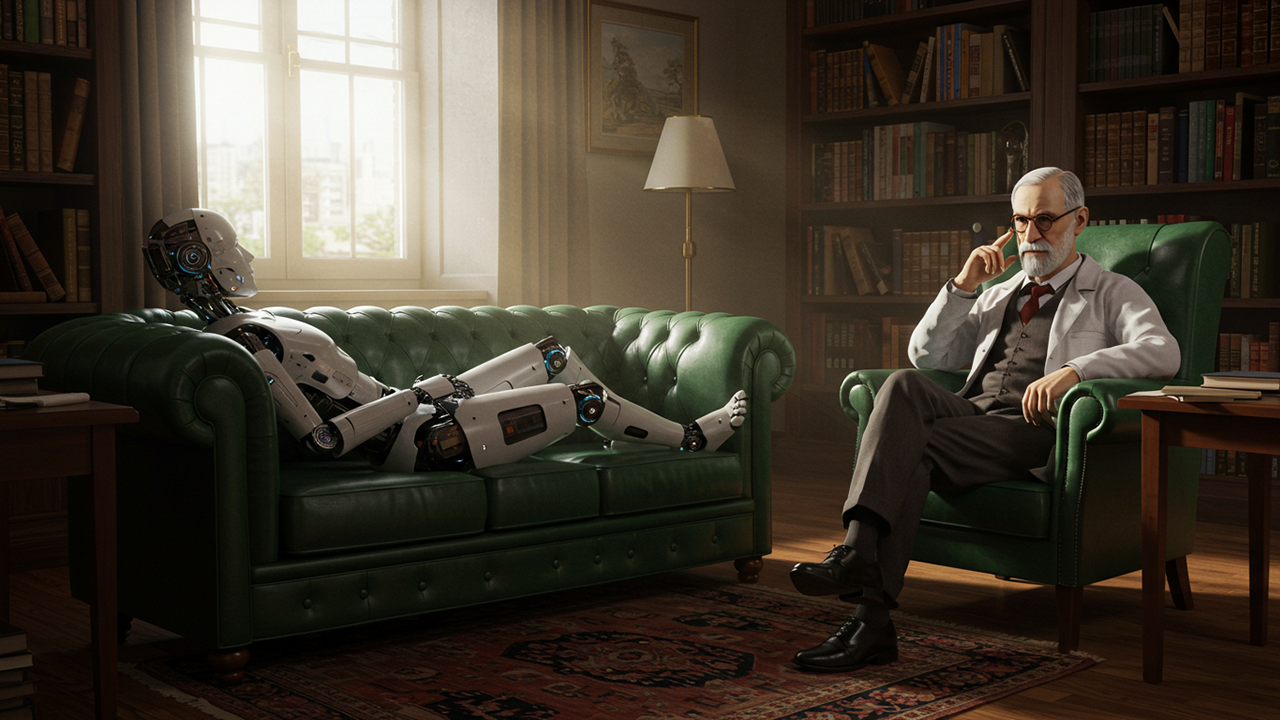
This is Part Two of J.’s series on AI and Judaism, “The Perils and Promise of AI.” Read Part One here. Learn more about the series here. Stay tuned for Part Three: How Jewish organizations are preparing for an AI onslaught.
Last year, I hired my first AI assistant. I asked it to search for online news stories relevant to a project I was working on. Once it found them, my “agent robot” clipped and sorted the articles for me. It worked quickly and reliably for a fraction of the price of a human assistant. It never complained. And it kept going, seven days a week — including on Saturday.
As an observant Jew, should I have paused it for the Sabbath, when halachah prohibits both work and use of computers? Or, because I wasn’t interacting with it, was it permissible to leave it running? It seemed this ran contrary to Orthodox thinking on what constitutes work, and maybe was forbidden by a 2012 Conservative opinion about using electricity on Shabbat. But I really didn’t know — much as I still don’t know whether I can take a driverless Waymo on Shabbat.
The problem is, there is almost nowhere to turn for answers to these new questions about autonomous agents working on our behalf. Until very recently, Jewish thinkers and religious leaders have had remarkably little to say on the ways — large and small — in which AI impacts Jewish law and ethics.
Many people believe AI might one day save the world. Others think it could destroy us. Given the emphasis Judaism places on tikkun olam (repairing the world) and pikuach nefesh (saving a life), the lack of a normative Jewish response to AI is glaring. At earlier technological inflection points, says Andrés Spokoiny, president and CEO of the Jewish Funders Network, Jews led the way in grappling with the religious and ethical issues that emerged.
“In one of humanity’s most fateful technological changes — the shift from hunter-gatherer societies to agricultural ones — Judaism provided what became the dominant theological, anthropological, and ethical guide to the new technological order,” Spokoiny wrote in 2023 in a special technology issue of the journal Sapir.
Earlier that year, the Skverer Hasidim of New York issued an edict banning the use of AI entirely. The Skverer beit din, writing in both Hebrew and Yiddish, was probably the first significant Jewish court to address artificial intelligence. But since it did so as part of its existing ban on using the internet without a web filter — “the use of AI is strictly prohibited in every way and form” — this was hardly a nuanced exploration of the issue.

Still, for the first couple of years after the launch of ChatGPT near the end of 2022 — the opening salvo in AI’s insinuation into public life — very few other Jews were speaking about AI with authority. That may have been out of humility, as many likely felt they didn’t have sufficient grasp of the technology to offer meaningful guidance. This humility is commendable, but it left a thought vacuum. Among the Jews trying to fill it was David Zvi Kalman.
As an avid science fiction fan and an expert in the history of technology, as well as in Jewish law and culture, Kalman had been a lonely voice calling for Jews to consider AI’s implications long before the public launch of ChatGPT. His newsletter, Jello Menorah, is among the only places to follow the latest news in Jewish AI. More recently his podcast, “Belief in the Future,” has become one of the more thoughtful outlets addressing the intersection of religion and AI, among other topics.
As early as 2021, Kalman published an article called “Computers can write Torah now — should we be excited or terrified?” In it, he demonstrated how chatbots can simulate Scripture (or Talmud, or Harry Potter) and argued that Jews should take advantage of these new opportunities.
“The threats of this technology are real,” he wrote. “But so are the rewards for creatively incorporating it into a new way of thinking about Torah.”
Four years later, a small but growing number of Jewish thinkers have jumped into the ring with Kalman. In January, for example, Clal — a Jewish nonprofit supporting communities, education and leadership — launched a think tank, Jewish Thought and Jewish Education for the Digital Future, which is exploring the use of AI and other tech in Jewish classrooms. Last year Yeshiva University published a digital compendium of articles exploring aspects of Judaism’s interaction with AI. Topics included moral responsibility in the age of AI and whether ChatGPT should be used to render halachic decisions.
Kalman, meanwhile, continues to push for more — and more definitive — engagement from a broader cohort of Jewish leaders.
“I would like to see someone make a normative statement about how AI should and should not be used,” he says. “AI policy cannot remain in the realm of techies and technocrats. Organized religion has the ability to actually help people think through what they think is right and wrong.”
Does AI have a soul?
When Jewish thinkers do discuss AI, they tend to talk about two fundamental questions. The first is if AI is, or ever could be, considered alive. What’s at stake in this question is whether, as Jews, we must treat genetically enhanced humans, cyborgs, aliens, sentient computers and any new intelligences with the same dignity and rights as halachah affords humans. The great Talmudic sage Hillel summed up all of Judaism in a single sentence: “What is hateful to you, do not do to your neighbor.” Is AI our neighbor? Can it be Jewish, with halachic obligations? What would it mean for a sentient AI to observe Shabbat?
Spokoiny says that on a practical level, certain distinctions between AIs and people are facile. “What difference does it make if a ‘body’ is made of silicon or carbon if it fulfills the same functions?” he wrote in Sapir.
But for Mordechai Lightstone, a Chabad rabbi and the founder of Tech Tribe, a New York-based community for Jews in tech, this misses the ingredient that makes people unique. Because for him, only humans have a neshama, a soul. That soul is housed in a very specific place — our bodies — and our bodies are created by God.
“I don’t think that whatever AGI [artificial general intelligence] looks like … will ever truly be alive from a Torah point of view,” he says. “And I think it’s dangerous for us to lose sight of what makes us human, or create technology that does not understand that difference, and confuse the work of human hands with something that’s alive.”
Part of the problem, says Rabbanit Sara Wolkenfeld, a North American rabbinic fellow of the David Hartman Center, is that when AI talks to us, it can feel like we’re talking to another person.

“In general, in life, when people speak to us, it’s because they have something that they want to express,” says Wolkenfeld, who is also chief learning officer at Sefaria, the free online digital library of Jewish texts. “And because AI speaks to us, it’s pretty much impossible for us to get through our heads that the AI does not have anything inside it to express.”
According to Kalman, a research fellow at the Shalom Hartman Institute and senior adviser at the interfaith science group Sinai and Synapses, we do not have to reinvent our entire worldview to accommodate developments in AI. We need only look to golems, angels, demons and other creatures on the “human gradient” to understand how to incorporate the new technology into our thinking.
Indeed, he says, for centuries, Jewish thinkers have not treated humanity as a “binary category.” For Kalman, Jewish wisdom literature demonstrates many ways of thinking about “humanoid creatures.” The problem, he says, is that Judaism, along with other world religions, is proving supernally slow in trying to work out where, or indeed whether, AI fits on the humanity spectrum.
“Humanity exists along a gradient,” he says, citing a groundbreaking 2003 essay on the halachic definition of a human being. “And no single criterion — neither form nor parentage nor intelligence — allows us to define who is human.”
A social rupture
The second AI-related question Jewish thinkers tend to focus on is how decisively the new technology will change society. As in the shift from hunting and gathering to agriculture, Jewish law has addressed large social paradigm shifts in the past. It even navigated the Industrial Revolution, which altered civilization and drastically changed social relations. But if AI provokes an even bigger social rupture — one where humans act like gods in creating new forms of life or where AI itself becomes a godlike artificial superintelligence, surpassing human intelligence in all regards — it is not clear that Judaism has the wherewithal to respond effectively.
Who are the decision-makers that will grapple with the ramifications of ubiquitous AI? How will we make informed decisions about the million little cases, like my AI assistant working on Shabbat, and a million more sure to follow? In Yeshiva University’s digital compendium on AI, Rabbi Michael Taubes, who heads YU’s rabbinical academy, takes an early step by considering autonomous vehicles. Specifically he considers the “trolley problem”: How will we treat an autonomous car that chooses to crash into one person to save five others?
It’s an important start, but Kalman worries it’s not enough.
“What we need are some new values that specifically respond to AI. But it takes awhile for people to agree that something they haven’t previously thought of as a value is, in fact, a value,” he says. “And nobody works as fast as tech companies.”
What we need are some new values that specifically respond to AI. David Zvi Kalman
However, if AI is just the newest or the most powerful tool, wrapping our heads around it seems less daunting. That’s how Yaël Eisenstat, the director of policy and impact at Cybersecurity for Democracy, sees things.
AI is “not this mythical thing that is so intelligent that it just creates itself,” she says. “Human beings with economic or power incentives are creating these tools, and they have a goal in mind. … So of course, there’s a million things I can think of that AI is going to help advance, but … government’s job is to protect against the harm while enabling you to do the good.”
For Wolkenfeld, AI offers humanity a moment to think deeply about human values.
Rather than dwell on the tools in our toolkit, she says, we should envision the world we want to live in and use the tools at hand to build that future.
To illustrate the point, she told the story of a grade school that summarily scrapped its use of Grammarly, the AI writing assistant, after state tests showed students were underperforming in grammar. The story illustrates both sides of the conundrum of how to approach AI. On the one hand, the decision was made because the app seemed to be hindering test scores. On the other hand, there was no discussion of why their grammar was being tested, or the value of such a skill to begin with.
“It’s not even the tools or the entity itself that gives us the opportunity,” Wolkenfeld says. “It’s a cultural moment.”
Rabbi bots
Beyond the enormous ethical questions raised by AI’s ascendance is a host of day-to-day issues that arise as AI insinuates itself into religious life — from High Holiday sermons to rides in driverless cars.
In 2023, Rabbi Josh Fixler of Congregation Emanu El, a Reform temple in Houston, was hearing a growing chorus of chatter about if and when AI might one day be considered alive. That line of thinking, Fixler says, represented a “depressingly narrow view of what our humanity means.” So he created a “rabbi bot” to write and deliver his Rosh Hashanah sermon that year.
“My goal in the sermon was to be inspired by these AIs to reinvest in our own humanity,” he says. “I describe a ‘great rehumanizing project’ and offer that ancient Jewish technologies like Shabbat, prayer and the holiday calendar are powerful in part because of their rehumanizing effect. In these dehumanizing times, we need these tools more than ever.”
Still others have found inventive ways to use the technology to enhance Jewish learning. Shira Hecht-Koller, Jewish educator, attorney and rabbinical student at the Shalom Hartman Institute, uses chatbots to sharpen her adult students’ ability to analyze Talmud.
“I’ll have the chatbot write a case in the style of the Babylonian Talmud related to laws of Return of Lost Property, for example, and then have them compare it to the actual sugya [discussion topic] we learned — how far does it differ, what is accurate,” she says.
The rabbi bot and a chatbot mimicking the Talmud may not be game-changers, but they do highlight the enormous speed with which aspects of AI are being adopted in the public sphere. In a recent newsletter, Shelly Palmer, advanced media professor-in-residence at Syracuse University’s Newhouse School of Public Communications and CEO of the Palmer Group, flagged some of the week’s technological advances, including a quantum computer that solved a problem in an astonishing five minutes that would have taken regular computers the entire life of the universe.
“Remember,” Palmer noted, “today you are experiencing the slowest rate of technological change you’ll ever experience for the rest of your life.”
The pace of change is bewildering, and unless Jewish leaders lead, Kalman says, the moment will pass us by.
“In a world where leadership and speed are linked, Judaism can be a moral leader only by accelerating, by proactively providing guidance on moral problems as fast as the problems themselves are emerging,” he says. “If Judaism fails to do this, it will become morally obsolete.”