

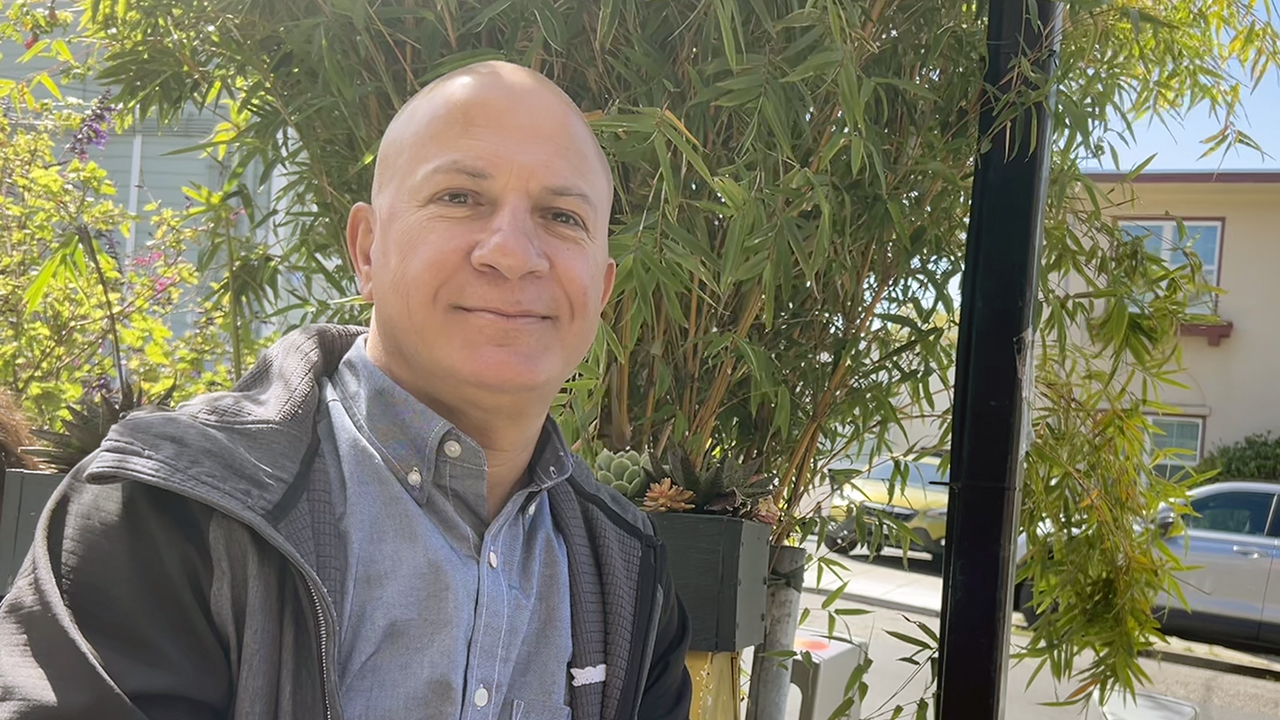
It’s a difficult time to be talking about coexistence in Israel right now, but Tareq Abu Hamed is doing it anyway.
Abu Hamed, a scientist and a Palestinian citizen of Israel, is the executive director of the Arava Institute for Environmental Studies, an egalitarian, multiethnic environmental center located on a kibbutz in Israel’s Negev Desert. Abu Hamed was in the Bay Area on a fundraising mission in May, extolling the virtues of dialogue among Arabs, Jews and others in the region.
He appeared publicly at The Kitchen SF as part of its “Shared Society Initiative,” at an event that drew around 150 people. Otherwise, he met privately with donors.
The ongoing war makes it harder than ever to talk about coexistence, but he feels he has no other choice, he told his audiences, summarizing his remarks in an interview with J.
To him, the conflict is deeply intertwined with personal experience, both past and present.
“I’m not talking about this conflict as someone who comes from Geneva or Zurich,” he said. “I live the conflict. I’m a Palestinian… And if you recognize that there should be an Israeli state and you believe that there should be a Palestinian state, you cannot reach that goal without a dialogue, without talking to the Israelis.”
That’s been a core belief of his ever since he was a young man. Born and raised in East Jerusalem, Abu Hamed went to work on a kibbutz outside of Jerusalem to earn money as a teenager, and it was there that he met his first Israeli Jews.
He obtained both his undergraduate degree and Ph.D. in chemical engineering in Turkey, and has done postdoc work in Israel and the U.S.
In 2013, he served as deputy chief scientist in the Israeli Ministry of Science, Technology and Space. At the time, he was the highest-ranking Palestinian in the Israeli government, according to his biography on the Arava Institute’s website.
Located at Kibbutz Ketura, historically, the Arava Institute has brought Israelis and American Jews together with Palestinians, Jordanians and other Middle Easterners to cooperate on environmental initiatives. The current student body is much less diverse than usual, as the war has made it impossible for Palestinians living in the West Bank and Gaza to attend, Abu Hamed said, and American universities aren’t sending their students to Israel now.
But the experience of studying there has had a lasting impact on those who have attended, he said.
“We have 2,000 alumni in the region, and they’re still in touch with us and each other,” he said. “They show solidarity and empathy to each other.”
A central focus of research at the Arava Center is the impact of climate change on the region. The effects are felt now; the matter is not theoretical.
“It impacts every aspect of our lives,” Abu Hamed said.
In just one example, farmers are dealing with increased salinity in the soil due to lack of rain. Scientists and students at the Arava Institute have been working on this issue with Palestinian and Jordanian partners by teaching methods of recycling, desalinating water and other sustainable agriculture techniques.
Participants in the Arava Institute work to solve environmental problems like these, while getting to know each other in a deep way, Abu Hamed said. Establishing trust is essential for tackling serious scientific problems, he said.
The participants — who can be either undergraduates or graduate students — “share family and personal stories, about serving in the Israeli army, or living in a Palestinian refugee camp and passing through checkpoints,” he said. “They talk about their family’s experience of the Nakba or Independence Day.”
Although Palestinian students cannot attend the institute now, Abu Hamed is still in touch with his Palestinian partners in the West Bank and Gaza, he said.
“Despite what’s happening, we continue our work,” he said. “We are still implementing projects in the Jordan Valley related to recycling wastewater.”
In Israel, Abu Hamed and his colleagues have been working on designing green shelters to eventually help Gazans displaced by the war. The initiative is called “Jumpstarting Hope in Gaza.”
“When Oct. 7 happened, we decided with our Palestinian partners that we should continue this partnership,” he said. “They said people will continue living in refugee camps in Gaza for years. This is not a short-term thing.”
The shelters can recycle wastewater using solar energy and provide clean drinking water, too.
“These systems provide an immediate solution,” Abu Hamed said. “You don’t need infrastructure. It’s easy to maintain and there’s no noise or smell.”
While the shelters have been approved by Israel’s civil administration, he said nothing is being allowed into Gaza at the moment.
Another cause for hope is that the institute has convened a few conferences with its regional partners, in Cyprus and Athens, since they can’t meet closer to home. The gatherings might not make the news, but they remain a sign of what could be possible.
“We brought around 60 people, Jordanians, Palestinians and Israelis, from the public and private sector together,” he said. “To have such a diverse group of people from the region representing the governments of Israel, Palestine and Jordan, to talk about joint projects, was really amazing.”