

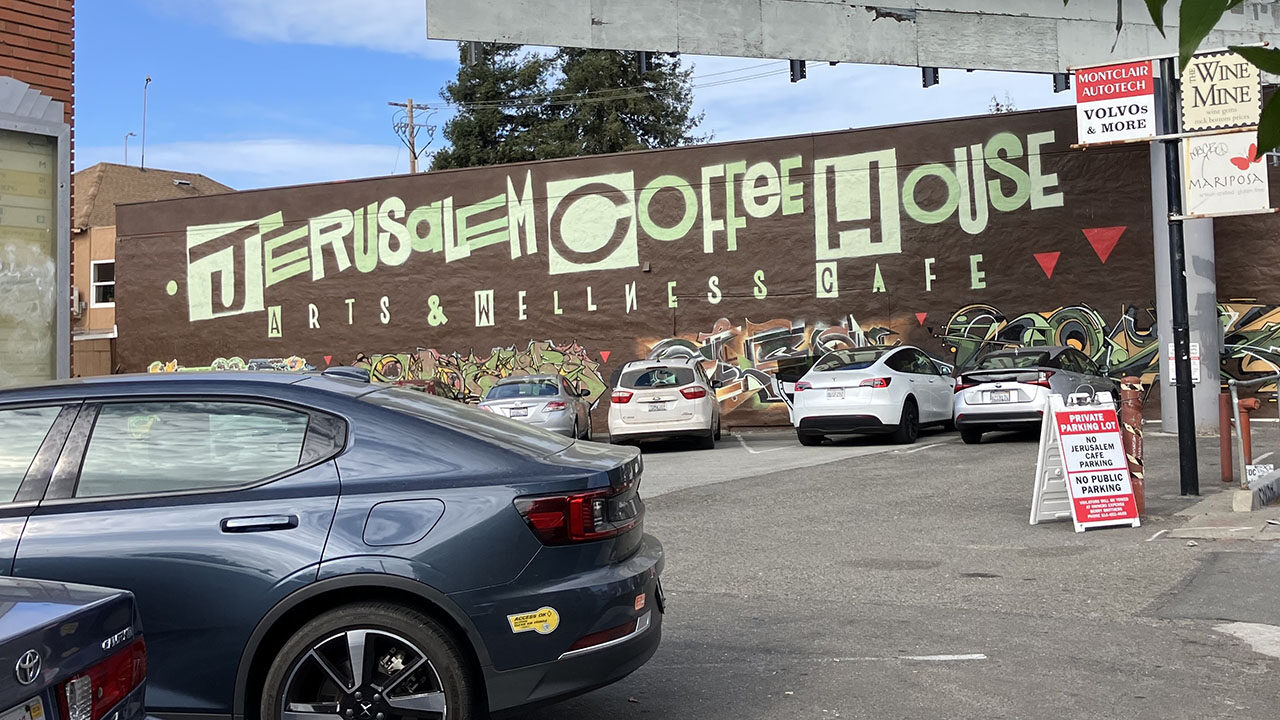
Oakland’s Jerusalem Coffee House, a Palestinian-themed cafe that went viral for releasing a “Sweet Sinwar” drink on Oct. 7, 2024, and for angry confrontations with suspected Zionists, was hit with a lawsuit from the U.S. Department of Justice on Monday.
Signed by U.S. Attorney General Pam Bondi and DOJ civil rights division head Harmeet Dhillon, the lawsuit alleges that the cafe and owners Fathi Abdulrahim Harara and Native Grounds violated Title II of the 1964 Civil Rights Act by “discriminating against Jewish customers based on race and religion.”
The lawsuit is the third one leveled against the business since February over alleged antisemitism.
The cafe is an homage to Palestinian culture. It is also staunchly anti-Zionist and radical in its political orientation. An exterior wall and menu are decorated with inverted red triangles, a symbol of violent opposition to Israel popularized by Hamas. In March, it advertised an event on combating “normalization,” a word used to describe legitimizing Israel as a nation with a right to exist.
The cafe serves Middle Eastern-themed menu items like cardamom rose or date tahini lattes.
On Oct. 7, 2024, the one-year anniversary of the Hamas terrorist attack that also roughly coincided with the one-year anniversary of the cafe’s opening, the shop published a new menu with a juice blend called the “Sweet Sinwar.” Another drink was named the “Iced In Tea Fada.” Both drinks are named in the DOJ suit. The late Yahya Sinwar was the Hamas leader widely considered the architect of the Oct. 7, 2023, massacre, the worst terrorist attack in Israel’s history.
Harara told the SF Standard that his family is from Gaza and that the drink was not named for the Hamas leader. Instead, he described the name as popular among Palestinians. However, Sinwar is not among the 1,000 most popular surnames among Palestinians, according to Forebears, an online database.
Harara has gotten into heated confrontations with cafe customers he suspects are Israel supporters, some of which were captured on video.
In October, a video shared widely online showed Jonathan Hirsch, who was wearing a Star of David cap, being told to leave. “Are you a Zionist? Are you a Zionist?” Harara says in the video. “This is a violent hat, and you need to leave.” In additional video footage shared with J., Harara repeatedly says, “F*** Israel. F*** Israel. F*** Zionism,” and also, “I love Jewish people.”
Hirsch, a Jewish Oakland resident, eventually left after police were called. He sued the cafe in March.
Months earlier, in two encounters in summer 2024, Michael Radice of Los Angeles has said that he experienced similar incidents. Radice sued the cafe in federal court with the help of the Anti-Defamation League in February.
According to the DOJ complaint, Radice approached the shop while wearing a cap with a Star of David on June 10, 2024. Someone asked him, “Are you a Jew?” and “Are you a Zionist?” On Aug. 3, Radice returned to the cafe and the same man said, “You’re the guy with the hat. You’re the Jew. You’re the Zionist. We don’t want you in our coffee shop. Get out,” the complaint alleges.
“Harara and the two other employees followed Mr. Radice outside, yelling ‘Jew’ and ‘Zionist’ at him,” the complaint alleges.
The DOJ lawsuit follows a pledge by the Trump administration to combat antisemitism using the levers of the executive branch including the Department of Justice. The president signed an executive order on Jan. 29 titled “Additional Measures to Combat Anti-Semitism.” Dhillon echoed that policy in a statement released Monday alongside details about the cafe lawsuit.
“The Justice Department is committed to combatting anti-Semitism and discrimination and protecting the civil rights of all Americans,” the statement said.
Until now, much of the department’s focus has been on universities, but the new lawsuit indicates an appetite to use civil rights law to target private businesses believed to be engaging in antisemitic practices.
Under Title II, the DOJ is not authorized to obtain monetary damages for customers, according to its statement. The civil rights division can “obtain injunctive relief that changes policies and practices to remedy the discriminatory conduct.”
Jerusalem Coffee House did not immediately respond to J.’s request for comment.