

Books coverage is supported by a generous grant from The Milton and Sophie Meyer Fund.
The funny thing about “family history” is that the more we explore it, the more we appreciate that our relatives’ lives were often profoundly linked to world events.
English journalist Rachel Cockerell reached her 20s with only the vaguest knowledge of her paternal family’s background. Her book “Melting Point: Family, Memory, and the Search for a Promised Land,” released in May, represents quite the corrective.
Cockerell resurrects the memory of her Kyiv-born great-grandfather David Jochelmann, whose painted portrait loomed in the old Edwardian in which Cockerell’s father grew up in northern London but whose story had been lost to the family. It turns out that more than a century ago, Jochelmann played a significant role through his association with Israel Zangwill, the tremendously popular London writer who became deeply involved with the quest for a Jewish homeland.
Cockerell provides the backstory: In 1903, in response to Zionist leader Theodor Herzl’s efforts to rescue Russian Jews in increased physical danger, the British government offered a portion of its colonial land holdings in Kenya (misidentified as Uganda) for Jewish settlement. Herzl died in 1904 before the movement he founded had an opportunity to decide on the offer.
At the seventh Zionist Conference, held in Basel, Switzerland, in 1906, the delegates voted overwhelmingly to reject the proposal, opting to focus exclusively on Palestine as the site for Jewish nationhood.

Zangwill had been a fervent proponent of the Uganda Proposal as an opportunity to provide immediate refuge to Russia’s Jews. Incensed by his fellow Zionists, he left the movement and was soon heading an alternative organization. The Jewish Territorialist Organization (known as ITO) sought to identify other locations suitable for large-scale settlement by Russian Jews. Zangwill wrote, “If we cannot get the Holy Land, we can make another land holy,” noting that “there must exist somewhere in the world, a healthy, empty, or thinly-populated territory, large and fertile enough to hold a population of many millions and not strong enough in its civilization to melt up the Jewish people into its shape.”
As the ITO scoured the globe for potential destinations, Zangwill received a proposition from German-born New York banker Jacob Schiff.
Disturbed by the growth of Manhattan’s impoverished Jewish ghetto, Schiff envisioned bringing Eastern European Jews to the United States through a southern port and sending the new immigrants into the American heartland, bypassing the densely populated cities of the Eastern Seaboard. He asked Zangwill whether the ITO might take charge of this effort. Zangwill was ambivalent, but Schiff’s argument that the plan would be an “immediately practicable” means of removing Jews from worsening conditions in Russia convinced him.
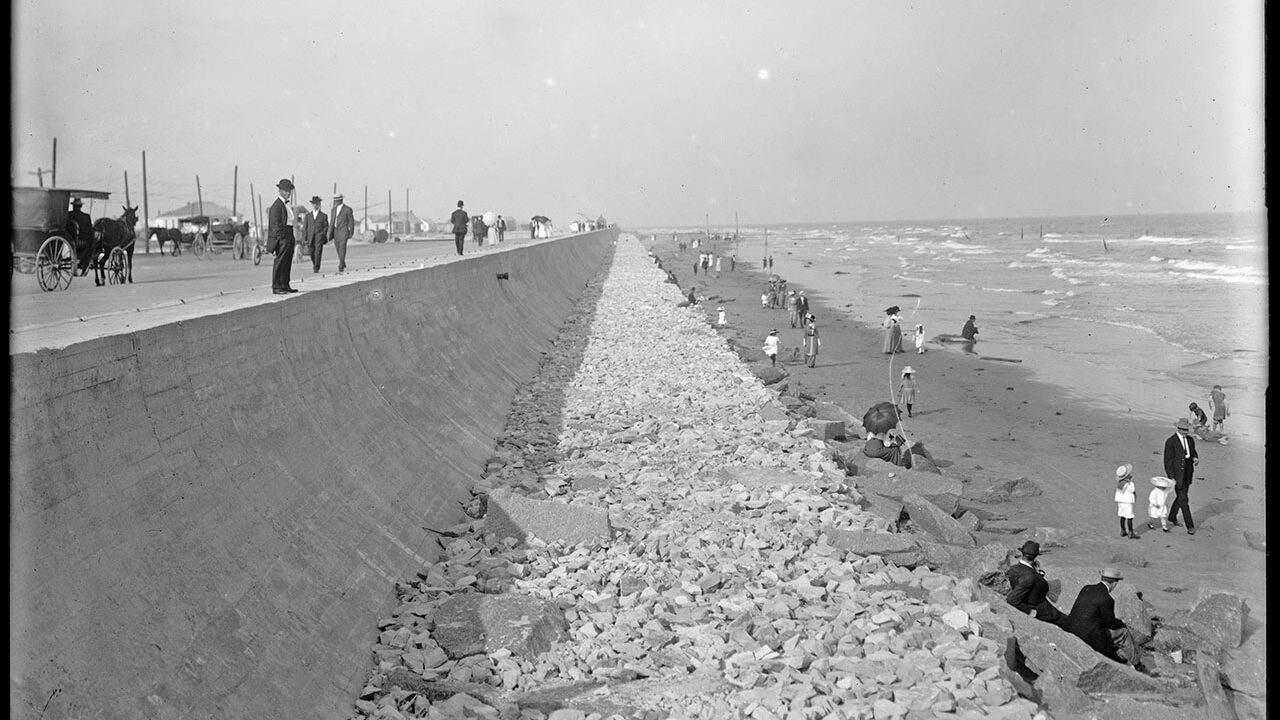
With the port of Galveston, Texas, selected as the gateway, the next challenge was to convince Russian Jews to take this significantly longer route to the United States. To lead this effort, Zangwill appointed Jochelmann, a delegate at the Zionist Congress who was likewise distressed by the rejection of the African plan. Jochelmann became responsible for the effort across Russia to recruit Jews and set them on their way. It succeeded but only to a degree. The project ceased in 1914, with only around 10,000 Russian Jewish immigrants having entered through Galveston, far short of what had been envisioned. With his work concluded, Jochelmann settled in London at Zangwill’s suggestion.
The book then moves to the next generation of Jochelmanns. One of David’s sons, Emmanuel, born in Vilna, came to New York, where he took the name Emjo Basshe and became a notable avant-garde playwright. David’s daughters Fanny and Sonia continued living in the home that David had purchased upon moving to London. Fanny married a gentile Englishman; the book’s author is one of their descendants. Sonia married an acolyte of fiery Zionist leader Vladimir Jabotinsky; they moved their family to Jerusalem in 1951.
Spanning from the end of the 19th century to the years immediately following World War II, “Melting Point” is remarkable for both the story that Cockerell tells and her means of telling it. Eschewing conventional narrative, the book is a patchwork composed of hundreds of excerpts from newspapers, diaries, letters and interviews. It’s almost as if narrated by a chorus, with voices as disparate as Henry James and Winston Churchill.
The author herself has no voice at all, except through the formidable craft of assembly.
The book’s second half includes recollections from elderly family members whom Cockerell was able to interview. For some, it will be a letdown to shift from the high stakes of history to a grandmother’s dreadful driving and cooking skills. But this reflects the essence of the project, as it is fundamentally a family story, though one that pays attention to the historical backdrop.
The book feels particularly relevant. The urgency of the early Zionist endeavor grew in the context of violence against Jews, notably the 1903 Kishinev pogrom. As we dwell in the aftermath of the Oct. 7, 2023, massacre, we are witness to forceful debates about the Jewish future, including the viability of nationalism, that echo earlier ones.
Interestingly, Zangwill’s reputation in the United States was solidified by the success of his 1908 play, “The Melting Pot,” which launched a metaphor that became the standard way of describing our nation’s absorption of people from many lands and beliefs.
The play’s plot, in which a Jewish survivor of the Kishinev pogrom comes to America and falls in love with a Russian Christian immigrant, was received by many as an endorsement of radical assimilation. Yet, at the same time, Zangwill was writing that the “salvation of the Jews cannot be achieved without a territory for the Jews” — essentially a call for ethnic nationalism. We see these conflicting impulses reflected in the Jochelmann home in London, in which one daughter embraces assimilation, and the other moves to Israel.
Both in her bold choice of form and the springboard she provides for a thoughtful return to historical events, Cockerell has offered us a rewarding journey through time.