

J. columnist Howard Freedman recently wrote an eloquent review of a book about a Jewish Argentine woman who desperately searched for her daughter and grandson after they were “disappeared” by the military dictatorship that held sway in the country from 1976 to 1983.
The tragedy of the tens of thousands of kidnap victims in Argentina is well known, but it took on a Jewish angle in the pages of this paper at the time.
It is estimated that the right-wing dictatorship murdered around 30,000 people — the number is disputed — whom it considered opponents. Of those, around 2,000 were Jewish, a much higher proportion than in the general public.
This paper was well aware that Jews were being targeted and that strong antisemitic tendencies ran through Argentinian society.
“Action alert: Argentina,” wrote columnist and Jewish community leader Earl Raab in 1976, after the right-wing military coup.
“The ‘right,’ currently under the leadership of General Jorge Videla, who took over in March of this year, has opened the door more widely than ever to neo-Nazi publications and activities,” Raab wrote. “The ‘left’ opposition, meanwhile, is ideologically ‘third world’ in orientation and anti-Zionist. The long range lesson in Jewish history is that Jews are in trouble in any politically unstable country, especially one which is not curbed by democratic restraints.”
Rumors swirled, and Videla eventually felt obliged to address them, as the Jewish Telegraphic Agency reported in 1977. He said, ominously, that Jews weren’t targeted for being Jewish, but for their politics.
“Videla said that Argentina is not a Nazi state. He expressed himself as ‘very grateful’ for the cultural contributions of the ‘great’ Jewish community,” the JTA article stated. “Lately, he said, Jewish names have appeared in activities inimical to the state and the image of Argentina has become deformed by apprehensions that there may be discrimination against Jews.”
Around 300,000 Jews lived in Argentina at the time, according to a 1981 Jewish Currents report. (Other estimates are even higher — up to 450,000.) How did they get there? Many, of course, came after World War II. Most famously, so did many Nazis, including Adolf Eichmann.
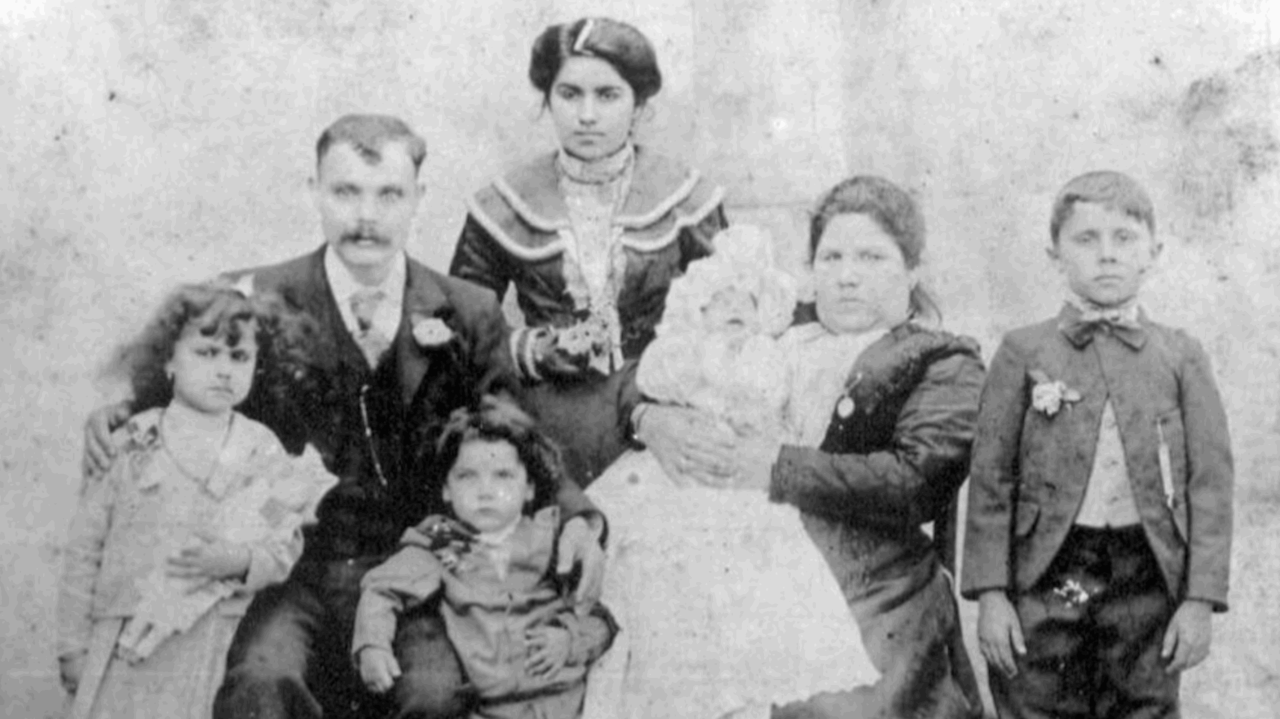
But most came before that, as part of a plan to settle Jews from Russian territories in the late 1800s. Baron Maurice de Hirsch was a German financier and philanthropist who donated huge sums of money to various programs, first for secular education for the Jews of Europe and then to settle Jews abroad. That included Argentina.
An 1896 obituary for Hirsch noted that “it is mainly to his energy and generosity that thousands of Russian Jews owe the facilities afforded them of emigrating to the United States and Argentina. In all this Baron Hirsch acted on the reasonable conviction that Jews are quite as capable as Christians of becoming skilled artisans and successful agriculturists, if only they obtain fair play; and before his death he had the satisfaction of knowing that he had completely proved his case.”
A report from 1898 on his project showed that 1,364 families had been settled in Argentina:
“We cannot say that at this hour the population which has been transplanted to Argentina has acquired all the qualities of old agricultural nations; the education of the colonists is not yet finished. But we are happy to state that great progress has been made; the last crop has been satisfactory.”
The Argentine contingent survived and prospered.
In 1979, we carried this report from the London Jewish Chronicle Service:
“Descendants of the refugees escaping the persecutions in Czarist Russia who pioneered Moisesville, the ‘mother’ of the Jewish agricultural settlements in Argentina, are celebrating the 90th anniversary of its foundation. The 824 original settlers who landed in Buenos Aires on Aug. 14, 1889, endured enormous hardships when they began working the desert land some months later. No fewer than 60 children, aged between five and 14, died from cholera. Yet, they persevered, and led by Rabbi Aaron Goldman, a shochet, a mohel and faithful helpers, the community maintained Jewish traditions, and according to the ‘Jewish Chronicle’ of Oct. 1889, it was possible to eat kosher meat for the first time in Argentina.”
It continued: “Thousands of new immigrants, not only from Eastern Europe, but from the Near East, Turkey and other countries, came to people the settlements or live in the cities as the forerunners of the present day Argentine Jewish community, which at 450,000 is the fifth largest in the world, after the United States, Israel, the Soviet Union and France.”
Argentina’s military dictatorship was toppled in 1983. The next year, we ran a JTA cover story by David Landau with the headline: “Few cried for Jews of Argentina.”
“The Jewish community here is stirred and troubled even more than the general public over the brief and bloody history of the military dictatorship. There is profound and at times acrimonious heart-searching within the community over the question of whether the leadership did enough to protect and save young Jews persecuted by the military,” he wrote.
“While statistics are still sketchy and investigations and revelations continue, it is already quite clear that the Jews suffered proportionately to their strength in the population considerably more than other groups. There were perhaps four times as many disappeared persons among the Jews than among the general population…. The evidence clearly shows that Jews, once incarcerated, were brutally tortured and treated worse than other prisoners.”
The disappearance of about 1,500 Jewish Argentines was under investigation in 1984.
“Complicating the controversy,” Landau’s article continued, “is a subdebate over the role of Israel. On the one hand, Israeli diplomats and other emissaries here were active discreetly in rescuing your Jews. Hundreds were quietly flown to Israel, and even now much of the story is untold and unknown. On the other hand, the Israeli government had and indeed still has a close arms supply relationship with Argentina.”
The brutal end for so many people remains a tragedy four decades later. The people of Argentina weathered a terrifying period, but many are still looking for answers and for the truth of what happened to the “disappeared.”