

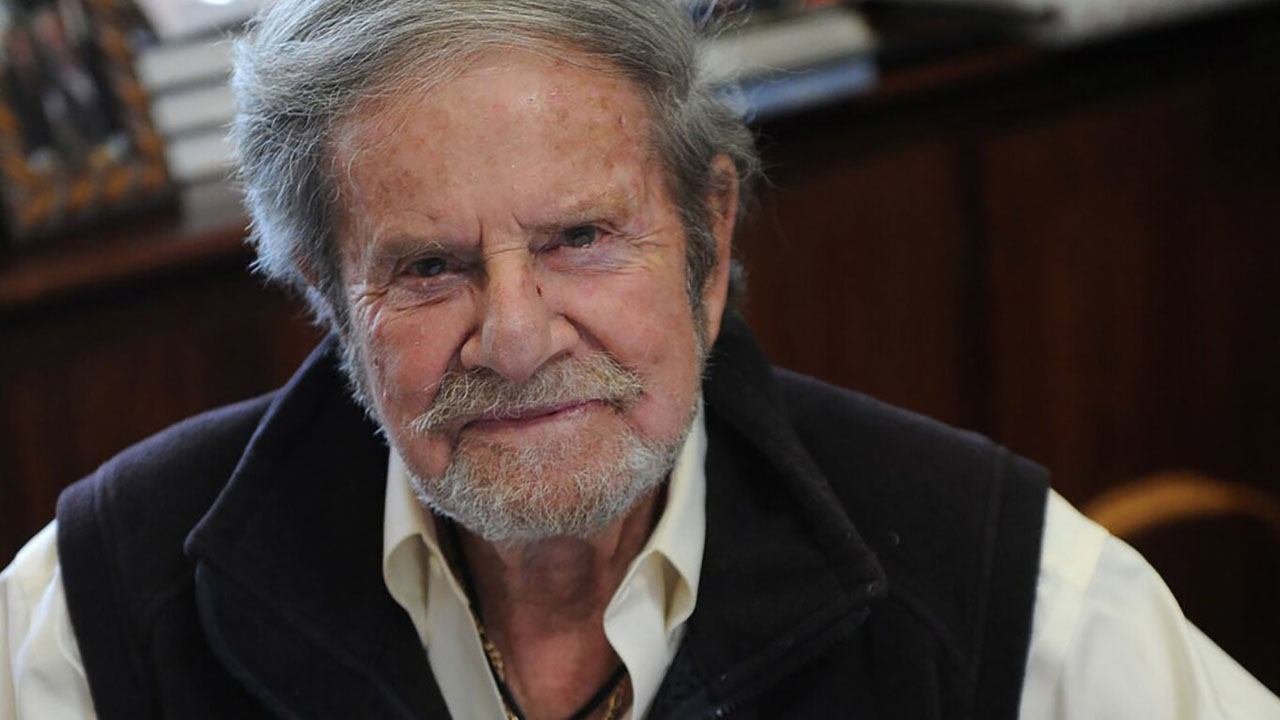
Sitting alongside international dignitaries on a cold and rainy day in 2003, Tad Taube looked across a rubble-strewn field in Poland where the Warsaw Ghetto once stood. In addition to memorializing the Holocaust, Taube was envisioning a sunnier future and a museum that would rise on that very site to honor the thousand-year history of Jews in Poland.
The POLIN Museum, a project co-led and significantly financed by Taube, has logged millions of visitors since it opened in 2014. The museum is but one of the outcomes of the countless acts of philanthropy that defined his life’s work.
Taube, who fled Poland as a child in 1939, became a giant of Jewish philanthropy and charted a trail of largesse that stretched from the Bay Area across the U.S. and all the way to Israel and his native Poland. He died Sept. 13 at his home in San Mateo County after a long illness. He was 94.

“We worked together for 50 years,” said Anita Friedman, executive director of S.F.-based Jewish Family and Children’s Services and chair of the Koret Foundation, which Taube presided over for years. “He had two major goals: to strengthen the Jewish community in the United States and locally, and to build bridges between Jewish communities everywhere, with a special emphasis on rebuilding Jewish life in Poland. That’s what made us philanthropic soulmates.”
As founder and chairman of Taube Philanthropies, Taube established a nearly 30-year legacy of giving that touched multiple aspects of local Jewish and community life, including the Taube Koret Campus for Jewish Life, which holds the Oshman Family JCC and other Jewish organizations in Palo Alto; the Taube Center for Jewish Studies at Stanford University, which was his alma mater; and numerous Bay Area Jewish agencies and institutions, including J.
Non-Jewish beneficiaries of his generosity include the S.F.-based Smuin Contemporary Ballet, the Stern Grove Festival Association, the UCSF Division of Cardiology, SFMOMA and dozens more.
“Tad was more than a philanthropist,” said Jordan Shenker, CEO of the Peninsula JCC in Foster City, to which Taube also donated generously. “He was a builder of community, a believer in justice and a strong supporter of Jewish identity.”
Born in Krakow in 1931, Thaddeus Taube grew up in a comfortable middle-class home. His father, Zyg, was by all measures a success story for Polish Jews, holding a law degree and launching several businesses. But with the coming storm from Hitler’s Germany, Taube’s parents knew it was time to leave.

“In 1939 my parents took a business trip to the United States,” Taube recounted in a film created by JFCS when he received its 2017 Distinguished Humanitarian Service Award for Lifetime Achievement. “The family made the decision not to go back.”
A friend of the family later escorted young Tad out of Poland by train across Nazi Germany and, eventually, to freedom. “The same time as the German army was marching in,” Taube said, “I was marching out.”
After entering the United States, Taube reunited with his family and they settled in Los Angeles. His mother, Lola, found work as a waitress, and his father became a night watchman. They had to start over from the bottom, but over time they reclaimed their place in the middle class. Taube saw the promise of America early on.
After graduating from Stanford with a bachelor’s degree in industrial engineering and a master’s in industrial management, he worked for a time in the fledgling high-tech sector before transitioning to Bay Area real estate investment. He launched Woodmont Companies in the 1960s and, later, Taube Investments. He also owned the Oakland Invaders, a team in the short-lived U.S. Football League.

One of the most fortuitous moments in his career came when Taube befriended Joseph and Stephanie Koret, who founded Koret of California, a successful garment manufacturing company. For much of the 1970s, Taube ran the business and also helped diversify the couple’s holdings. In 1979, he orchestrated its sale to Levi Strauss & Co., which netted the Korets millions of dollars and kickstarted the Koret Foundation.
Meanwhile, his own real estate investment business thrived, with apartment buildings and properties located in the Bay Area, Texas, Arizona, Oregon and Maryland. After Joseph Koret’s death in 1982, Taube became president of the Koret Foundation.
“I shifted the emphasis of my work from making money to giving money away,” he told J. in 2019.
Over the decades, he supported Hillels and JCCs and invested in health care initiatives, including the Tad and Dianne Taube Pavilion at Stanford’s Lucile Packard Children’s Hospital.

Taube’s foundation also gave millions toward the arts, education and civic life, including to the United Way, the Commonwealth Club of California, Notre Dame de Namur University in Belmont, the Ronald McDonald House and the San Francisco Opera.
For all that, he received dozens of honors, such as a lifetime award from JFCS, the Scopus Award from Hebrew University and recognition from the Anti-Defamation League and Israel Bonds.
One of the causes nearest and dearest to Taube’s heart was the Jewish Heritage Initiative of Poland, created in 2003 to focus on the revitalization of Jewish life in the country of his birth.

“We had a real affinity for what was happening in Poland,” recalled Taube Foundation for Jewish Life & Culture executive director Shana Penn in a 2017 interview with J. “Much of our work would be to shift American Jews’ attitudes about Poland, to move past the death-camp attitudes. By the time we started our work in Poland, Tad was a seasoned philanthropist.”
The Koret and Taube philanthropies together gave more than $16 million toward construction of the POLIN Museum and spearheaded a campaign to raise $50 million for the core exhibition. (The Polish government contributed $100 million toward the $150 million in construction costs.)
In addition to the museum, Taube’s foundation also launched Krakow’s Jewish Culture Festival, now in its 34th year. Taube was named Poland’s honorary consul to the Bay Area in 2007. He received the Commander’s Cross, Poland’s highest civilian honor, in 2015.
“This was my dad’s greatest achievement, from his point of view,” recalled his son Juddson Taube. “He always said Poland doesn’t have to be a Jewish graveyard, a place where Jews just come to see Auschwitz. The museum is just one piece of his larger project of reviving Jewish life in Poland.”

In the early 2000s in Poland, “Jewish life was a desert,” Taube told J. in 2019. Now, he said, “I feel like it’s bloomed.”
Taube married three times and had, as his son noted, three nuclear families over his life. “He loved coming home to kids,” Juddson Taube remembered. “He just had this idea of what a family was. He was extremely affectionate and attentive and had no problems saying ‘I love you.’ He loved company.”
Conservative politics made up another core aspect of Taube’s perspective. He was a key supporter of Stanford’s Hoover Institution, a conservative think tank, research and academic center. Among its faculty is economist Michael Boskin, who chaired the President’s Council of Economic Advisers under President George H.W. Bush. Boskin also served on the Koret Foundation board.
“Tad and I go back maybe 45 years,” Boskin said. “He became a dear friend. Tad was an entrepreneur at heart, and he liked philanthropy that had tangible results helping people. He brought a lot of important innovation to the [Koret] foundation, to his own foundation and philanthropy.”
Though his small, wood-paneled Belmont office was lined with photos, awards and memorabilia celebrating his life and achievements, Taube was quick to credit colleagues for much of the nuts-and-bolts work of philanthropy. “It takes a capable, hardworking team to make a major gift that truly impacts an organization or an entire community,” he wrote in a 2016 Times of Israel opinion piece.
Taube was also more than a writer of checks. He took a hands-on interest in the causes he supported.

“There are no families without problems and no people without problems,” said Friedman. “He had a sensitivity to what it meant to be alone and poor in the world because of his own family experience, and he never lost that sensitivity. I was a good partner for him. He was my caseworker.”
Taube continued working into his 90s. But earlier this year, his health began to fail. His son, who is a director on the board of the family foundation, shared that Taube and his team together planned for the inevitable day he would no longer be around.
“We basically prepared for this transition for three years,” Juddson Taube said. “We have this template that dad laid out over several decades.”
Years ago, Taube set up endowments to fund his foundations in perpetuity. In 2013, he signed the Giving Pledge, a promise by wealthy individuals to give away the majority of their money to charity during their lifetimes or at death.
As Taube told J. in 2017, “We have planted a lot of shrubs over the years that have grown into trees. I still have a lot of work to do.”
Taube is survived by his wife of 28 years, Dianne, and children Mark, Paula, Sean, Juddson, Travis and Zakary. Contributions in his memory may be made to American Friends of the POLIN Museum in New York or to the Ronald McDonald House Charities at Stanford University.