

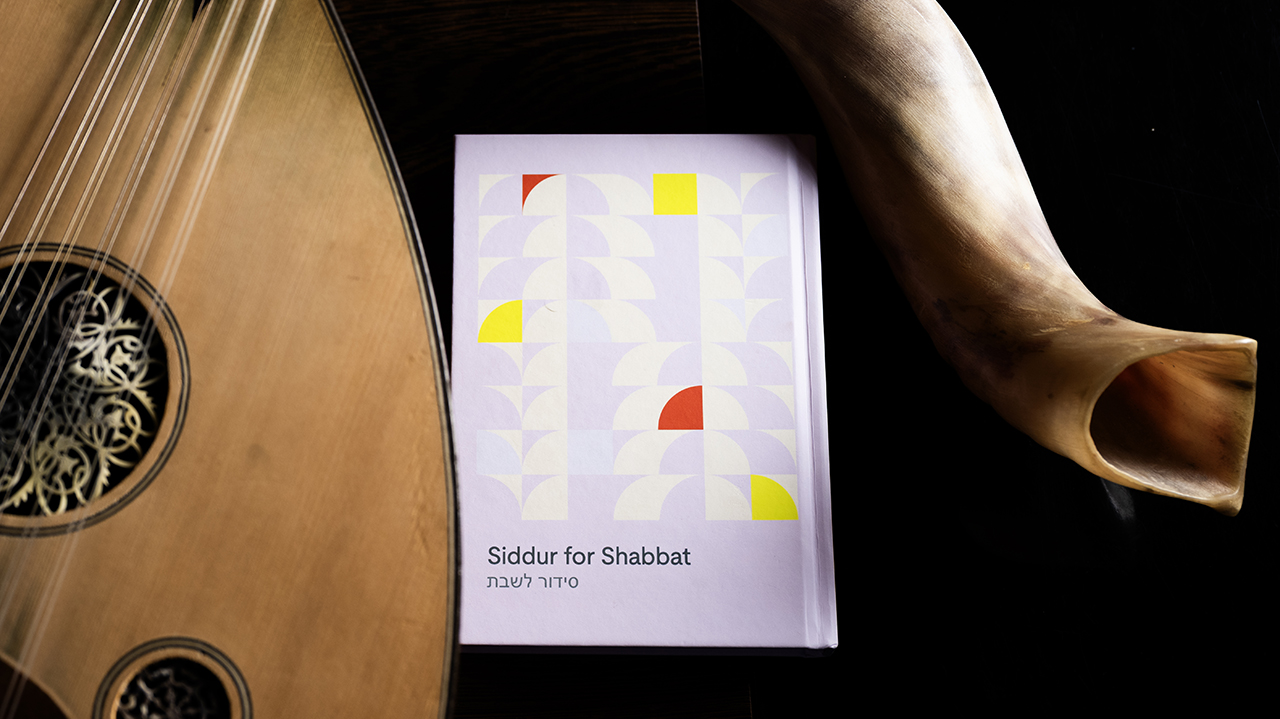
Though founded less than 15 years ago, San Francisco congregation The Kitchen has already produced three editions of its in-house Shabbat prayerbook. The latest version, simply titled “Siddur for Shabbat,” has been in the hands of congregants for about nine months.
Why revise so often? “We’re building the book for the kehillah [community]. Not the other way around,” said Rabbi Noa Kushner, co-editor of the siddur with Hazzan Asher Shasho Levy, who uses the Hebrew title for cantor.
With flourishes of soft lavender and pale yellow throughout its 307 pages, the bound volume starts with the complete version of the Song of Songs and ends with the Priestly Blessing.
Traditional prayers fill the pages in Hebrew and English, with transliterations and egalitarian translations by Levy and Leora Koller-Fox. In addition are not-so-traditional entries, such as original poems by Kitchen members.
More striking is the selection of Sephardic piyyutim (liturgical poems) that make the siddur a rare mix of both Ashkenazi and Sephardic liturgy. Also included, in the Musaf section, is the Ein Keloheinu prayer translated into Ladino, the mix of Hebrew and medieval Spanish spoken by Spanish and Portuguese Jews.

Kushner said that a blended Ashkenazi-Sephardic siddur has been created before in Israel. But The Kitchen’s siddur is believed to be the first in the U.S. that blends the traditions, Levy said.
Ashkenazi nusach, the combination of liturgy and music, dominates synagogues and siddurs in America, reflecting the heritage of the majority of Jews here. An estimated 10% of American Jews are Sephardic and Mizrahi.
“We thought this would be the way forward, to have a siddur and a nusach that brings together all the corners of our community,” Levy said.
In the introduction, Kushner and Levy credit Rabbi Isaac Luria — the famed sage and mystic born in Jerusalem in the 16th century to a Sephardic mother and Ashkenazi father — with championing the early blending of the traditions.
Luria, they wrote, “understood that different prayer traditions represent a community’s individual path to God.”
The independent congregation, which generally holds its Shabbat services at the San Francisco Friends School in the Mission District, has 300-400 member households, Kushner said. On its website, The Kitchen describes itself as a religious community that is “grounded in serious exploration of Jewish tradition, text and ritual for people with all levels of Jewish knowledge and experience.”

That isn’t just lip service. For both Levy (raised in a Syrian Sephardic family in Los Angeles) and Kushner (raised in the Ashkenazi tradition on the East Coast as the daughter of the renowned Rabbi Lawrence Kushner), “all” definitely means “all.”
“San Francisco in 5786 is a really interesting place,” Kushner said, alluding to the new Jewish year that began last week. “Our people come from all kinds of backgrounds, some Jewish, some not. Some have strong affiliations to tefillot [prayer], some don’t. But my sense is once you start opening the doors to a wider variety of people, then you have more people open to new liturgical ideas.”
The siddur’s piyyutim were curated from sites across the globe, including North Africa, the Middle East and Turkey.
“They represent the ones I see in use in many congregations,” said Levy, who chants them at Friday night services while playing the oud. “Those will often be in standard Sephardic siddurim. We bring together elements of these traditions we see as being relevant — things we feel are an important part of the Jewish world at large.”
Many of the new, original poems in the prayerbook, which was designed by Chen Blume, were written as a result of The Kitchen’s adult education classes on piyyutim.
For example, there is member Rob Fram’s “Return to Me and I Will Return to You,” which includes the lines: “What will endure / When your body finally surrenders / Not the vigor of arms or legs / They dissolve / But the breath of kindness / It was here before you arrived / It will be here after you are gone / And in the short time between / We try to return to it.”
As for the inclusion of the complete Song of Songs, the most sensuous book in the Hebrew Bible, Kushner said it’s there for a reason.
During Friday night services, congregants chant one of the book’s eight chapters, something not typically done outside of Orthodox or Sephardi shuls. Its emphasis on love, whether spiritual or physical, fits in with The Kitchen’s ethos of, as Kushner once wrote, “Bringing heaven to earth and earth to heaven.”