

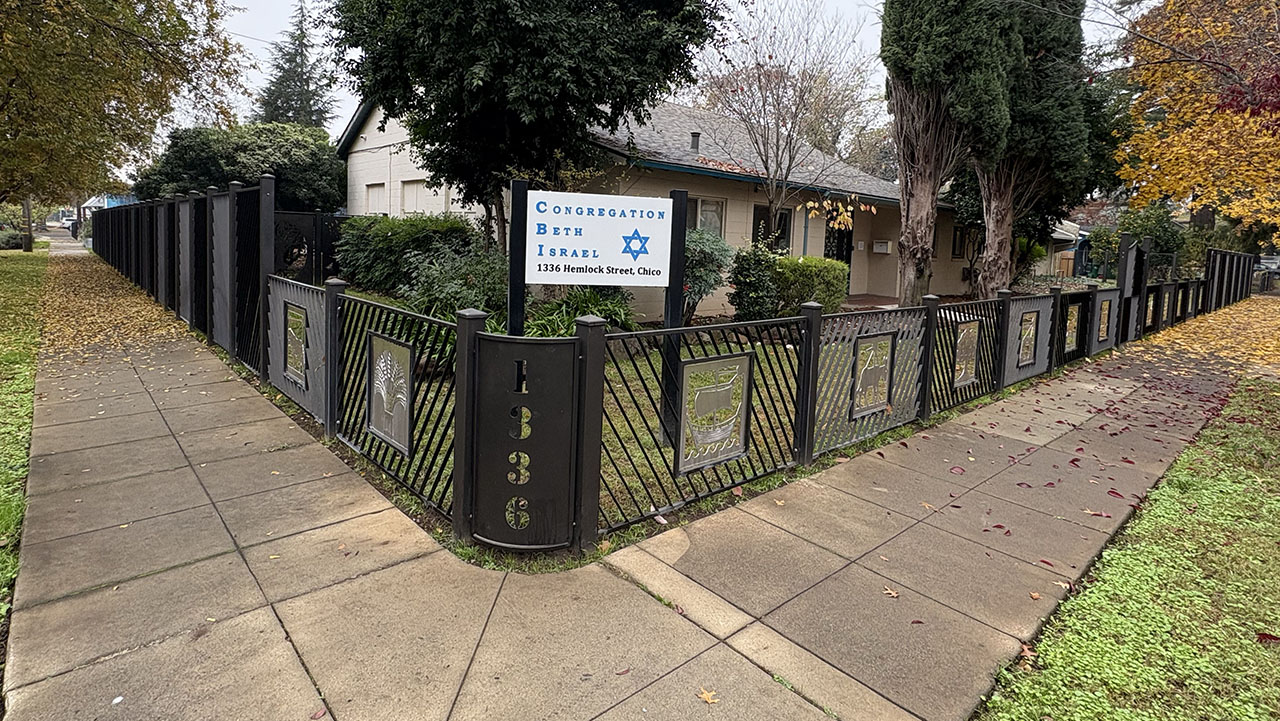
Do good fences make good neighbors? For members of Congregation Beth Israel of Chico, a small synagogue in Butte County, it was the other way around.
After an incident of antisemitic arson and vandalism three years ago, some of its neighbors came together to design, build and fund a new fence, a beautiful security feature that somehow avoids feeling like one.
“I love telling this story,” said Beth Israel’s Rabbi Lisa Rappaport. “It is so beautiful. It is so spiritual. It is so Jewish.”
Back in November 2022, a vandal defaced the synagogue’s wooden welcome sign with Nazi symbols and set it on fire. The sign was made by a member of the congregation, Rappaport said.
“It was very alarming and distressing for our community — not just [for] our Chico community, but … people from everywhere,” the rabbi said. It left people asking, “What can we do to help?”
As word of the crime spread, there was an outpouring of support. Since 2022, the synagogue has received a new sign, new electronic security systems, a more secure front door and, most noticeably, a unique, meaningful new fence.

Among local helpers were Richard and Susie Sparkle, a pair of metalworking artists and sign makers.
Rappaport remembers when Richard Sparkle told her that he wanted to make a new sign for the temple because “hate has no place in Chico.”
Synagogue officials were moved by the community’s response. “They’re not even Jewish!” said David Halimi, a longtime Beth Israel board member who led the charge on security upgrades. “They’re good folks in the community who called the synagogue.”
So, working with Halimi, the Sparkles designed and made a new sign. Then, at a bagel brunch to dedicate the new sign, a second family was inspired by the Sparkles’ generosity. Bob Bell, a retired contractor, and his wife, Cindy Bell, volunteered to donate $38,000, covering the cost of the fence and its installation.
The Bells had moved to Chico from Paradise in 2018 after the Camp Fire. Though Jewish, they had not connected with the Chico Jewish community until they joined the effort to improve the synagogue’s security.
“There was a lot of antisemitism going on around 2022, and it was in the newspaper here,” said Bob Bell, 70. “We went to support the local temple.”
It would not be an ordinary fence if Halimi, 72, had anything to say about it. Halimi, who came to the U.S. from Iran when he was 16, is a real estate developer who also teaches business at Chico State University, owns a restaurant based on the TV show “Cheers,” runs the largest Western wear store in Northern California, and operates rodeos and bull-riding competitions. In creating such an elaborate fence, he drew upon his background in math and an eye for design that has served him well in business. To create the fence, Halimi worked with David Gayheart, a local metalworking contractor he knows from his real estate work, who provided his services at cost.
Halimi didn’t want the fence to look like a fortification. It needed to delineate a perimeter of the synagogue property while deterring would-be vandals from gaining access. Halimi wanted to make sure that after all that, the synagogue would still look like an inviting place.
“I knew I absolutely do not want vertical bars because that’s the first thing that looks like a [prison],” he said.
Instead, the metal fence features diagonal bars.
He wanted the fence to have meaning as well, so he recruited the Sparkles to help. They designed a series of 12 stainless steel panels, each with a symbol of one of the Twelve Tribes of Israel. There is a palm tree for Asher, a boat for Zebulon, and so on — with designs evoking the Jewish folk art of paper cutting. The front portion of the fence is divided into 12 sections, each with a tribal panel in the center.

There have been a couple of minor incidents since the wooden sign was burned. A new camera system has been useful in protecting the synagogue.
Though the fence was officially dedicated in June, it’s like any synagogue facility — a work in progress. Ask Halimi if it’s done, and you’ll hear about some small steel accents he thinks are still needed in the corner of each panel. But not to worry: He’s sure one of his community’s new friends will be willing to help out with those finishing touches.
“So what I love about this story is, yes, we had this really terrible, alarming, distressing, act of hate committed against us,” said Rappaport. “But the amount of love and beautifulness that that was the response to that was a thousand-fold.”