

For years, San Francisco writer Edith Newton was haunted by a recurring dream.
In it, she would return to the duplex where she grew up in Los Angeles, only to discover that her beloved “auntie,” an elderly Austrian neighbor who died decades earlier, actually had never passed away. Instead, she had been waiting patiently, year after year, for Newton to knock on her door again.
“I realized that she would continue to visit me in dreams until I visited her in art,” Newton said.
That realization became “In a Memory Palace,” a new play premiering July 30 in San Francisco. The play, produced by international ensemble Theatre Nohgaku in partnership with San Francisco’s Theatre of Yugen, blends one of Japan’s oldest theatrical traditions, known as Noh, with a story of immigration, memory, aging and sacrifice.
Noh is a highly stylized form of classical Japanese drama that originated in the 14th century. Much like ancient Greek theater, where serious tragedies were balanced by lighter plays, a Noh performance frequently includes a lively intermission, providing comic relief to balance the heavier themes of the play.

Newton’s new play is highly personal and centers on her childhood neighbor, a Viennese Catholic woman who relinquished her privilege as an “Aryan” to flee Hitler’s Europe with her Jewish husband.
Newton’s parents were Austrian Jews who escaped after Germany’s annexation of their country. They spent the war years in England before immigrating to the United States in 1948, eventually settling in L.A.
By chance, that Viennese Catholic woman and her Jewish husband — Hedwig Müller and Georg Müller — lived next door. With most of Newton’s extended family dead, the couple became surrogate grandparents to Newton and her twin sister.
“We spent more of our waking hours on their side of the duplex than on our own,” Newton recalled. “We loved them.”
The Müllers introduced the girls to Viennese culture, literature and opera.
Eventually, Newton’s family moved away. As years passed, visits became less frequent. Georg died, and Hedwig grew increasingly isolated before dying when Newton was a teen.
“I always felt bad,” Newton said. “There was always the sense of wishing to see her more often and thinking of her alone in that house.”
Newton first encountered Noh while earning her degree in medieval and Renaissance languages and literature at UC Berkeley, where she learned about the tradition through Irish poet William Butler Yeats, whose own plays were deeply influenced by Japanese theater.
“As soon as I became aware of Noh, there was a story from my own life that I realized I wanted to tell because Noh aligned with an experience that I was having,” Newton said, referring to the recurring dream of Hedwig.
Noh has a two-act structure that combines chanting, poetry, music, dance, masks and symbolic movement into a solemn and meditative form of storytelling. Unlike Western drama, which often emphasizes action and dialogue, Noh is more concerned with atmosphere, memory and emotion.
Newton went on to study Noh for decades, eventually training with a Japanese master and performing at Tokyo’s National Noh Theatre in 2014. Writing her own Noh play, however, was another challenge entirely.
The form follows precise conventions regarding poetic structure, rhythm and dramatic progression. Newton waited years for an opportunity to study Noh playwriting before finally attending a San Francisco workshop taught by composer David Crandall.
There, she began writing “In a Memory Palace.”
Crandall immediately recognized the potential of the script and, together with co-composer Kevin Falcone, gradually developed the script into a fully staged production.
Like many classical Noh dramas, “In a Memory Palace” centers on a spirit unable to move on.
Noh plays traditionally feature a ghost or spirit that cannot find peace because of an unresolved issue with the living — usually grief, love, regret or trauma. The spirit often appears disguised as an ordinary person before revealing its true identity. The secondary character is frequently a wandering priest or pilgrim who encounters the mysterious spirit, listens to their story and, through prayer or compassion, helps the spirit achieve release.
“I wrote the play in order to visit her again,” Newton said of Hedwig. “And sure enough, from the time I wrote the play, I stopped having the dream.”
Instead of a medieval priest, the traveler in “In a Memory Palace” is simply identified as Woman, a daughter visiting her father in a nursing home. There, Woman encounters an elderly woman resident whose face she does not recognize but whose warmth and mannerisms feel strangely familiar.
The elderly woman disappears, promising to change into another robe. A second character then enters to explain the elderly woman’s story. Only then does the audience discover the truth.
The resident was a once-glamorous couture designer in 1930s Austria. In Vienna, she owned her own fashion salon, but in America she quietly disappeared into anonymity, never returning to the artistic life she loved. That character is based on Newton’s real-life neighbor Hedwig.
The title “In a Memory Palace” refers to an ancient mnemonic technique. A “memory palace” is an imagined building in which memories are assigned to different rooms so they can later be mentally retrieved by walking through the space. Newton transforms that idea into the play’s central metaphor.
Although the dramatic structure remains faithful to classical Noh, the production intentionally broadens the tradition musically and visually.
“We’re really breaking away from that within ‘In a Memory Palace,’” director Jubilith Moore said. “The script follows the Noh structure quite closely, and musically it follows the text. But it’s much more expansive.”
Typically Noh music features powerful vocal chanting and an ensemble of traditional Japanese instruments. This production adds cello, piano and piccolo to bring the iconic Viennese sounds of the era into the play.
The production’s visual world similarly bridges cultures.
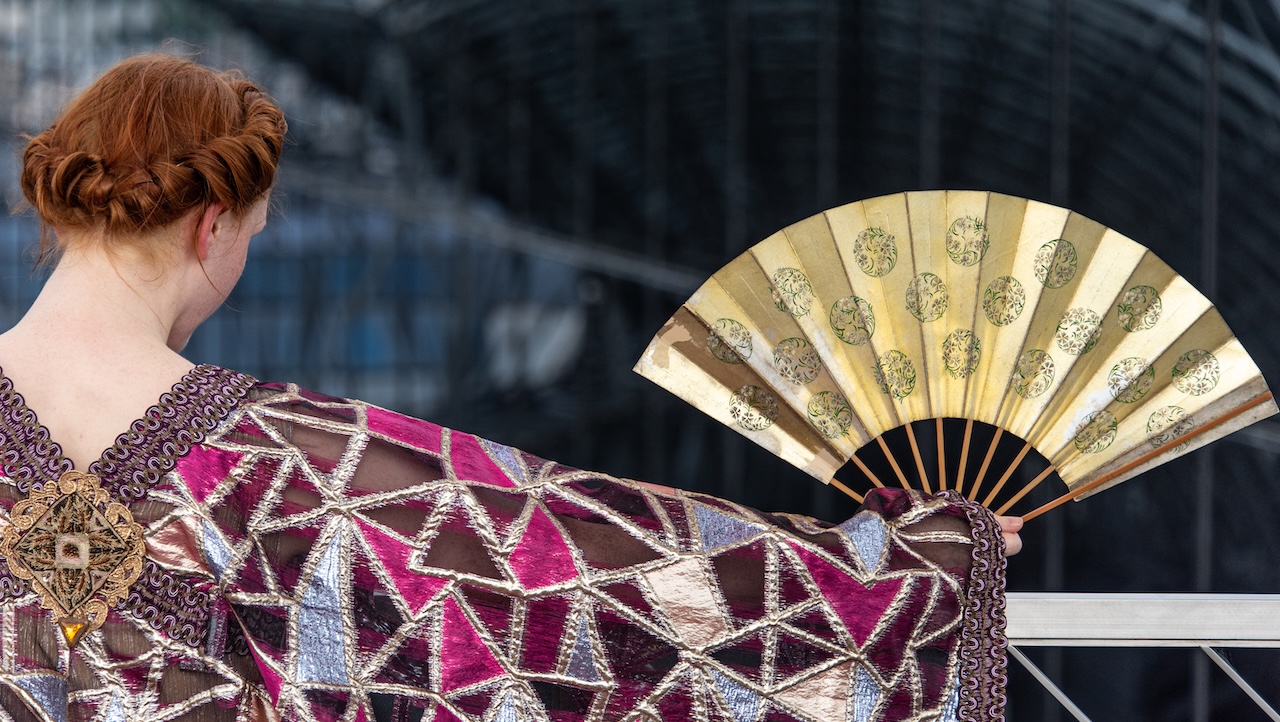
Instead of dressing Hedwig in a traditional kimono, costume designer Margaret Mitchell created garments inspired by the late 19th- and early 20th-century Viennese painter Gustav Klimt.
“We were definitely looking at Vienna and what was going on in the early part of the 20th century and what Hedwig would have been familiar with and what was around her,” Moore said. “So there’s all these hints, and this is very much how Noh works.”
The production features two traditionally carved masks by master maskmaker Kitazawa Hideta, reflecting two different chapters of Hedwig’s life. One portrays her ghost inhabiting the frail body of an elderly nursing home resident in America. The other restores her to the poised, young couture designer she was in interwar Vienna.

Recognizing that many audience members will be experiencing Noh for the first time, the creative team has surrounded the production with workshops, discussions with the composers, movement classes and pre-performance talks beginning July 26.
“Then you know what to look for,” Moore said. “And so you don’t feel completely lost.”
The production also includes a community art installation inviting visitors to share their own migration stories through a cell phone app.
“When Hedwig came to America, she didn’t tell her story. Nobody really knew who she was, and there’s a tragedy in that. There’s a sadness in that,” Moore said. “I think there’s a transcendent feeling about when you go to see a Noh, you realize we’re all in this together.”