

This article was first published in Haaretz and is reprinted with permission.
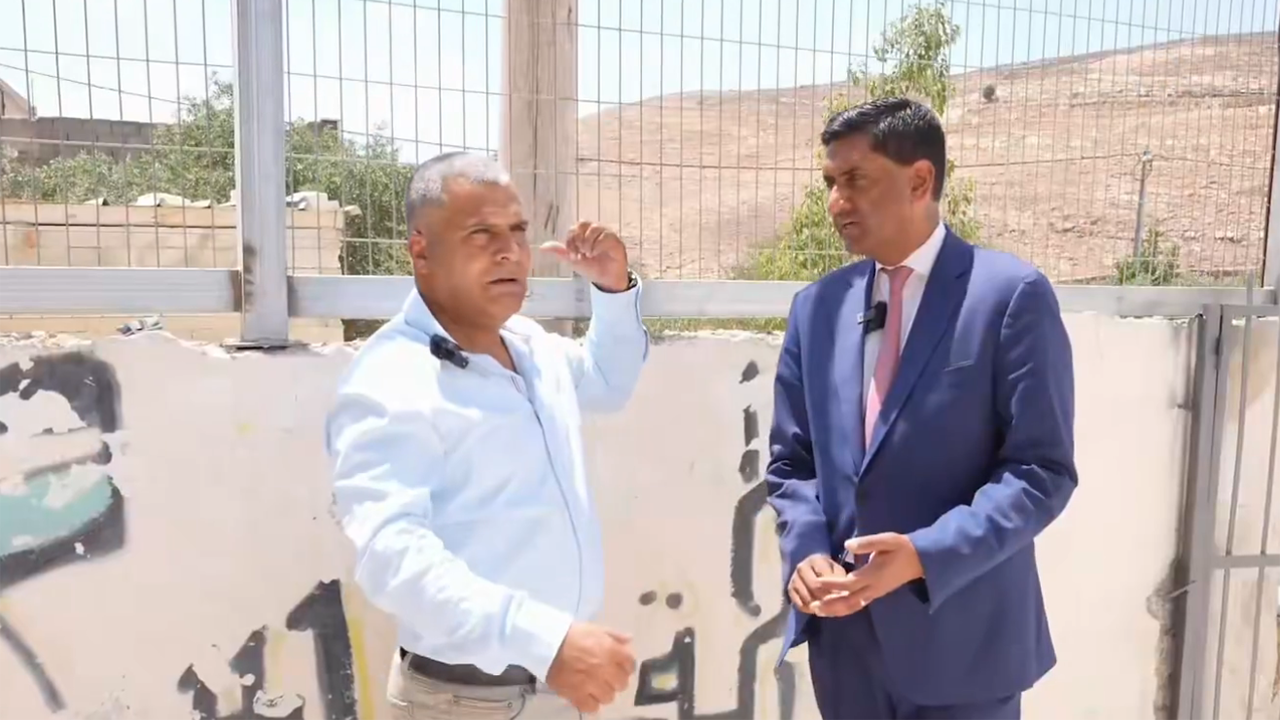
California congressman and 2028 Democratic presidential hopeful Ro Khanna (D-Santa Clara) made his “outrage” known far and wide after he and his delegation were blocked and harassed by armed settlers on July 8 while touring Zanuta, a Bedouin village in the South Hebron Hills that was forcibly displaced twice by settler violence, and Israel Defense Forces soldiers who arrived on the scene “sided with the settlers.”
In a wide-ranging interview with the Haaretz Podcast released July 15 — the first he has given to any Israeli media outlet — Khanna recounted what he called a “harrowing” experience, along with discussing the ways in which the current Israeli government, the “genocidal” Gaza war and the record-setting settler violence in the West Bank have affected his views and policy positions on Israel — and the transformative impact it has had on Americans at large.
Israeli Prime Minister Benjamin Netanyahu’s Israel “has lost Americans under 50,” the Silicon Valley politician declared. “Not just Democrats but Republicans. And these young Americans are going to be the future members of Congress, senators and presidents; not just in 2028 but in 2032, in 2036, in 2040. It is one of the most foolish strategies to have antagonized an entire American generation, and that’s what Bibi Netanyahu has accomplished.”
This transcript has been edited for length and clarity.
Why did you make this trip at this time, and what were you trying to accomplish? Who initiated and coordinated this trip? What did you do in your three days, and why did you come?
I wanted to see the occupation from the lens of the Palestinians. I have been to Israel three times before. I met with Prime Minister [Naftali] Bennett and Prime Minister Netanyahu. I came on a delegation with Speaker [Nancy] Pelosi with the Armed Services Committee, and many years back, I actually came on Project Interchange with the American Jewish Committee with a group of Indian Americans around 2005.
But all the times I came, we would go once to Ramallah, meet with President [Mahmoud] Abbas, and meet with business leaders. But I never really saw the occupation from the lens of Palestinians. I was talking to Jasper Nathaniel — he’s a journalist in the occupied West Bank — and he said, “Come while I’m here. We’ll get you a Palestinian-led guide and perspectives, and you’ll really be able to see firsthand how devastating life is for Palestinians and Palestinian Americans.”
So that is why I went on this trip.
When this now-famous incident happened, however, you were being guided by an Israeli, by a member of Breaking the Silence, the activist organization?
We were largely on a trip led by Palestinians. We went to Hebron, the Palestinian side, led by a Palestinian. We were in villages where Palestinians and Palestinian Americans invited us into their homes. We were in Beit Sahour, Bethlehem and Beit Jala, where we met with Palestinian leaders.
But Nadav Weiman, who has done incredible work at Breaking the Silence, said, “I want to take you to this village, Zanuta, that has been destroyed by the extremist settlers — Yinon Levy and others — and I want you to see the elementary school so you can see settler violence firsthand.”
And so, for that portion of a few hours, Nadav took us there. The irony is that was the most routine part of the trip. He had taken Congresswomen [Rosa] DeLauro and Congressman [Sean] Casten there four or five months ago without incident. And so we got into a van with him.
There were two other Americans with me, [Khanna aide] Cam Kasky and Ben Linder, Jewish Americans, some Palestinians, and there was a New York Times photographer with us the whole day, because she was documenting my trip. She was with us in Hebron and other parts of that day to see what it was like seeing the West Bank through the lens of Palestinians.
So, with that all said, can you go over again, step-by-step, what happened to you?
It’s not very controversial. I don’t know why Israel just doesn’t take accountability, apologize, have investigations and move on.
The reality is, we were at Zanuta village. There were two extremist settlers who came up. One was brandishing an M-4. We were quickly told to get into our van, and they blocked our van from exiting.
You can’t do that. I’ve called it detainment, you could call it false imprisonment. The bottom line is we couldn’t leave the road.
There were no signs there. There was nothing that said it was a restricted [closed military] zone. If anything, the restrictions were on extremist settlers who had destroyed that village. And, like I said, members of Congress came before us.
Now, first, the IDF put out a statement saying it was a [closed military] zone. Now they’ve walked that back, and The Jerusalem Post has concluded that it was not a restricted area. Now they’re saying, “Well, the extremist settlers thought it was restricted.”
Well, even on that account, they basically detained us with a false assumption about the site. And they were cursing at us. They were kicking our tires. They were laughing at us, wiping our windshields.
They didn’t let us go, even when we said we were with the American Embassy. They called other extremist settlers, their friends, who further detained us, locked us in and then when the IDF came, the IDF also said, “No, we believe the settlers. We are not going to let you through.”
And it really took David Brownstein at the American Embassy, the No. 2 person, calling a senior person in the Israeli Foreign Service or whoever he called, that led the Israeli police to come. At which point, they scattered 75-90 minutes into it.
When the IDF statement came out saying that the soldiers had dispersed the settlers, you basically said that was a lie.
Well, that is a lie. Even now, they’ve walked that back. I mean, the IDF and the video camera [footage] shows they didn’t disperse the settlers. I’m actually probably even more disturbed about the government’s lies than I am about the incident itself — that was harrowing.
Cam Kasky, one of my staff, had a panic attack. He’s a Parkland [school shooting] survivor. Ben Linder, a Jewish American, also wrote about how harrowing the experience was. Nadav has talked about it. It’s not just me. It’s a lot of other folks, and that’s why The New York Times talked to our security person. And then the IDF basically lied.
To this day, we have not had a commitment to investigate those settlers. At the very least, the settlers need to be investigated. You can’t just be a civilian and block any person from leaving and brandish M-4 guns and mock them and think that’s acceptable. Even if it was a restricted zone, you couldn’t do that.
It turns out it wasn’t a restricted zone, but that’s vigilante justice. They need to be investigated and prosecuted. My suspicion, from what I’ve been told, is that they’re connected to Yinon Levi.
He needs to be investigated and prosecuted, not just for what he did to Zanuta village, not just if he had a connection to those extreme settlers, but also for his murder of Awdah Hathaleen. And I met Awdah’s brother Khalil, and this guy [Levi] is still roaming around free. It’s like the law of the jungle, and his outpost needs to be demolished.
So I’m going to be meeting the ambassador. The ambassador said he wants to meet with me, and these are going to be my very simple demands. And then we need to have an investigation on those four IDF officers. Why were they not letting us through? Why did they take the side of the settlers?
Israel’s ambassador to the U.S. Yechiel Leiter wasn’t very nice to you. In the media, he said the whole thing was concocted somehow to distract from the scandal around former Senate candidate Graham Platner, who you supported. He said it was suspicious that it happened on Wednesday [July 8], and that you only went public with it on Saturday [July 11] and not in real time.
With due respect to the ambassador, he doesn’t really understand American politics. If he did, then Israel’s approval ratings wouldn’t be as low as they are.
The reason that it was reported in on Saturday is that we did not want to have any news break until I was out of Israel, and The New York Times respected that.
We were, on Thursday, still in the West Bank, going to Palestinian areas. And in some cases, after we left some of these towns, settlers came an hour later, so I didn’t want to be out there saying I was in the West Bank for security reasons. The New York Times on Friday was verifying the reporting. They were talking to our security guard, to the New York Times photographer, to other people in the delegation. They knew it would be a very sensitive report, and they wanted to get the facts right. And that’s why we waited until The New York Times report came out, and that came out Saturday morning.
What did you think of Prime Minister Netanyahu’s response on July 12 on “Meet the Press” that settler terror is merely 150 juvenile delinquents that are not really part of the settler community? He said that actually in several U.S. media interviews and downplays their activities, saying it pales in comparison to Palestinian terror.
First of all, this is just his talking point. But let’s just take him at face value that these are juvenile delinquents. Why haven’t they been arrested? Their pictures are all over social media. My understanding is that they’re connected to Yinon Levi [the Israeli settler who runs Meitarim farm outpost, adjacent to Khirbet Zanuta, and was sanctioned by the European Union in 2024 over human rights violations].
Why has Yinon Levi not been arrested? I can give you the names of other extremist settlers, having talked to Palestinians and Palestinian Americans.
The next American president will demand the arrest of these violent settlers. This is not going to be some dialogue with Israel. It will be a clear directive to Israel that they need to arrest these violent settlers. They need to demolish the outposts. They need to stop the terrorizing of the Palestinian people.
I met a Palestinian father who was grieving for his 14-year-old Palestinian American son [Omar Rabea, who was shot to death in April 2025 on the outskirts of Turmus Ayya]. His son — born, raised in the United States — came to the West Bank. The father admits that he threw rocks at one of the cars, but the IDF soldiers shot him 21 times for throwing rocks, and he has had no justice, no investigation. He was talking about how the room of his son is still the same, not changed.
I went to a school [in Al-Mughayyir, north of Ramallah] that had a shooting. The principal showed me the blood of the 14-year-old [Aws Hamdi Al-Nassan] who was killed [by Israeli settlers], and the principal was never consulted by the IDF or the police. He still doesn’t know if that shooter is out and free.
I met the Suleiman family in Umm al-Khair whose house is attacked by settlers every other night. The 18-year-old daughter was studying, and she can’t study there anymore. Windows rattled, an Israeli flag planted on a Palestinian home.
It is inhumane and cruel what’s going on. People in Hebron throwing rotten tomatoes, throwing acid, urinating on Palestinian shopkeepers. If you want to see the cruelty of humanity, go spend a day in the occupied West Bank.
What do you say to those like Netanyahu who say that you don’t balance it with the cruelty of the other side, of Palestinians toward Israelis?
First of all, I say that there has to be an end to the occupation, and justice, in the West Bank and in Gaza.
I have always believed, and still believe, in Jewish self-determination, in a secure Israel as a Jewish democratic state with equal rights, which treats people with equality and dignity. And I condemned Hamas as a terrorist organization; I condemned Hezbollah’s terrorism; I’ve condemned the Oct. 7 terrorist attacks.
I have met with people in my office — with Jon [Polin] and Rachel [Goldberg-Polin], who lost their beloved son Hersh [Goldberg-Polin, a hostage killed in captivity in Gaza in August 2024]. I did my very, very, very little part to try to advocate for the release of Hersh. Obviously, he was brutally murdered.
My heart breaks for the families of the hostages. My heart breaks for the victims of Oct. 7.
But I want a way forward for peace — for a secure, democratic Israel living side-by-side with a Palestinian people and a Palestinian state, where we can have a just peace.
You make no secret of the fact that you’re weighing a bid for the presidency in 2028. Israel-Palestine has always been a niche issue with American voters, and very rarely at the top of concerns when they actually vote.
Do you believe that things have changed? That this is not the case? That, when it comes to voters, especially Democratic voters, this is a top-tier issue? And do you think it’s enough to make it such a key element of your potential presidential campaign?
My core focus is economic patriotism. How do we tackle the wealth inequality in our country?
I represent Silicon Valley. I grew up in Bucks County, Pennsylvania [a working-class suburb of Philadelphia]. I saw factory work shut down. I saw steel plants shut down. I’ve seen wealth concentrate in the hands of a few in my district, and I believe that we need a New Deal in America. We need a Marshall Plan for America, where we have economic security and economic dignity for people across this country. A lot of my work has been on those economic issues.
But I also believe that we need an America that is moral and has moral leadership in the world.
And my view is that the issue of Palestine and the injustice in Palestine has become a rallying cry for whether you believe in a moral American foreign policy, whether you believe in standing for principle and not being influenced by lobby groups or the status quo powers that be.
You spoke about lobby groups in June. You became the first sitting member of Congress to sign a formal pledge refusing to accept donations or even political support from AIPAC, and explicitly campaigning in this pledge that you signed against the influence of pro-Israel AIPAC money.
Defenders of AIPAC say that Americans join together in PACs to support all kinds of causes: gun control, climate change, even Middle East peace. J Street has a PAC. They say why shouldn’t supporters of Israeli policy do the same?
I object to all PAC money.
I have been for banning super PACs. I don’t take a single dime of PAC money or lobbyist money. I’m for getting all of that money out of our political system, and I’m for a constitutional amendment to regulate large amounts of private spending. It has no place in our politics.
I don’t question the American citizens’ right who are pro-Israel to join AIPAC and play under the rules of the system. The system is broken, and I have been for banning all PAC money.
But I also, as an American politician, have the right not to take their financial support, just like I would not take support from a big-oil PAC or from the [gun lobby] NRA.
So I don’t say that AIPAC can’t participate in politics. I don’t question the loyalty of an American citizen who is very, very supportive of the Netanyahu government and wants to advocate for that. They have every right to do that, and I have every right to say that I don’t want their support.
Have the years of war since Oct. 7, the experience of watching what’s happened in Gaza and perhaps what you are observing now in the West Bank, changed your fundamental positions on the Israeli-Palestinian conflict?
In the past, you’ve defined yourself as supporting Zionism and Israel’s right to exist; you even said that it’s antisemitic to oppose the existence of a Jewish state, which essentially is [NYC Mayor] Zohran Mamdani’s position. You’ve also not supported the boycott, divestment and sanctions (BDS) movement. You’ve been much more outspoken on the Palestinian issue in recent months and years. Do you feel like something’s fundamentally changed in you since before Oct. 7, 2023?
Yes. Initially, my sympathy — if you look at my statements in the first couple of months after Oct. 7 — were all with Israel, with the horrific terrorist attack, with the hostages. I was sickened by what happened. But the response in Gaza was so disproportionate, so inhumane, that it really affected me.
Seeing the children being killed, I was in Dearborn at the Wall of Tears, and there is a wall with the names of the children — about 18,000 children, all with their ages — and that deeply affected me, the genocide, as I have called it, in Gaza, I believe it was a genocide. But even to people who don’t believe it was a genocide, it was certainly just awful, awful crimes.
And I was deeply affected by this trip to the West Bank and seeing how Palestinians are being treated.
Now I want to move forward toward peace, and I believe that we can get there, if we stop the aid to Israel, if we stop military sales that are being used to kill civilians, if we demand — not request, but demand — the arrest of violent settlers.
That’s something that can happen in 100 days. You don’t need a long peace process for that.
If we demand the removal of these outposts, if we begin to demand the removal of illegal settlements, even under Israeli law; if we begin to sanction the banks and the construction companies that are continuing to build there; and then if we work toward a peace process modeled after the Arab Peace Plan on what a Palestinian state would look like, there may be some settlement swaps. You have some settlements near Jerusalem that are part of Israel, and others where Palestinians in Israel become part of Palestine. There are a lot of creative ways of doing that.
But I do believe that you can keep Israel as a Jewish democratic state if you end the occupation and the apartheid there, and if you have a Jewish state that has equal rights.
I mean, you have England, for example, with the Church of England working toward having equal rights for British citizens. The hope would be to have a Jewish state with equal rights, end the occupation and have a Palestinian state as well.
You still believe a two-state solution is not only desirable but possible.
I think it’s much harder than I anticipated.
But it’s possible to get to a Palestinian state with some of the land swaps and stopping the settlements. I also believe that there are things we can do immediately, right? Part of the challenge is we keep talking about the hypotheticals of peace.
What are we doing to eliminate the outposts, to arrest the violent settlers, to allow Palestinians to drill for water, to make sure that they aren’t subject to the cruelty of the checkpoints?
So I would argue that the next American administration needs to work toward justice now while adopting a broader framework for peace.
I do think the conditions on the ground make a two-state solution much harder, and every new settlement that goes up makes it harder. But I still believe that the Arab Peace Plan has some possibility of working, and we’ve not tried it. We’ve not really had an American administration, probably since George Bush Sr., that has put real pressure on the Israeli government to get to a peace.
Together with Republican congressman Thomas Massie, you have been leading the charge to strip the National Defense Authorization Act of Section 224, which would deeply intertwine the U.S. and Israeli militaries’ through unprecedented integration of the weapons industry and wider industries. Are you still part of that fight?
Also: You said that you believe in ending military aid. Netanyahu is a little bit on the same page with that. He wants to move the dynamic from “aid” to “partnership,” and that’s why, obviously, he’s in favor of this section of the act. Can you clarify your position?
Well, for ending all military aid, I didn’t know Netanyahu was for that too. He should endorse the Massie amendment if he’s for that, and we’ll get more votes for it this week, because that’s what the Massie amendment does.
It zeroes out all military aid to Israel.
Netanyahu has said he wants it “phased out,” and he says he wants it to transform from “aid to partnership,” and that this act and this section of the act kind of personifies the partnership.
Well, if he’s sincere about that, he should endorse the Massie amendment. I’ll wait after this interview for him to announce the arrest of the settlers who detained us and the endorsement of the Massie amendment.
But beyond that, we can’t have Section 224, Section 219, which is kind of Netanyahu’s clever ploy, which is to basically integrate America’s military with Israel’s military and jointly produce all the weapons and compromise American sovereignty. And that would allow for the sale of these — you wouldn’t even need the sale. That would allow Israel to get these weapons, bypassing American foreign sale laws.
I led the effort with Massie to strip Section 224 from the House Armed Services Bill. I did it in the Armed Services Committee, where I’ve been a senior member now. I’ve been on the committee for 10 years. I will continue to work to make sure that we don’t have that kind of integration.
One message I would give — and I gave this message to the prime minister, not that he probably cares much about what I think — but when I met him in 2024, I said, “You know, Mr. Prime Minister, you may have won certain battles, but you’ve lost the war.”
And I want your readers to really understand that: This Israel has lost Americans under 50. They’ve lost them — not just Democrats but Republicans.
Thomas Massie won young Republicans by 30 points, and I just don’t understand what the calculus is, because these young Americans are going to be the future members of Congress, senators and presidents — not just in 2028, but in 2032, in 2036, in 2040.
It is one of the most foolish strategies to have antagonized an entire American generation. And that’s what Bibi Netanyahu has accomplished.
You have a lot of opportunities to speak to Israelis. You’re speaking here to Israel’s leaders, but you have a lot of Israeli expats in your district in Silicon Valley, so you must interact a great deal with Israelis. What do you say to them, and what do you say on this podcast, which is based in Israel, not just to Israeli leaders but to Israeli people?
Israel has a lot of wonderful contributions to humanity.
I’ve been there three times, and I’ve seen the science; I’ve seen the education, the poetry, the innovation, and the contributions to moving human knowledge forward.
And it saddens me that that contribution to human civilization is being corrupted because of an ugly occupation in the West Bank and Gaza, because of extreme elements that want to see the aspirations for a “Greater Israel,” because of an unwillingness to recognize the humanity and dignity of the Palestinian people.
And what I believe is that a new generation, hopefully, of leadership in Israel can emerge that wants to take seriously the dignity and aspirations of the Palestinian people.
I’m inspired by how the Palestinians treated Cam Kasky and Jasper Nathaniel on this trip because, as ugly as it was, one of the things that I was so struck by is how warm the Palestinian people were. They welcomed us into their homes. And Cam Kasky, a Jewish American, and Jasper Nathaniel, a Jewish American, were greeted with hugs and love and no resentment, but gratitude for them seeking justice and fighting for justice. And there were many Israeli Jews there who were doing protective presence, and there was a love and gratitude that the Palestinian people had for them.
They didn’t have anger. They didn’t have bitterness. They treated them with the kind of humanity that gives me hope for something going forward.
I understand the trauma of Oct. 7. I understand that it’s a tough neighborhood. I understand how hard the fight was for the foundation of Israel. But we can’t go on this way. We need something better.
Bibi Netanyahu and Donald Trump — they don’t represent the best of humanity. My hope is that people like Cam Kasky and others — they represent where humanity should go. And that’s my hope for the region and for the world.