

This story was originally published in the Forward. Click here to get the Forward’s free email newsletters delivered to your inbox.
As prisons go, Eastern State Penitentiary in Philadelphia was unusually luxurious. For one, it had flush toilets — beating out even the White House in making the upgrade, museum exhibit developer Beth Tinker told me on a recent tour.
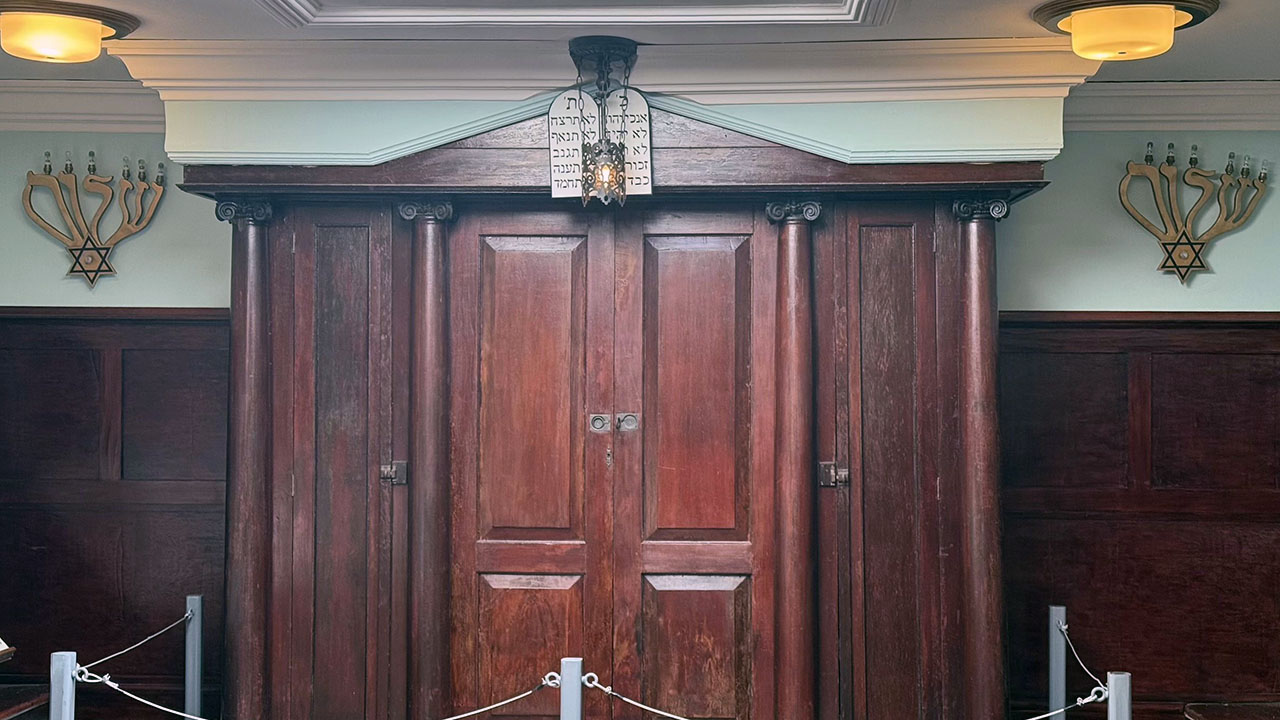
But if plumbing reflected the penitentiary’s commitment to prisoners’ physical well-being, its biggest innovation was more spiritual. Eastern State housed the first synagogue inside a U.S. prison, complete with a Torah ark and ner tamid, or eternal light. That restored sanctuary — a short walk from gangster Al Capone’s former cell — is now newly open to the public in a museum exhibit, “Freedom through Faith: Judaism at Eastern State and Beyond.”
“It’s a place really of humanity, when you’re not getting a lot of humanity in this space,” Tinker said.
The synagogue, founded in 1922, hosted holiday celebrations and weekly Shabbat services. Outside volunteers brought in kosher meats. A circus performer visited and provided entertainment. After a prisoner gave birth to a baby boy, they brought in a mohel and held a bris.
Compare that level of institutional support with modern-day prisons, where there are often multifaith chapels, but a separate, dedicated space for a synagogue is rare, according to Rabbi Joseph Kolakowski, the first full-time Jewish chaplain in the history of the Pennsylvania Department of Corrections.
The exhibit comes on the heels of a Supreme Court ruling that makes it more difficult for prisoners to obtain a remedy when their religious rights are violated. Last month, the Court ruled that a Rastafarian man, Damon Landor, could not sue prison guards for monetary damages after they forcibly shaved off his dreadlocks, which he kept as part of his faith. When he entered the prison, Landor carried with him a copy of a 2017 court decision that required the Louisiana Department of Corrections to honor Rastafarian religious practices — which a guard threw in the trash, according to court records.
But while Landor couldn’t sue the guard, the Supreme Court did agree that Landor’s rights had been violated. His case led the Louisiana Department of Corrections to update its prisoner grooming policy to prevent similar violations.
Eastern State, meanwhile, was accommodating Jewish religious practice decades before those legal protections existed, Tinker said.
“That’s part of what makes this synagogue and this Jewish congregation so amazing, is because they didn’t have to do it, legally,” Tinker said. “It was able to not just sort of secretly start up, but thrive.”
The synagogue’s history
Eastern State didn’t exactly start as a model of restorative justice. Opened in 1829, the state-funded prison pioneered solitary confinement in the U.S., with the idea that solitude would force prisoners to reflect on their sins and find redemption.
That philosophy shaped the prison’s design. A wagon-wheel shaped, panopticon-esque layout allowed for centralized surveillance of prisoners. Skylights in each cell represented the “Eye of God,” suggesting to prisoners that they were always being watched. Cells were attached to small outdoor exercise yards, enclosed by high walls to discourage communication between prisoners. Guards placed hoods over prisoners’ heads whenever they left their cells to prevent them from seeing each other.

But overcrowding made isolation difficult to enforce, so Eastern State abandoned solitary confinement in 1913. That same year, Jewish prisoners gathered to pray for the first time together in the prison’s emergency hospital.
The idea for a more official synagogue came from the top: Alfred Fleisher, the Jewish president of the prison’s board of trustees, advocated for the construction of a sanctuary, partly over concerns that Jewish prisoners would be pressured to convert to Christianity, according to Tinker.
In 1922, prisoners and outside volunteers built the ornate sanctuary. Lights in the shape of menorahs surrounded the ark, and a gold Star of David was affixed to the ceiling next to a skylight.
“It was a chance for the Jewish congregants to have a space that really resonated with their religion, and was a little fancier than the rest of the prison,” Tinker said. “It has sort of the gravitas that you might really find in a synagogue.”
Most of the congregants were serving time for petty crimes, Tinker said, and their stays at Eastern State lasted no more than a few years. For instance, Sydney Bleecher, a prisoner and congregant at Eastern State, was serving time after pleading guilty to stealing 542 suits and overcoats from a store. But for many congregants, the synagogue’s impact lasted beyond the lengths of their prison sentences.
“It is not easy to find words that can say what we feel about you,” Bleecher wrote in a 1948 letter to Joseph Paull, one of the synagogue’s most devoted volunteers. “You have done so much for us that we are far and away indebted to you. Maybe we can repay in part by becoming decent citizens and, like you and your wife, reach out a hand to those who need help.”
The synagogue was also unusually integrated with the outside community. Fleisher attended every service at the synagogue until his death in 1928. Sabato Morais, the spiritual leader at Congregation Mikveh Israel in Philadelphia, simultaneously served as a chaplain at Eastern State.
All that support occurred despite the prison’s small Jewish population, which never rose above 80 in a prison that held roughly 1,800 people in the 1930s.
Yet according to Tinker, the synagogue never faced much pushback from people of other faiths.
“When they started it, it’s also World War I, World War II, and all that antisemitism that’s happening,” Tinker said. “It could have easily gone another direction.”
Jewish life behind bars
Most prisons today hold Jewish services in multi-faith chapels rather than separate Jewish sanctuaries — a practical arrangement that allows facilities to accommodate prisoners of many faiths in a shared space.
After Eastern State closed in 1971, its successor, Graterford Prison, also featured a dedicated synagogue. But after Graterford closed in 2018, its replacement, SCI Phoenix, opened with a multifaith chapel instead.
Today, Kolakowski, chaplaincy program director at the State Correctional Institute at Waymart, Pa., conducts services in a multifaith chapel or, when it’s occupied, a classroom shared with Jehovah’s Witnesses.
There, he leads regular services and holiday celebrations, including Passover seders and Hanukkah candle-lightings. During Sukkot, he hosts services in a makeshift sukkah.
“It’s meaningful to every inmate that practices a religious tradition,” Kolakowski said. “I remember one inmate in particular — he expressed how much he appreciated having the opportunity to have the lulav.”
But accommodating religious practice inside a prison often requires balancing spiritual needs with security concerns. When Kolakowski advocated for a Sikh prisoner to be able to wear a turban, for example, prison officials had to consider that the traditional head covering could be used to hide contraband, he said. Kolakowski ultimately got the item approved by suggesting a small turban with less fabric.
Modern-day prisons are legally required to accommodate prisoners’ religious practices unless they can demonstrate a compelling reason not to, such as a risk to staff or other prisoners’ safety. How those accommodations are carried out, however, can vary from prison to prison.
In 2023, for example, Jewish inmate Riley Benjamin sued the D.C. Department of Corrections after officials required him to produce outside proof of his Judaism before providing him with kosher meals. The jail later agreed to change its policy.
“Today, it’s really prison by prison, warden by warden, how they are defining religious freedom,” Tinker said. “One thing those laws really do is they sort of let the prison decide and the staff decide what it means to a certain extent.”
Still, there have been some successors to the Eastern State synagogue — including at Sing Sing Correctional Facility in Ossining, New York, where Rabbi Irving Koslowe convinced the prison administration to let him convert a basement storage room into an exclusively Jewish place of worship in 1959.
Koslowe died in 2000. But his great grandson, Benjamin Koslowe, visited the prison years later and wrote about the experience for Yeshiva University’s student newspaper.
In an interview with the Forward, Koslowe recalled one of his great-grandfather’s favorite jokes: “They’re the only synagogue that hopes that they don’t have a quorum.”