

I moved to San Francisco four years ago this week. Friends and family were worried. They’d been reading the headlines about the city since the pandemic and couldn’t understand why my husband and I had moved across the country. Last weekend, I felt a spark of hope and wanted to share it with you.
“Optimism and hope are not the same,” writes Rabbi Jonathan Sacks, the late chief rabbi of the U.K. “Optimism is the belief that the world is changing for the better; hope is the belief that, together, we can make the world better. Optimism is a passive virtue, hope an active one. It needs no courage to be an optimist, but it takes a great deal of courage to hope.”
Sacks calls hope a verb, something active. I believe just as deeply that service, also active, is hope coming to life.
Sit with that. I am. If hope matters this much, it’s worth knowing how to reach it and how to make it real.
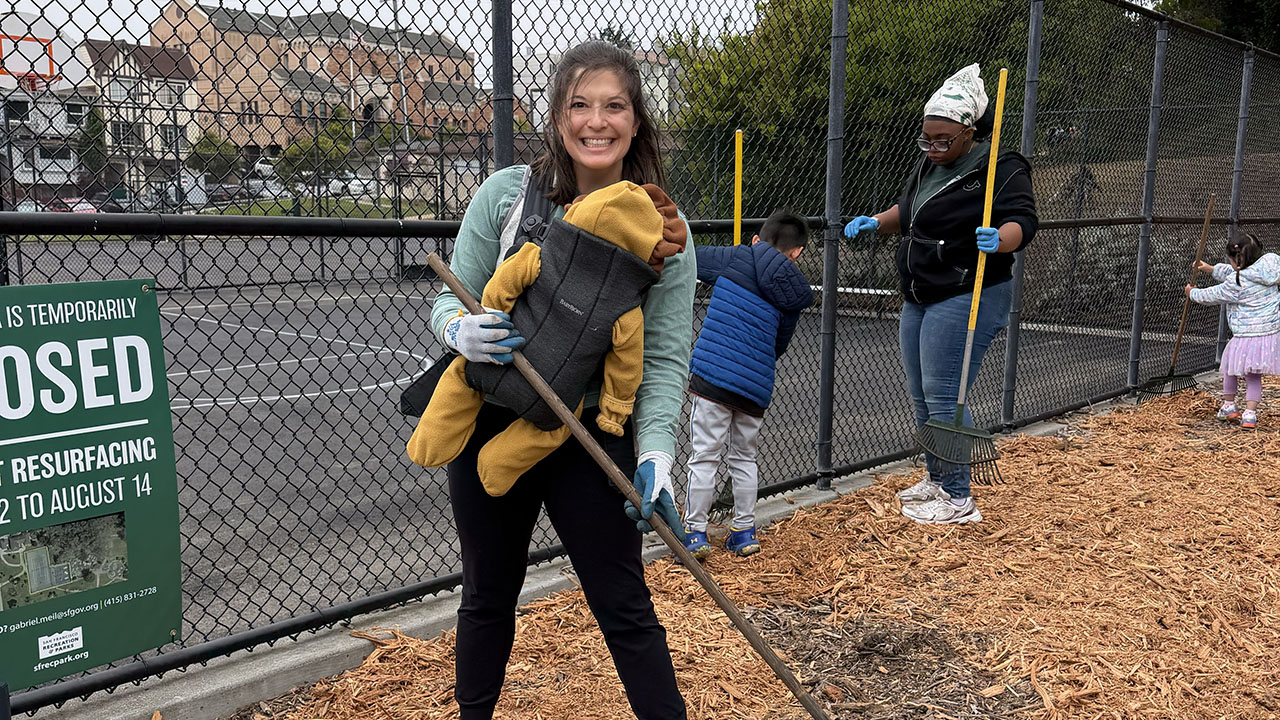
I saw exactly that at One City Day, San Francisco’s citywide day of service on July 11. A friend spotted McCoppin Park on a list of sites still needing volunteers and asked me to join her.
The scene when we arrived was a little disorganized and there weren’t quite enough supplies, but there was no shortage of optimism. One young volunteer, a regular at the park, spoke about the importance of young people getting involved and staying active in their communities.
Our project leader oversees six parks across the city. His team put us to work, clearing invasive species from around a playground about to be resurfaced. Along the way, we found broken glass, trash and a plastic toy truck next to a pipe. It was a small, sharp reminder that a few hours of volunteering can’t fix a park like this for good. It’s ongoing work, and One City Day was one piece of it. Then we moved to mulching, laying it 4- to 6-inches deep until we ran out.
I had my 6-month-old strapped to my chest, so I couldn’t do quite as much of the physical work as I’d have liked. Instead, I helped direct people, pitched in on cleanup and chatted with other volunteers about why they’d come out, what they were reading and where they’d been eating around the city lately.
We finished an hour early. One volunteer asked the project leader, “Are you sure there isn’t more to do?” He thanked us and said what we’d done in an hour and a half would have taken him six days. It reframed the morning; our service made a real difference to him and our park system.
Driving to meet my family for lunch afterward, I passed project after project happening across the city, bright orange vests abounding. I felt real hope for this city — hope for deeper connection with my neighbors, hope that we can show up to meet the needs right in front of us, and hope for what’s ahead, because I’d seen what’s possible when people act on hope.
Sacks says hope takes courage because it’s a choice. That’s what I watched at McCoppin Park. Nobody there was waiting to feel hopeful about San Francisco. They just showed up. Hope isn’t something that happens to a city. It’s something a few hundred people with rakes and mulch and one good Saturday morning make happen.
In the Jewish tradition, we don’t separate belief from action. As the Torah says, “na’aseh v’nishma” — “we will do and we will learn.” Learning follows action; that’s the model. Sometimes we have to act first, and the meaning catches up. I didn’t need to believe things would get better to spend Saturday morning pulling weeds around a playground. I needed to show up.
Stephanie Harrison of The New Happy puts it another way: “Hope grows as we take small steps toward the hoped-for thing.” Hope caught up with me somewhere between the mulch and the volunteer asking if there was really nothing left to do. This was na’aseh v’nishma in action. It made me proud to call San Francisco home, and prouder still to feel like a real part of it.
I believed in hope with my 6-month-old strapped to my chest, surrounded by strangers who turned into neighbors over a pile of mulch by noon. I have spent my career living this idea at Repair the World, a Jewish service movement that guides people into volunteerism and, through that, into hope as a practice.
Repair the World’s next volunteer event is July 24. Come join me. I’ll bring the coffee.