

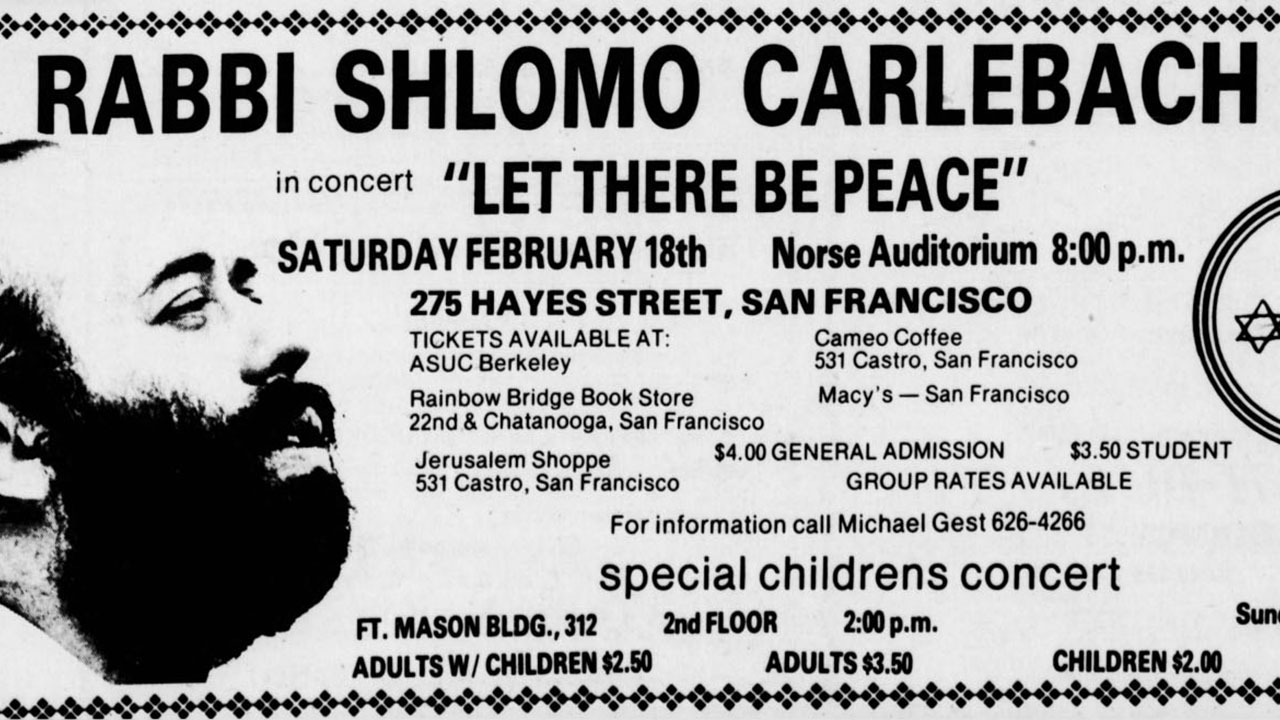
Rabbi Shlomo Carlebach, the most influential Jewish liturgical composer of the 20th century, lived for a time in San Francisco and often visited the Bay Area after he left. So it’s no surprise that J.’s archives are replete with articles about the man known as “the singing rabbi.”
A new documentary that explores the tension between his musical legacy and the many detailed allegations of sexual abuse and harassment against him has brought renewed attention to his complicated legacy. With the premiere of “The Darkest Light” at the San Francisco Jewish Film Festival on July 19, it seemed like a good time to look back at our coverage of Carlebach over the years.
As I paged through our archives, I expected to come across a mention of the allegations against him in 1998. That’s the year that Lilith, the Jewish feminist magazine, published “Rabbi Shlomo Carlebach’s Shadow Side,” the article that first brought many of his deeds to public attention.
But J., which had covered Carlebach’s Bay Area activities extensively and glowingly over the decades, made no mention of the allegations — for years.
Finally, in 2004, Alix Wall, then a J. staffer and now a contributing editor, profiled Susan Weidman-Schneider, editor of Lilith. The profile opens with an anecdote about Lilith’s seminal expose:
“When the family of much-beloved Renewal Rabbi Shlomo Carlebach recently tried to get a New York City block renamed in his honor, opponents relied upon a magazine article to help prove why he should not be given this honor,” Wall wrote. “That article, from the Jewish feminist magazine Lilith, alleged that Carlebach had sexually abused a number of young women.”
Long before those allegations became public, Carlebach first appeared in our pages in the form of a brief notice in July 1966 about an upcoming concert, headlined simply, “Rabbi to Sing in Berkeley.” It read: “Rabbi Shlomo Carlebach, Chassidic folksinger, guitarist and composer, will perform Saturday night, July 9 at 9:30 p.m. at Hillel, 2736 Bancroft Way, Berkeley.” Tickets were just $1.50.
The range of organizations and synagogues he appeared at or with during his times in the Bay Area reflected how widespread his music would eventually become.
Here’s a small sampling: In ’67, he played at a gala for the Jewish Federation’s Young Adult Division. In ’69, he played at an event at San Francisco’s Congregation Emanu-El, bastion of establishment Reform Judaism. And in ’70, he held a “Soul Teach-In” at Oakland’s Congregation Beth Jacob, a Modern Orthodox synagogue.
Much of his reach ran through House of Love and Prayer, the storied Jewish outpost he led within San Francisco’s hippie scene.
Our notice about the Soul Teach-In captures his knack for bringing together seemingly disparate groups of Jews through music:
“San Francisco’s House of Love and Prayer enters the second phase of its ongoing experiment called the ‘Soul Teach-In.’ … The program started in December when Chassidic Rabbi and folk singer Shlomo Carlebach took his Orthodox, ‘longhaired’ congregation from the House of Love and Prayer to study together with Rabbi Paul Laderman and his more conservative congregation at Beth Jacob. The result was a week long happening of song, dance and study.”
Our first full-length feature story on the House of Love and Prayer was published in February ’71 as the institution neared its end, under the headline “House of Love and Prayer: He Digs ‘Turned on’ Religion.”
“The House became famous for its 24-hour Shabbos ‘happenings,’ and a meeting place for ‘turned-off’ young followers of the mystical,” the article states. “Carlebach, who has recorded nine long-play albums, says he has never seen a Jewish community like the one in the San Francisco area.”
Carlebach himself is quoted: “The kids are so awake and the older people are so asleep.” He added, “I really discovered my soul in 1966 at the time of the Berkeley Folk Festival when the eyes of the world were focused on the youth in the Haight-Ashbury.… Young people are holy souls.”
Although he had left the Bay Area by the 1980s, Carlebach remained a local fascination. In ’88, the Magnes Museum hosted an exhibit of photography from the community that Carlebach helped found in Modi’in in central Israel.
Our obituary for Carlebach, who died of a heart attack in 1994 at the age of 69, was laudatory. Aquarian Minyan co-founder Barry Barkan was quoted in the article, recalling Carlebach the way he would be remembered until the other shoe dropped in 1998.
“Shlomo had a way of greeting everybody as if they were his friend,” Barkan said. “His teaching and his music went right to the heart. Shlomo really opened the door for me to come home [to Judaism]. He did that for tens of thousands of people all over the world.”
With the rise of the #MeToo movement in 2017, Carlebach’s legacy came under renewed scrutiny. That year, I wrote an op-ed titled “How to purge the music of Shlomo Carlebach in the age of #MeToo.” His music had become so well known and so widespread by then that avoiding it was (and remains) a serious challenge. With that in mind, I pointed readers to online resources for discovering new and more obscure Jewish music, along with a few contemporary Jewish musicians worth exploring for new tunes.
Carlebach’s daughter Neshama Carlebach, who is one of the main subjects in the new documentary, came to San Francisco in 2018 on a talking and listening tour. At Emanu-El, she spoke about and publicly acknowledged her father’s legacy of sexual abuse for the first time. In the years between his death and #MeToo, she had become a popular performer in her own right, mostly singing her father’s music. At the local event, she came face to face with some of her father’s accusers and found herself in dialogue with them.
Our then-culture editor Andrew Esensten covered a minor controversy in 2023 when a filmed version of “Soul Doctor,” a hagiographic musical about Carlebach that makes no mention of his serial sexual abuse, was slated to be screened around the Bay Area. “It’s not kosher to show the film,” Rabbi Lynn Gottlieb of Berkeley told us at the time. “How would we feel if it were about Harvey Weinstein? It wouldn’t even be a question. So how is this different?”
Ahead of this summer’s SFJFF, I wrote a review of “The Darkest Light,” which I think is now the definitive take on Carlebach and his legacy. At least the silence no longer rings in our ears.