
Do not be alarmed by that rumbling sound, or the cloud of dust faintly visible in the rearview mirror.
It’s not an earthquake. It’s the pulse-quickening onslaught of Egyptian chariots, enhanced with Dolby sound and digital effects.
 Fear not, for God is on our side. Nonetheless, it would be a good idea to pick up the pace across the wide, surprisingly dry and shellfish-free opening in the Red Sea.
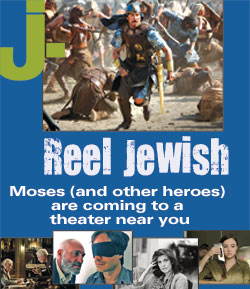
No spoiler alert necessary for this climactic scene from the biggest, loudest and most overtly Jewish-themed major film of the year, “Exodus: Gods and Kings.” After all, you’ve probably read the book (the Torah), or at least the Cliff’s Notes (the Haggadah).
Ideally suited to open around Passover, Ridley Scott’s 3-D swords-and-sandals epic instead hits theaters nationwide Dec. 12, four days before Hanukkah. The holiday that’s primarily driving the release date, of course, is Christmas — a major moviegoing season — as the film needs to command (by a factor of 10, or two stone tablets) an audience beyond the Jewish community to cover its Great Sphinx-size budget.
To that end, Scott (“Gladiator”) and screenwriter Steven Zaillian (“Schindler’s List”) have conceived of Moses (portrayed by Christian “Batman” Bale) as a warrior and action hero rather than a reluctant prophet with a speech impediment. (Or so one gathers from the 50 minutes of selected work-in-process scenes recently previewed for film critics.)
In the meantime, during the six weeks before “Exodus: Gods and Kings” splashes across some 3,000 screens across the country, patience is due. However, several other movies of Jewish interest will roll into theaters. They don’t boast the same eye-popping effects, but their approaches to more recent historical events are arguably more impressive. After all, it’s harder to amaze in two dimensions than three.

German director Volker Schlöndorff’s intelligent and deeply felt “Diplomacy,” which opened Oct. 24, imagines a high-stakes, late-night August 1944 meeting between canny Swedish diplomat Raoul Nordling and Gen. Dietrich von Choltitz, the veteran officer assigned to destroy Paris’ landmarks and population before the Allies arrive.
Beautifully acted by André Dussollier and Niels Arestrup, the film subtly links Choltitz’s dilemma vis-à-vis sparing the City of Lights, to his execution of Jewish civilians earlier in the war — an equally insane order of Hitler’s that the general unquestioningly and unhesitatingly obeyed at the time. Adapted by Cyril Gély from his play, “Diplomacy” is ultimately a reassuring celebration of civilization more than a profile in conscience.
The Holocaust, and the absence of conscience, propels a pair of documentaries awaiting Bay Area engagements following their New York premieres.
In “The Decent One,” Israeli filmmaker Vanessa Lapa mines a trove of Heinrich Himmler’s letters, diaries and photos that depict the loathsome Nazi as a dedicated family man. Winner of the best documentary prize at this year’s Jerusalem Film Festival, “The Decent One” challenges and disturbs viewers with Himmler’s disconnection between public crimes and private affections.
Immediately after World War II, producer Sidney Bernstein embarked on a documentary about the Allied liberation of the camps that combined harrowing archival footage with eyewitness testimony. However, the British and American governments withdrew their support and “German Concentration Camps Factual Survey” lay uncompleted until Britain’s Imperial War Museum recently restored it. Andre Singer relates this infuriating saga in “Night Will Fall,” which opens Dec. 5 in New York.

“The Daily Show with Jon Stewart” is arguably the most respected news source among college students and plenty of post-baccalaureates. Stewart’s a brainy guy, no question, but he’s also a comedian, a TV personality and a fabulously wealthy fellow. When a man like this declares his intention to write and direct his first feature film, it could easily turn out to be a misguided vanity project that shoots him in the foot. Stewart doesn’t fall into that trap.
The New Jersey native acquits himself beautifully with the fact-based drama “Rosewater,” based on Iranian-born journalist Maziar Bahari’s memoir of being jailed and interrogated as a spy by the Ahmadinejad regime for four months in 2009. Strewn with gratuitous (and welcome) jokes at New Jersey’s expense, the film also finds grains of absurdist humor in Iran’s demonization of its all-powerful enemies: America (aka the Great Satan), Zionists and American Jews.
“Rosewater” is primarily concerned with serious matters, of course, notably the risks of reporting in a police state, the importance of voting and the terrible vulnerability of solitary confinement. The film opens Nov. 14.
Bahari’s arrest while covering the Iranian presidential election for Newsweek stemmed in part from the Iranian government misinterpreting his 2009 appearance on “The Daily Show.” (Comedy rarely translates, you know.) After his arrest, the Comedy Central show repeatedly mentioned Bahari’s incarceration and championed his innocence, and it’s conceivable that Stewart felt some responsibility.
But “Rosewater,” which stars Mexican heartthrob Gael Garcia Bernal as Bahari, never feels like a makeup or make-good project. It’s a solid, worthwhile movie, pitched at moviegoers in their 20s and 30s but without the snark that would date it even before it reaches Netflix.

Also on the more serious side are two documentaries about notable Jewish women.
Protagonists in every sense of the word, Sophie Tucker and Susan Sontag ran from nothing and met every challenge head-on. Tucker, the child of Ukrainian immigrants, triumphed in vaudeville, legit theater, radio, the movies and television. Today we’d call her the queen of all media; in her heyday she was known as “the last of the red hot mamas” because of her public, forthright and irreverent acknowledgement of her sexuality. The affectionate documentary “The Outrageous Sophie Tucker” opens in November in Florida with a Bay Area date to be determined.
Tucker, on occasion, was certainly a camp performer, while Sontag defined camp (intellectually, not metaphorically, in her influential 1964 piece “Notes on ‘Camp’ ”). The complicated essayist and filmmaker, who was raised in Los Angeles and Arizona and reinvented herself as a New Yorker and Parisian, is given a fascinating, nuanced rendering by East Bay filmmaker Nancy Kates in “Regarding Susan Sontag.”
The great public intellectual staked out controversial positions on many topics, such as Vietnam and 9/11, while tabling other subjects, like her bisexuality. “Regarding Susan Sontag,” which played both the San Francisco Jewish and LGBT film festivals this summer and screens for free Thursday, Nov. 6 at the Roxie Cinema in San Francisco courtesy of Frameline, premieres Dec. 8 on HBO.
On a lighter note, biting humor is a recurring, albeit secondary, theme for Jewish filmmakers. In that vein, Israeli writer-director Talya Lavie makes a stellar, sharp-edged debut with the distaff workplace satire “Zero Motivation,” opening Dec. 12 in the Bay Area (opposite “Exodus: Gods and Kings” in a David vs. Goliath tussle).

A droll comedy with serious undercurrents, or a drama that smiles as it dips the dagger, “Zero Motivation” hones in on the female soldiers doing the dull administrative work on a remote army base. Alternately ignored, insulted and ogled by the macho military men, the women adopt various strategies for surviving their banal and boring service time in the Israel Defense Forces.
The film’s many pleasures include a savagely funny turn by Dana Ivgy, known for her wrenching performances in the weighty dramas “Or” and “Jaffa.”
Along with Lavie’s breakthrough debut, another film that premiered hereabouts in the S.F. Jewish Film Festival and will return for a theatrical run is Edet Belzberg’s ambitious “Watchers of the Sky.” To describe this documentary as an unequivocally inspiring film about genocide is accurate, but also guarantees you’ll somehow forget to put it on your must-see list.
The film honors the legacy of Raphael Lemkin, who waged an uphill, one-man campaign to persuade the United Nations to create a legal framework to prosecute genocide. Lemkin escaped Poland to American, evading the Nazis’ clutches, but 49 members of his family died at their hands. (It was Lemkin who coined the word “genocide,” referring to such mass atrocities.) In the film, this remarkable and pivotal sidelight of history is intertwined with the efforts of contemporary justice fighters such as Argentine attorney Luis Moreno Ocampo, the first chief prosecutor of the International Criminal Court.
For an altogether different, brain-twister take on effect of memory and the narrative power and disturbing echoes of the Holocaust, check out Larry Brand’s low-budget 2013 American indie, “The Girl on the Train,” now streaming on Netflix. A documentary filmmaker is drawn to an attractive young woman on a commuter line, and his (and our) trust in reality is called into question.
The notion of trust, or faith (to put it in a religious context), brings us back to “Exodus: Gods and Kings.” We should remember, though, that we’re talking about a Hollywood interpretation of the Bible, even if the source material is substantially longer and infinitely more detailed than the brief Old Testament passage that inspired last spring’s “Noah” (an even darker saga involving God and water).
As such, “Exodus” is simply well-meaning entertainment, no matter if the marketing seers at 20th Century Fox brand the film as a parable of God’s might and the perils of misplaced faith in false gods.
Consequently, our curiosity about “Exodus: Gods and Kings” likely has more to do with seeing state-of-the-art computer-generated imagery brought to bear on the Ten Plagues than with the triumph of good (and God) over slavery.
Well, that and the immortal question: Can anyone compare to Charlton Heston?