

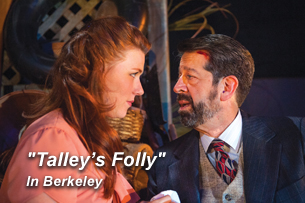
“Talley’s Folly” is, on the surface, about a Jewish man wooing a gentile woman in 1944 in the Midwest. But its focus is not on that interfaith relationship, nor on the Holocaust raging in Europe, which Matt Friedman narrowly escaped when his family fled the Continent after World War I. The Jewish angle is merely a foil to help playwright Lanford Wilson, who won the 1980 Pulitzer for this play, establish these two emotionally wounded individuals as consummate outsiders, moving fitfully toward resolution as a couple.

Now playing in Berkeley at the Aurora Theater Company’s tiny Harry’s Upstage through June 7, “Talley’s Folly” is the second in Wilson’s masterful trilogy that follows the wealthy Talley family of Lebanon, Missouri, over three decades, from World War II to post-Vietnam America. “Fifth of July,” third in the trilogy, plays at the Aurora’s main stage in tandem with “Talley’s Folly.”
The one-act, two-person drama is the most intimate of the three plays. It takes place entirely in one setting — the Talley family’s boathouse — and consists of one conversation between Matt and his love interest, Sally Talley, as Matt tries to persuade Sally to leave her suffocating family and move with him to St. Louis, where he works as an accountant.
Physically, Matt is a caricature of the mid-century Jewish American. He can’t hold a drink, is awkward at ice-skating and is childishly afraid of pain. And who wears a three-piece suit at a boathouse except a German Jew? (As he tells Sally in a wonderfully rambling tale that reads like a fable, his father was a prominent Prussian scientist, his mother was “a Yuke,” his sister was born in Latvia and he in Lithuania, as the family escaped various evils in each country.)
Holding true to another stereotype, he is stubbornly loyal, pursuing Sally with such wit and persistent honesty she can’t help but love him back. Finally, in a gently humorous denouement, each reveals what they fear is a fundamental character flaw and discover that in fact they are beshert (no, Matt doesn’t use the word, but the woman sitting behind this reviewer did).
Lauren English and Rolf Saxon are well cast as Sally and Matt. Both are very experienced actors, and they make the most of an excellent script. The dramatic arc of the story, however, is compromised somewhat by a marked lack of heat between the two, which must be attributed to the actors rather than the words they are speaking. It might have been a directorial choice, by Joy Carlin. If so, it errs too much on the side of emphasizing Matt’s fastidiousness.
Overall, this is an intelligent, beautifully mounted production of a play that is now part of the American canon. Seeing a classic well done is always a treat.