

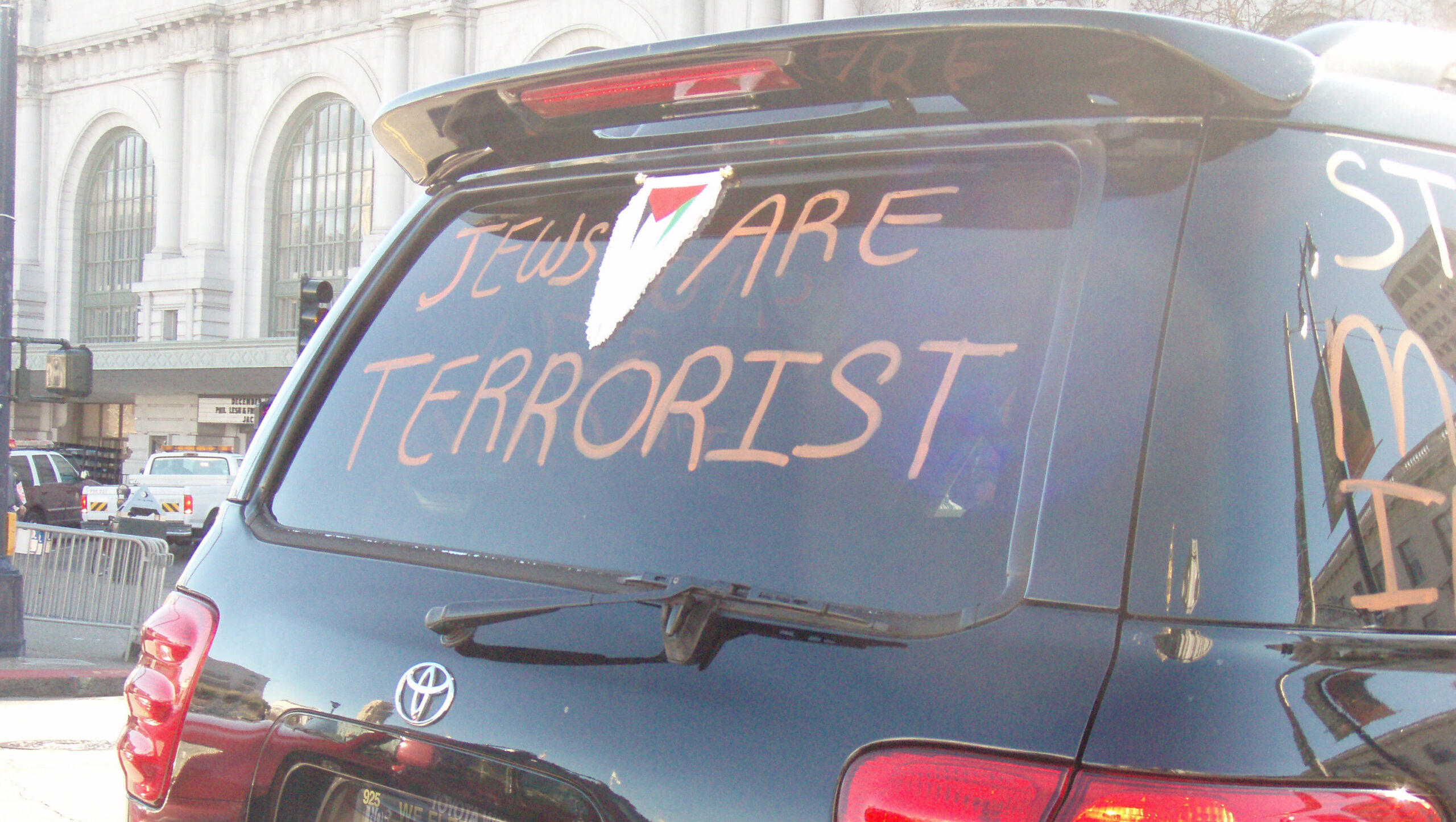
Last weekend’s Women’s March was fabulously energizing and, up to a point, unifying in its condemnation of many of the escalating “isms” and “phobias” that plague our country and pose a danger to its people. I say “up to a point” because while I love a good protest, I was dismayed by what was not at the march. When did anti-Semitism become a non-issue?
I was proud to see the many “Jews Marching for Justice” signs at the marches. But there was no condemnation of anti-Semitism joining the shouting down of Islamophobia, Homophobia, Sexism and Racism.
I understand that the boycott, divestment and sanctions movement against Israel has changed the political landscape so that it now is considered acceptable to question the right of the Jewish state to exist. In the extreme, BDS uses classic anti-Semitic canards to push the anti-Israel movement into the mainstream. But I did not realize that this type of anti-Semitism also has shifted the political landscape of the denouncement of bigotry.
Calling out anti-Semitism for the bigotry it is seems to be frowned upon in politically correct conversations about civil rights. Apparently, anti-Semitism is no longer viewed as offensive enough to warrant condemnation.
With the rise of the newly empowered alt-right, online and very personal hatred against Jews is back in the spotlight. It is obvious anti-Semitism still exists. It is equally clear that this anti-Semitism is different than the type my parents and grandparents felt. It isn’t the “you’re not welcome in this club-hotel-university-profession” kind.
The new anti-Semitism manifests itself as militarily armed planned marches in small towns against fabricated Jewish conspiracies. It is the kind of anti-Semitism that causes a white supremacist to murder people at a JCC in Southern California and a neo-Nazi to hunt down Jews in the heartland of the American Midwest.
In only a few weeks of 2017, we have experienced two rounds of bomb threats to JCCs around the country. And we’re not talking Pepe the Frog memes here. We are talking about dangerous explosions of anti-Semitic violence. But it is the kind of anti-Semitism that is sown from the fringes and not from within the general population. And Jews in America continue to grow in comfort and acceptance and just plain normalcy.
What struck me about last week’s Women’s March was the idea (scolding, even) that to be a good ally, we Jews must acknowledge that the bigotry leveled against us is more particularized (though potentially just as deadly), and we must not mention anti-Semitism for fear of offending our allies and driving a wedge between our mutual struggle against prejudice. Isn’t that like saying that I can’t be a good ally to my friend with Stage 4 lung cancer because I only suffered from treatable thyroid cancer?
Has the BDS movement, in its attempt to isolate, marginalize and obliterate Israel, also made anti-Semitism irrelevant? Of course, reasonable criticism against Israeli policies is not anti-Semitism. But in the extreme, criticism of Israel’s legitimacy to exist morphs into anti-Semitism under the guise of political speech.
Last week’s ruling by a German court — that the attempted firebombing of a synagogue in Germany was merely an act of anti-Israel protest and not an act anti-Semitism — illustrates the merging of anti-Zionism and anti-Semitism. It impacts how others, including some Jewish groups, view the very existence of anti-Semitism.
The popular pro-BDS group Jewish Voice for Peace recently condemned the post-election spike in hate. It rightfully called for the protest of hate incidents directed at the Muslim, immigrant, black and LGBTQ communities, exclaiming on its website that these “attacks are happening to our communities, our friends and loved ones.”
Very true, indeed. But it struck me as odd that JVP erroneously excluded hate incidents directed at … Jews. All the more odd, because hate incidents directed at Jews were among the largest segment of hate incidents reported post-election.
It started me thinking. Was this exclusion an oversight, or was it intentional? Has anti-Israel criticism in the extreme morphed into an anti-Semitism that denies the existence of anti-Jewish bigotry?
On International Holocaust Remembrance Day on Friday, Jan. 27, we need to be vigilant — vigilant against bigotry impacting others as well as against bigotry impacting our own communities. Be a strong ally. Be a strong Jew.
Get with the times. These days, we fight antisemitism by promoting the immigration of large numbers of people from the world’s most anti-Jewish countries. And we support Israel by facilitating Iran’s nuclear weapons program.
January 20 that ceased to be US government policy, but as we can all see, those ideas have metastasized their way into the minds of millions of American “progressives”.
During the era of the anti-war rallies in San francisco, Jewish Voice for Peace stood side by side with the anti-Semites, and turned a blind eye to the hate. Anyone who went to an ANSWER rally remembers Jewish Voice for Peace proudly marching alongside people with signs like “Smash the Jewish state”and worse. Never once did they condemn the Antisemitism in the streets.
You’ve put your finger on an important issue…I’ve been wondering why Bernie Sanders doesn’t vigorously draw attention to, and condemn, antisemitism. And JVP…not very effective in my book at promoting peace. Americans for Peace Now has done more.