

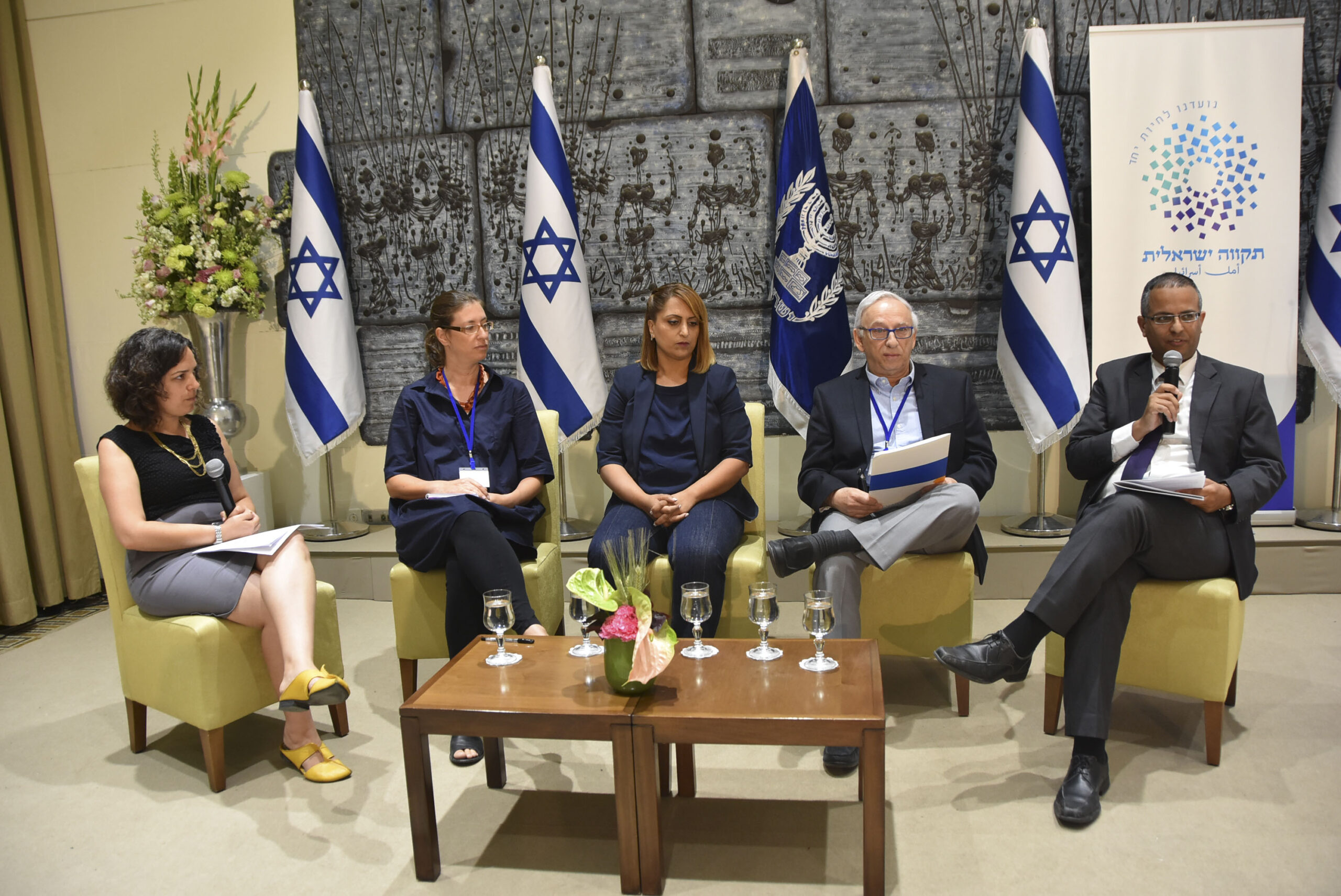
Israeli Hope — an Israeli-based initiative designed to address the Jewish state’s changing demographics — has yet to gain widespread traction in the United States, but the S.F.-based Jewish Community Federation is lending its support as an early believer.
Introduced last year, the initiative is officially titled “Israeli Hope — a New Israeli Order” and it’s Israeli President Reuven Rivlin’s vision for the country’s four sectors (secular Jewish, national-religious Jewish, ultra-Orthodox Jewish and Arabs) to cooperate with one another around values of a shared society.
“As part of Federation’s goal to bring Israelis together and foster pluralism and a truly shared society, we are thrilled to support Israeli Hope,” Federation CEO Danny Grossman said recently.

“This innovative initiative invests in diverse, young Israelis on campus at a moment when they are open to learning about themselves and others, their differences and commonalities, and the inequalities present in Israeli society. This is critical work that builds on the efforts of thousands who are actively strengthening the fabric of Israeli society.”
Grossman said “campus” because the initiative, though composed of several pillars, has made much of its headway so far in the arena of academics, securing the involvement of 30 institutions of higher education across Israel.
“Staff diversity officers” working as part of the initiative have been (or will be) recommending new campus policies, introducing courses about Israel’s diverse communities, and creating inclusive academic calendars and exam schedules.
Already, diversity among staff and faculty has improved at a number of institutions who made a commitment to change things, according to Ayala Hendin, Israeli Hope’s Jerusalem-based director.
She praised the S.F.-based Federation for being an early believer in the initiative.
“This is an example of smart philanthropy,” Hendin said. “Federation had faith in us before the initiative was fully articulated. They gave the first dollar, which made it easier to get the second dollar.”
The initiative was born in response to striking shifts in Israel’s demographic picture. The composition of Israel’s elementary school population — especially in terms of expanding haredi (or ultra-Orthodox) and Israeli Arab populations — puts that shift in stark relief.
According to Israel’s Central Bureau of Statistics, Israeli first-grade students in 1990 were 52 percent secular Jewish, 23 percent Arab, 16 percent Orthodox and 9 percent ultra-Orthodox. By 2018, the numbers are expected to be 38 percent secular Jewish, 25 percent Arab, 1 percent Orthodox and 22 percent ultra-Orthodox.
“[These demographics] create a situation where each group has to re-evaluate the role they want to take in society,” Hendin said. “We no longer have a clear majority and minorities. In this changing reality, the groups will have to partner with each other in order maintain a sustainable society.”
According to Barak Loozon, director of the Federation’s Israel and Global network, which has an office in Kfar Saba (near Herzliya), there is a big difference between Israeli Hope and prior governmental funding for minority programs.
Before, “investments were made so minorities would become more like us, meaning Israelis,” said Loozon. “They didn’t take their stories into account. We are waking up 70 years later asking, ‘What do I have in common with everybody else?’ We are using philanthropic funds toward real integration.”
The initiative also reflects a move from the Israel Defense Forces to academia as the central perceived meeting place for Israelis.
“The IDF is the biggest professional development provider,” Hendin noted. “It is a place where many Israelis learn skills and receive training. But today, at least 50 percent of all 18-year-olds will not serve in the IDF. Higher education institutions are becoming the new meeting point and mechanism that will prepare young adults for their future within Israeli society.”
Loozon stressed a connection between Israeli and U.S. campuses, noting both are drivers of diverse ideas and multiculturalism. And with the boycott, divestment and sanctions movement active at growing numbers of American colleges, he believes Israel can demonstrate how campus life can better express a pluralistic vision.
“We are creating an intervention that brings new ways of how to create a shared society in Israel,” he said. “This is something to be proud of and it could be a huge engagement tool in the Bay Area. Imagine what campuses would look like if we could bring about shared narratives for different segments of students.”
I get it that american Jews are incapable of understanding Israel. And the arrogance of a diaspora Jewish community that is disintigrating in an orgy of mass intermarriage and disaffiliation trying to tell another how to structure itself is mind boggling.
It seems that you guys have learned a lot from the forces using american universities to spread antisemetic poison in the states. Having failed to gain traction for your new Israel fund type objectives among grown-ups you’ve decided to fund campus organization to try and turn our universities into centers of propaganda dissemination.
The fact that despite the lefts continual barrage of hateful lies about how Israel discriminates and is some sort of hateful theocracy the fact that participation higher education seems to be reflective of the actual demographics of the population means that it is already diverse and needs no initiatives to achieve what has already been accomplished without american style drama.
You seem to want to transform Israeli students into snowflakes who attend university looking for validation as opposed to actual education that can produce skilled workers so our children can graduate and then move home to spend their twenties living with Mommy and Daddy.
Just like the idf will never be like the us army, Israeli universities will never be like american universities. First of all like idf soldiers a huge proportion of college students live with their families and those that don’t are no more than an hour or two from their families via public transportation.
In the us college is a big sleep away camp where almost adult children run free for months at a time without moral compass or family involvement allowing for easier indoctrination by subversive ideology. Its not unusual for us college students to see family only on Christmas and summer breaks. They are isolated from any reality aside from childish academia making them easy prey for indoctrination. Kinda like a big cult recruiting center.
Israeli students interact with their families away from campus life on a regular basis. Even the supposedly secular students that live on or near campus go home for the plethora of Jewish (and muslim) holidays and regular Shabbat visits. Israeli students get regular reality checks.
And to the real point of your missionizing…”secular” Israelis are no more likely to embrace american style judiasm and Jewish culture than anyone else in Israel. A truly secular Jew, which is a tiny subset of the reported numbers has no use for a reform or conservative synagogue. They already have orthodox shuls they don’t attend. And the simply non observant Jews view orthodox traditions as something more cultural than religious that they interact with at life cycle events binding them to their ancient people giving the culture a sense of continuity.
You guys simply can’t get that.
Probably cause your kids are marrying gentiles and your traditions are dying.
American universities seem awash with concern-hate speech, protests, lawsuits, actual violence-over the israeli Arab conflict that is thousands of miles away. Israeli universities simply educate arabs, Jews, secular and religious side by side (actual peaceful diversity and coexistence) in the epicenter of the conflict without much drama at all.
Actual diversity is allowing different cultures to exist as distinct cultures side by side without forcing them to blend into a universal non culture. What you call multicultural is really an orwellian distopia where deviations from the popular culture are stigmatized and persecuted. When everyone believes all of the same things and looks at life the same way how can anything be diverse?
Who do you think should be showing who to do it better?