
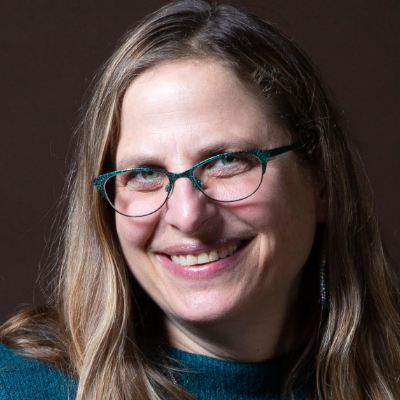

For International Holocaust Remembrance Day in January, Silicon Valley resident Daniel Patt was flown to New York City to take part in a taping of “The View,” the popular daytime television show.
He knew he was going to talk about his creation, From Numbers to Names, which identifies people in Holocaust-era photos using artificial intelligence by comparing them with photos in archives at Yad Vashem in Israel and the U.S. Holocaust Memorial Museum. But “I didn’t know what to expect,” the Google software engineer said.
What awaited him were video hookups with three people he had helped by identifying their family members. One was the actor Josh Gad, who appeared on camera with his mother, Susan, whose grandmother was killed in the Holocaust before she was born. They described how — due to Patt’s efforts — they felt a certain sense of closure they never expected. Susan never had a chance to meet her grandmother. Now she had a photo of her.
“That gift that Daniel brought us is truly a miracle,” Gad said.
Since launching the website From Numbers to Names in 2021, Patt has gotten a lot of press — from the Washington Post to National Public Radio to the Times of Israel.
Patt, 40, lives in the South Bay where he, his wife and two children are active in the Jewish community. He has been working evenings and weekends on the project for years.
Originally from Westchester County, New York, Patt said three of his four grandparents were Holocaust survivors. “I can’t remember a time when I didn’t know about the Holocaust,” he said.
As a youngster, he heard from his maternal grandfather about his Holocaust-related experiences “in a very general way, and as I got older, he told me more. He was a man of few words in general, but he was a very optimistic and positive person. He didn’t tell me an unnecessarily saccharine version of what happened, but wanted to focus more on how he survived and overcame this incredibly difficult time.”
In contrast, his father’s parents did not hold back.
“It was an incredibly painful topic for them, and they wanted to talk about it a lot,” he said.
Patt’s idea of applying AI facial recognition technology to Holocaust-era photographs was sparked by a 2016 visit to Warsaw’s Polin Museum of the History of Polish Jews. He and his wife spent hours there, struck by the photos of people whose names had been forever lost.
He couldn’t shake the feeling that he might be looking at images of his own relatives without knowing it.
“I thought a lot about it on the plane ride back,” he said, wondering how he could help. In 2018, he began to develop his idea.
According to Patt’s research, more than 60 percent of the photos in Holocaust museums do not identify the people pictured. “We’d like to have their identities restored to them,” he said.
Before the pandemic, Patt figured people would compare their family photos to photos in museums when they visited. But with the societal shifts brought on by Covid, he decided it would be more beneficial if his software could be used from home, and in early 2021 he launched From Numbers to Names.

The first part is straightforward: An individual uploads a photo to numberstonames.org, which then searches available archives of Holocaust photos for potential matches. The results, which come back in about 24 hours, do not identify a person with certainty; instead they consist of any number of photos that could be possible matches.
At that point, however, the process hits a roadblock: Once a match is made, it needs to be verified with human eyes.
“There are more matches to look at than people who can go through and look at them,” Patt said.
He has a team of volunteers and has received inquiries from others offering to help. Time is of the essence, he said.
“As survivors are passing on, I think it’s essential to try to find as many of these IDs as we can now, as they can identify others,” he said.
While he has reached out to inform museums when he’s made a successful match, Patt said nothing is as personally gratifying as notifying an individual that a photo of their relative has been found.
The first positive match he made outside of his own family was for the rock star Geddy Lee, lead vocalist, bassist and keyboardist for the band Rush. (Patt grew up listening to his music.) In interviews, Lee had shared that his mother was a Holocaust survivor.
When Patt sent a message identifying a photo of Lee’s mother, Mary Weinrib, in a displaced persons camp after the war — a photo that Lee had never seen — he confirmed it was a match. “It was so meaningful for both of us, as his mother had just passed away,” Patt said. “So it was a special experience to have with him.”