
A perpetually lousy science student, I never got much out of chemistry until I read Primo Levi’s “The Periodic Table” — the Jewish Community Library’s One Bay One Book selection eight years ago.
A chemist during Italy’s fascist regime and a Holocaust survivor, Levi used the chemical elements as a lens through which to process much of what he had experienced in life, including 11 months in Auschwitz.
 So I took it as a good omen that Rosa Lowinger’s soon-to-be-published “Dwell Time: A Memoir of Art, Exile, and Repair” begins with these words from Levi’s memoir: “Understanding matter is necessary to understanding the universe and ourselves.”
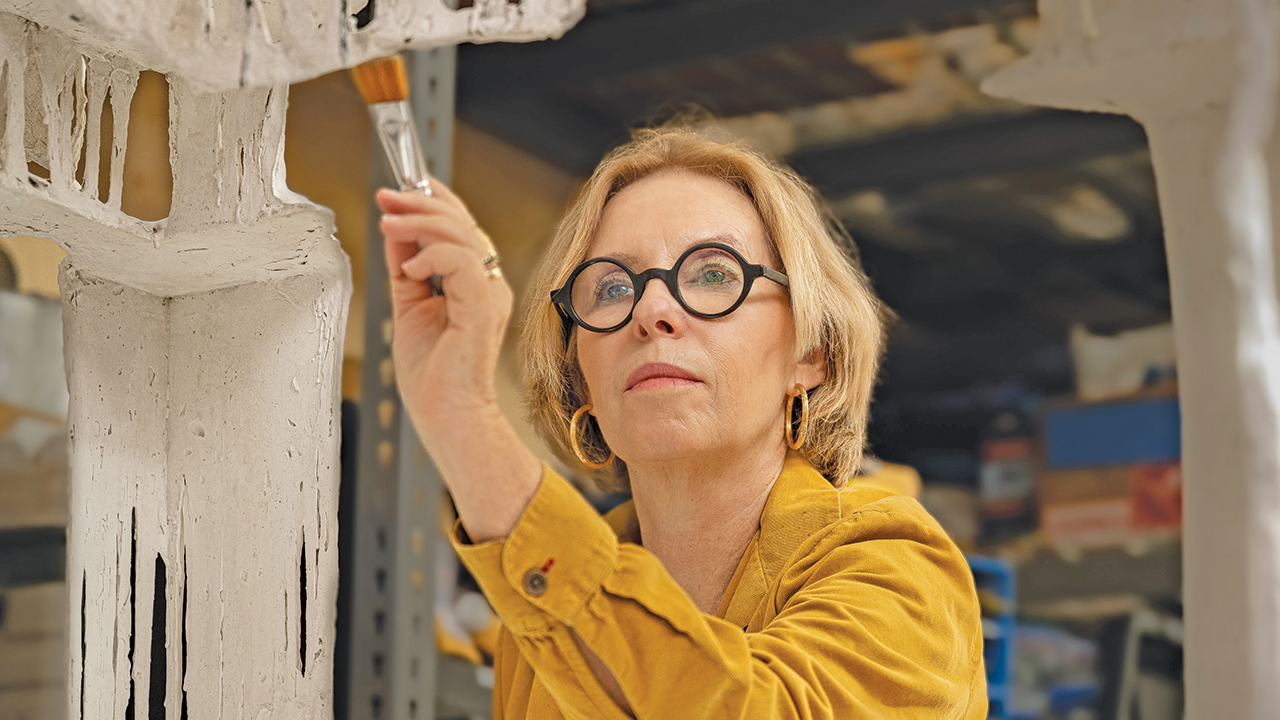
Born in Cuba and now living chiefly in Los Angeles, Lowinger is a leading art and architecture conservator. In chapters named for the materials she works with in her private practice — such as Marble, Limestone, Paint, Terrazzo, Glass and Plastics — she tells the story of her life, with particular attention to her Jewish family: how they came to Cuba, how they fled after the revolution, and what happened after they settled in Miami.
Guiding her investigation is “the first essential principle” she learned for her vocation: that “conservation is a mix of art, science, and hand skills, but it is fundamentally the art of understanding damage. You can’t repair what you don’t comprehend.”
And so, she sets out to comprehend.
Lowinger’s grandparents were Jews from Eastern Europe who ended up in Cuba due to circumstance. They intended to continue on to the United States, but, thwarted by America’s tightening of its immigration policies in the early 1920s, resigned themselves to remaining on the tropical island.
Lowinger’s parents were both born in Havana, but came from different sides of the tracks. Her father, Lindy, grew up in a family that had managed to make it into the city’s upper-middle class. Her mother, Hilda, had lost her own mother during childbirth and spent much of her youth in an orphanage for Jewish children. Lindy and Hilda met as teens and eventually married despite strong protestations from Lindy’s parents. Lindy had a successful career, and the couple’s daughter Rosa, the book’s author, was born in 1956, three years after the Cuban Revolution had begun.
Along with most of Cuba’s Jews, the Lowingers left Havana in the aftermath of the Jan. 1, 1959 victory of the revolutionary forces. In 1961 they joined the exodus to Miami, starting anew with few resources and with the initial expectation that they would be returning following Castro’s overthrow.
The trauma of dislocation took a great toll, and Hilda frequently engaged in abusive behavior toward Rosa that continued throughout her childhood. Rosa was in a hurry to leave home, both to exit the often painful environment of her nuclear family, and to leave behind the Cuban expatriate community with its nostalgia and bitterness.
Lowinger’s interest in art eventually landed her in a pioneering art conservation program at New York University, where she was initially in over her head but eventually found her passion. During the following decades, she found herself traveling the globe, most often on missions to restore materials that were scarred by time, climate, neglect, vandalism or war. Noting that “inadvertently, I had stumbled upon the best profession in the world for remaining far away from my family,” she founded what grew to be a successful business and took on a wide variety of conservation work.
RELATED: We found strength, camaraderie and happiness among Cuba’s Jews
The renewed role that Cuba came to play in her life was against all expectations. When college had offered her an escape route from Miami, she applied exclusively to schools in Boston and New York, “where my grandfathers had hoped to land when they’d first left Transylvania and Bessarabia.”
This would be a sort of corrective, as “Cuba had been just an accidental stopping point for our family.” However, after spontaneously deciding to participate in a 1992 conference on conservation and restoration in Havana, Lowinger became “a born-again Cuban” (her friend’s words), and began returning as often as she could — something her parents never did.
In Cuba she reconnected with a part of herself, and developed a better understanding of her parents’ lives. When she visited her first home in an apartment building her father had designed when he was young, she encountered people who still remembered her grandparents, her parents and even her. And nearby was the Patronato, Havana’s still-extant main synagogue, which her grandfather had helped found.
Amid Cuba’s decaying infrastructure, there was no shortage of projects for a conservator. She found “so much wreckage mixed with so much beauty,” and although she made little money doing so, she began taking on projects in her native land.
It is remarkable to follow Lowinger’s account of her path, which includes efforts to heal her relationship with her parents through the prism of her work. As she writes in the acknowledgments, her book, which will be published Oct. 10, “is a love story to conservation, a profession that honors change over time and the beauty within damaged things.” (The book’s title emerges from that work: in conservation, “dwell time” refers to how long it takes for a chemical to react with a material that is being treated.)
The crash-course in conservation that unfolds in the book functions in two ways. One is offering the sheer pleasure of gaining a better understanding of the material world in which we dwell, and appreciating how buildings and objects fall to decay and damage (often due to the essential nature of the materials of which they are made).
The second, and more salient, point is the application of these properties of the physical world to human relationships. For example, when Lowinger explains how reinforced concrete gets its strength, but how it is inherently vulnerable to corrosion, she draws a comparison to how marriages collapse. And because many of her relationships suffer significant damage, the principles of conservation offer a compelling model for examining a life, and for engaging in repair.