
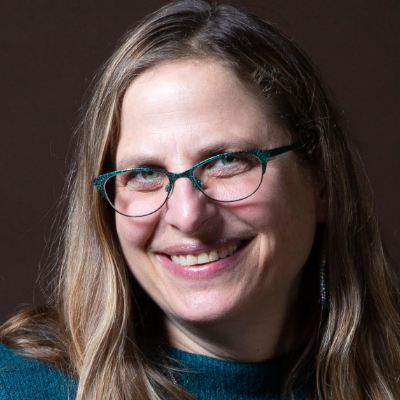
Linda Kurz remembers going to her friend Barbara Sackman’s house as a child and seeing a curious new food she had never seen before: doughnut-like rolls smeared with white stuff, then topped off by thin sheets of pinkish-orange.
The Sackman family was new to the Peninsula, and this traditional food was reminiscent of their East Coast origins. Kurz, who grew up in Menlo Park, was a fourth-generation California Jew. She had never seen this strange cuisine before, called bagels and lox.
Now married to an Israeli and living in Stanford, Kurz is an active member of the Peninsula Jewish community. She was a founding member of the Mid-Peninsula Jewish Community Day School, which she thinks is a tremendous achievement for the Peninsula, and served as its second president.
Kurz, 53, also helped found New Bridges, the Peninsula Jewish outreach group, and was on the steering committee that founded Peninsula Havurah High.
However, when she was growing up on the Peninsula, the community was not quite as Jewish-friendly.
She could not take dance lessons with her friends, because the country club that offered them did not allow Jews. And in high school, she said, they had sororities, and one was called ABCs, which meant “Always Be Christian.”
“This was a very different place when I was growing up. It’s been incredibly exciting to see the growth of so many organizations here.”
Kurz’s California roots can be traced back to her maternal great-great-grandparents, the Wurtenbergs, who came to Calpella from Germany in 1849. They lived on the Pomo Indian reservation, near Ukiah. Great-great-grandfather Wurtenberg was the postmaster there.
Their daughter, Marianna, convinced them to let her attend San Jose Normal School, which later became San Jose State University, to become a teacher. After she graduated, she taught in a one-room schoolhouse in Ukiah. She married another Jew of German descent, Manfred Kohlberg, and they moved to San Francisco.
After the 1906 earthquake, many families had to camp out in Golden Gate Park.
Her great-grandfather Kohlberg “set up a printing press in the park, to do a newsletter for the residents, so people could communicate in the middle of the disaster,” said Kurz.
Her family on her father’s side arrived around the same time, Kurz said, although they were from Alsace-Lorraine, in France near the German border. Her paternal great-grandparents, Aaron and Babette Cahn, went first to New Orleans in 1847. The Gold Rush lured them to California. Aaron Cahn was one of the early directors of Congregation Emanu-El.
Three out of four of her grandparents were born in San Francisco, Kurz said, and three out of four attended U.C. Berkeley.
Kurz’s maternal grandparents, Alice and Harry Gaballe, moved to the Peninsula after graduating from college.
They helped start two Peninsula Reform synagogues, Peninsula Temple Beth El in San Mateo and Peninsula Temple Sholom in Burlingame, with Harry Gaballe serving as president of both at different times. He was also on the board of the Girl Scouts.
Alice Gaballe helped start the Mother’s Milk Bank, which kept a reserve of breast milk on hand for nursing mothers who could not produce enough of their own.
Kurz’s paternal grandfather, Nathan, was a pharmacist in San Francisco, who died when Kurz’s father, Alan Cahn, was 13.
Kurz’s parents, Alan and Bea Cahn, both went to Lowell High School in San Francisco and U.C. Berkeley. They moved to San Mateo in 1946, and then to Menlo Park.
Kurz remembers attending religious school at Congregation Beth Am, in a house. “We rented a house in Palo Alto, and one class was in the dining room, while another class was in another room.”
She also remembers Beth Am holding its services in a church, where they had to cover up the crosses in the sanctuary.
Bea Cahn was the secretary of Beth Am’s board, and she was the one who signed the lease when Beth Am bought its current site in Los Altos Hills. Alan Cahn was the first religious school chair.
Jewish involvement is a family affair for Kurz, who is a vice president of Beth Am and the former associate director of the Koret Institute, a think tank at Stanford.
Now on sabbatical, she lives with her Israeli-born husband, Mordecai, a professor of economics at Stanford, and their two sons, Nathaniel, 17, and David, 13.
Nathaniel attended school at Mid-Peninsula and spent the summer as a counselor at the Albert L. Schultz Jewish Community Center day camp, and David will celebrate his bar mitzvah next month.
Kurz’s brother, Bob Cahn, who lives in Walnut Creek, was involved in Temple Isaiah in Lafayette.
“People always ask my mother, ‘Why you? Why did this happen?'” referring to our Jewish involvement, Kurz said.
Being part of a Jewish youth group was important, she said, but moreover, “It was more than just going to High Holiday services. [Judaism] was really in the home. We had Shabbat every Friday night. That was the key.”
Also, both “Judaism and our roots were important to us. There’s some pride in that kind of connection.”
Kurz said that before she became involved with the she would day school, she couldn’t have imagined sending her child to one.
“I never expected to do that as it was something fairly foreign,” she said.
Her son’s Jewish education affected her parents as well. Her father passed away last year, but her mother, who at 78, is thinking about beginning Hebrew lessons, wants to own a tallit to wear at her grandson’s bar mitzvah.
And what’s happening in her family can be seen all around the Peninsula, Kurz said.
“Now there’s been a wonderful resurgence in this area. Having watched the Jewish community become more vibrant here has been really exciting.”