

Variations of headlines about “campus antisemitism” can be read in pretty much any Jewish publication right now, including this one. But it’s frankly not a new topic.
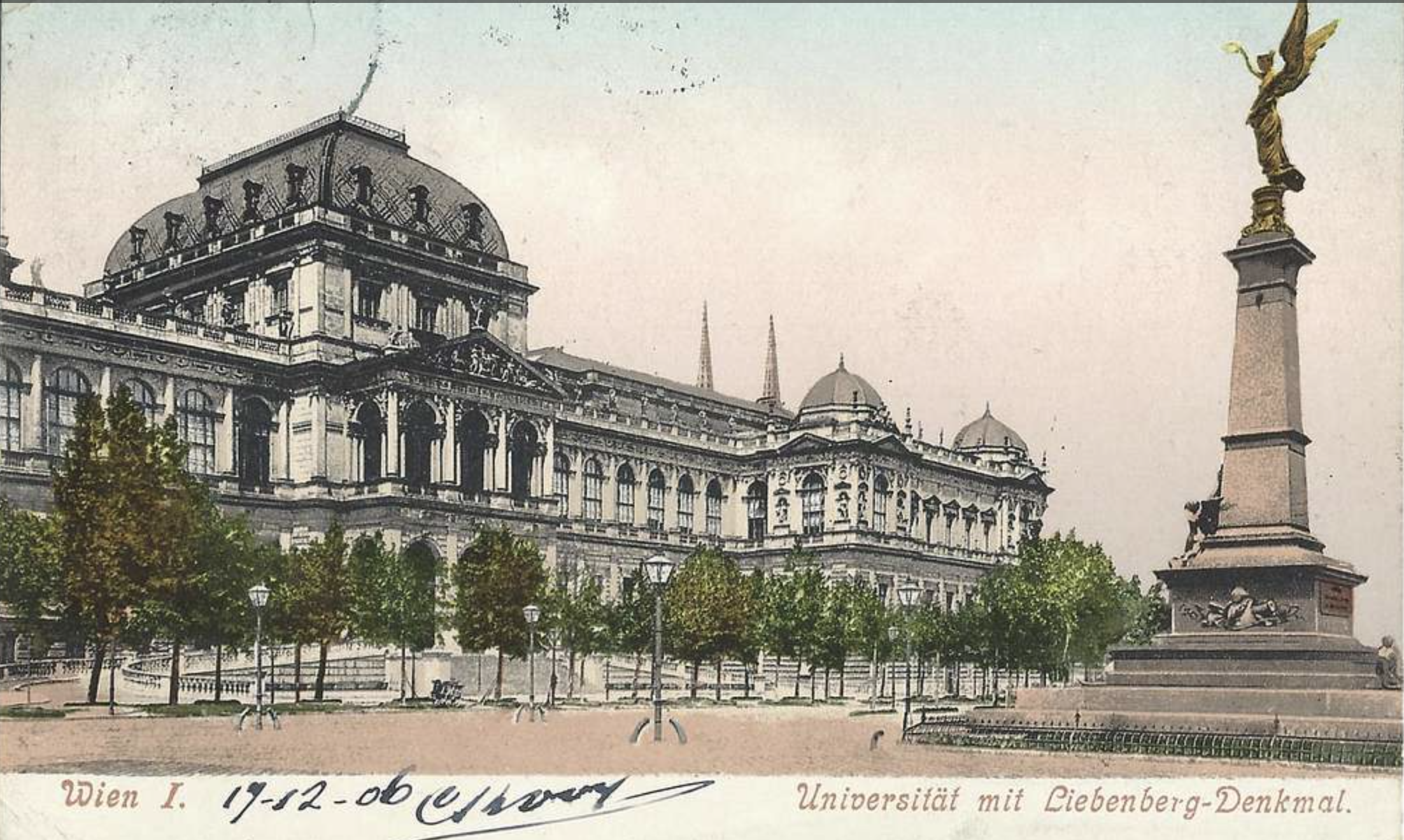
Just over 100 years ago, we carried a front-page article headlined “Anti-semitism in European Universities.” Despite the familiar headline, the content is far from the campus troubles of today. Freedom of speech wasn’t the question then. It was the very rights of Jews to attend school.
In the mid- to- late-1920s, Zionist writer and activist Marvin Lowenthal left the U.S. to report on conditions of European Jews. We ran one of his reports in the Jan. 4, 1924, issue.
Lowenthal “set out on a swing through the chief university centers of Austria-Czecho-Slovakia, and Poland,” he wrote, “and I found myself in a great battlefield, which stretches from Germany east to Russia, where each campus is a front-line trench, and where the Jewish students, organized almost to a man, with practically no weapon but their organization, are lustily fighting for what to them is chiefly the privilege to study, but what for the world is the essential principle of academic freedom.”
What Lowenthal found was chilling. Almost a decade before Adolf Hitler became chancellor of Germany, Jewish students at the universities across Europe were getting barred from class, ostracized and even attacked.
The universities are poisoning the wells.
“I arrived in Vienna the day after a major engagement,” Lowenthal wrote. “The German nationalist students had gone on a two-day strike, and with long canes and thick rubber clubs had persuaded the Jewish students not to attend classes.”
The issue at stake here was the “numerus clausus,” a regulation intended to cap the number of Jewish students at universities at 10%.
“The demand for a clausus has spread now to practically every campus in Central and Eastern Europe; it has been taken up by the legislatures of Austria, Poland, Hungary, the Baltic States, and Rumania.”
While Jews fought the “numerus clausus” in courts — and in the court of public opinion — the battle was also in the streets.
“I watched the reports come in from the widespread front: In Jassy a bloody scuffle; in Czernowitz the university senate refuses the demands of the Rumanian nationalist students, there is a strike and bloodshed; in Riga a Jewish student is killed. The Polish students of Lemberg march en masse to the Plac Maryacki and before the statue of the poet Mickiewicz take an oath to drive the Jews from the university.”
Just as disquieting was the situation at medical schools.
“Klausenburg [now Cluj, in Transylvania], where there is a medical college, brings forth what was then a novelty but is now a commonplace: the Rumanian students demanded, with the usual rioting, that the Jews be excluded from the college unless the Jewish community furnished corpses for dissection.”
The call for corpses was on the surface a request for the Jewish community to do its part in supplementing a scarce resource: cadavers used in training doctors. But there was much more behind it, including centuries of blood libel conspiracies. While cadavers for anatomy study were necessary for medical schools, Jewish funeral practices and chevra kadisha customs meant that the Jewish dead didn’t usually end up in pauper graves or as unidentified bodies at the hospital.
All medical students needed to dissect bodies, but the idea that Jewish students could cut up Christian bodies without letting the opposite happen put medical training at the center of an ugly discourse that was a stew of nationalism, antisemitism and paranoia.
This was widespread. It was the same in Lviv, Bucharest and Krakow, Lowenthal wrote, with some macabre specifications: “Cracow has demanded one Jewish for every ten Christian corpses and has given a date, together with an ultimatum, when the first corpses are to be delivered.”
Lowenthal explained that a “Central or Eastern European university, one must first understand, is atmospherically against the Jew. As a student he works and plays in an academic Ghetto; the walls shutting him out from social and professional intercourse with the general student body are high and rigid. He sits beside the Gentile student in class — except where, as proposed in Jena, he sits behind him — but he does not sit with him. He has the same interests as the other students but he never shares them.”
Student clubs were closed to Jews, as were professional associations (except a club in Vienna to fight the spread of syphilis, Lowenthal dryly noted).
“Up to the present time the Jews have found no weapon but protest,” he wrote. “This is a rather empty satisfaction, for there is no one, with both goodwill and power, to whom they can protest. The only other defense, if such it may be called, is flight.”
But why were the students of the great European cities so adamantly against their Jewish peers, who just wanted to come to class to learn and train? Lowenthal saw an answer in the nationalist movements of the region. “A mere recital of these outward manifestations against the Jewish students reveal only faintly the nature of the driving forces behind,” he wrote.
“The people of Central and Eastern Europe are hungry,” he added. “And more cruel than the absence of a real meal, they are without economic security or hope.”
Lacking those, he said, they are turning either to communism or nationalism — mostly the latter. “And the love of one’s own nation is inextricably bound up with the hate of other nations, especially if those other nations are within the gates,” he wrote.
The Jewish students were the casualties of a larger problem, he contended, and one that would be hard to contain.
“Central and Eastern Europe is saying ‘The Jew must go,’” Lowenthal wrote. “He won’t, of course, and he can’t. The struggle will lead no one knows where. One thing seems certain: In those lands where toleration and freedom could be waters of healing, the universities are poisoning the wells.”
We know exactly where all of this led — to the near obliteration of Jewish European life after those students who wanted to be doctors, teachers or poets were rounded up and murdered in the Holocaust.
It’s important to contrast the current wave of campus antisemitism with the brutal reality that Lowenthal laid out. The U.S. of 2024 is not the Europe of 1924. At the same time, his accounts remind us of why campus antisemitism is unnerving Jews yet again.