

Grappling with an unprecedented swell of antisemitism in the Bay Area, young Jewish professionals are mobilizing grassroots resources to fight newfound discrimination in the spaces that many Gen Z and millennial Jews inhabit most: at work and on social media.
Like other millennial Jews who have ended friendships with people who excused, celebrated or denied Hamas’ attack on Oct. 7, Allison turned to the Jewish community for relief.
Allison, who didn’t want to use her last name due to concerns over her employment, is a therapist in her 20s who works for an East Bay public school district. At work, she hides her Magen David pendant and avoids using any Hebrew with Israeli students. Allison is afraid that if colleagues discover that she is Jewish, it could spur the sort of hate she’s experienced on social media.
“I grew up in the Bay and always felt comfortable as a Jew, but I don’t feel safe anymore. And it’s pointless talking to anyone who uses Instagram or TikTok a lot because people my age are brainwashed by antisemitic propaganda on social media,” she said.
“Social media algorithms control what people see, what they think and what they become,” she added. “It makes me question humanity and what the internet has done to us.”
Allison joined about 80 other young Jewish professionals in late March for an event in San Francisco focused on navigating Jewish identity in the workplace. The event was spearheaded by J Leaders fellow Daniel Krigel, 30, an executive recruiter who has become a resource for many of his clients and friends dealing with antisemitism at work.
J Leaders is a Silicon Valley-based nonprofit established by tech industry professionals who volunteer their expertise to support young adults’ career development, though in recent months it has pivoted to responding to the duress they have felt since Oct. 7.
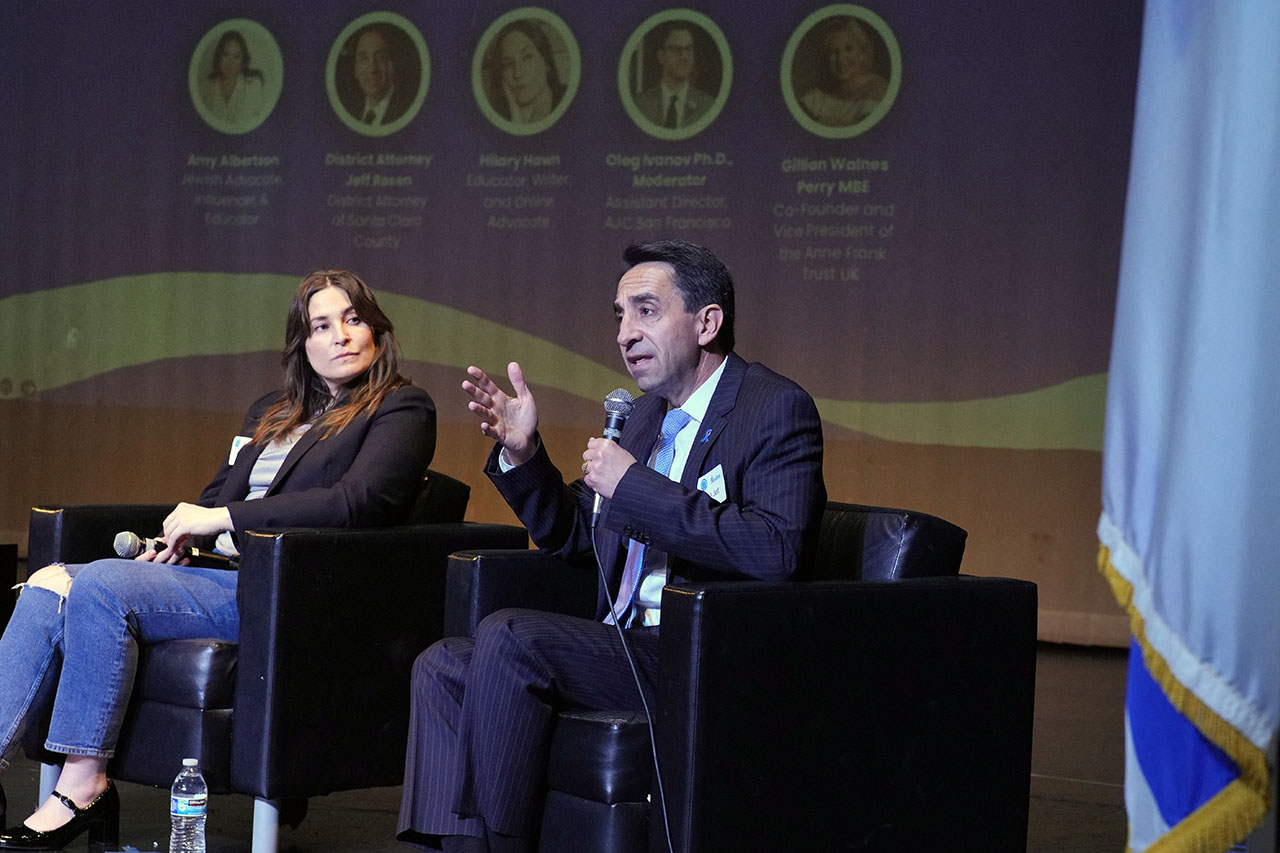
A month before the San Francisco talk, another event took place in Los Gatos in partnership with the American Jewish Committee that focused on antisemitism. Panelists included social media advocates and educators Amy Albertson and Hilary Hawn and Santa Clara County District Attorney Jeff Rosen, who discussed his work to curtail online hate and to pressure social media companies to take more responsibility for the content on their sites.
At the March event, Krigel said, he sensed the healing effect that the gathering had on his peers.
“One thing became clear to me,” he said. “We need to continue to share our experiences and learnings, both in order to better navigate work spaces and to continue to build Jewish community.”
Attendees ranged from social workers to tech executives — many fearing that their Jewishness at work could hurt their careers or even cost them their jobs.
One man anonymously shared with J. that he is filing charges for discrimination against Jewish employees at the government agency where he works; another said that his managers made antisemitic statements and have openly expressed that they don’t want to hire Israelis.
Rabbi Shimon Margolin, who leads the Russian-speaking Jewish Community of SF Bay Area, spoke at the March event about his experience as a refugee from the Soviet Union escaping persecution. Margolin said he never imagined that he would find a comparable level of antisemitism in the U.S.
His remarks were echoed by AJC regional assistant director Oleg Ivanov, who shared an example of the covert discrimination that his mother faced in the Soviet Union. Despite graduating with top grades, she wasn’t extended the same opportunities as her peers because she was Jewish.
“To think we are still not even one generation removed from quotas against Jews is profound,” Krigel told J.
Krigel suggested to attendees that anyone who believes they are experiencing discrimination at work should document every incident, even if they don’t immediately act on it. He also advocates for building bridges with peers by demystifying what it means to be Jewish.
To that end, Ivanov provided AJC’s corporate training guide that’s been used to educate organizations such as the FBI and the Golden State Warriors to understand both antisemitism and the Jewish experience.
Other groups are supporting young adults with similar events, such as Hadassah’s April event in San Francisco called “Tools for Tough Conversations in a Post October 7th World” and a private event last month in San Francisco organized by Dr. David Gendelberg, a physician in his 30s. He brought nearly a dozen Jewish young adults together in a private home where they practiced ways to respond to the more common attacks leveraged at Jews in person and on social media, such as “Israel faked those ‘atrocities,’” “Israelis are white settler colonizers” and “You’re calling everything antisemitic to shut us up.”
If a statement is blatantly antisemitic, Gendelberg said, he might quip: “That sounded better in the original German.”
But more often he will respond to the false, frequently heard tropes by asking for clarification and facts, by calling out people who hold double standards about Israel and by remaining calm even if someone raises their voice.
“People need to not just know the facts, but also practice engaging and responding,” Gendelberg said. “Being passive has never served us well in our history.”