

Why do so many chapters of the Prophets begin like Ezekiel 16:2, “Proclaim Jerusalem’s abominations to her”?
When I talk with people about prophecy, they mostly think of telling the future, but prophecy is often about the gritty present. No wonder most of the Biblical prophets were reluctant. No one wants to hear the truth of what’s happening around them.
As the rabbi for San Francisco Night Ministry, the unfortunate duty now falls to me of proclaiming the abominations of the city, particularly in the matter of homelessness.
The U.S. Supreme Court — which violates “Do not pervert justice” (Leviticus 19:15) almost daily — issued a ruling on June 28 in City of Grants Pass v. Johnson, endorsing the cruel and preposterous idea that people with no money may be fined for existing in a public place when they have nowhere else to go. Justice Neil Gorsuch wrote that Eighth Amendment protections against cruel and unusual punishment do not prohibit municipalities from punishing people for sleeping in public when they have no alternatives.
San Francisco has been forced by previous court orders to limit encampment sweeps, in which poor people’s belongings are confiscated (which is to say, stolen) by the government and thrown in the trash. But now, with the Supreme Court’s blessing, an unholy alliance of the cruel and the misguided in San Francisco is preparing more counterproductive sweeps as you read this.
It is impossible to take Judaism seriously without being kind to the poor:
“You shall surely open your hand to your poor and needy sibling.” (Deuteronomy 15:11)
“The fast I seek … is to share your bread with the hungry, and bring the homeless poor into your house; when you see the naked to clothe them.” (Isaiah 58:7)
And perhaps most importantly to our profit-maximizing society, “You shall not reap all the way to the edges of your field, or gather the gleanings from your harvest; you shall not pick your vineyard bare, nor gather the fallen fruit of your vineyard. You shall leave them for the poor and the stranger; I am God.” (Leviticus 19:9-10)
The commandments to care for the poor are too numerous to list here. The Torah could not possibly be clearer that it is our holy duty to provide for the poor, feed the hungry, ensure those who need clothes have them and provide housing for our unhoused neighbors.
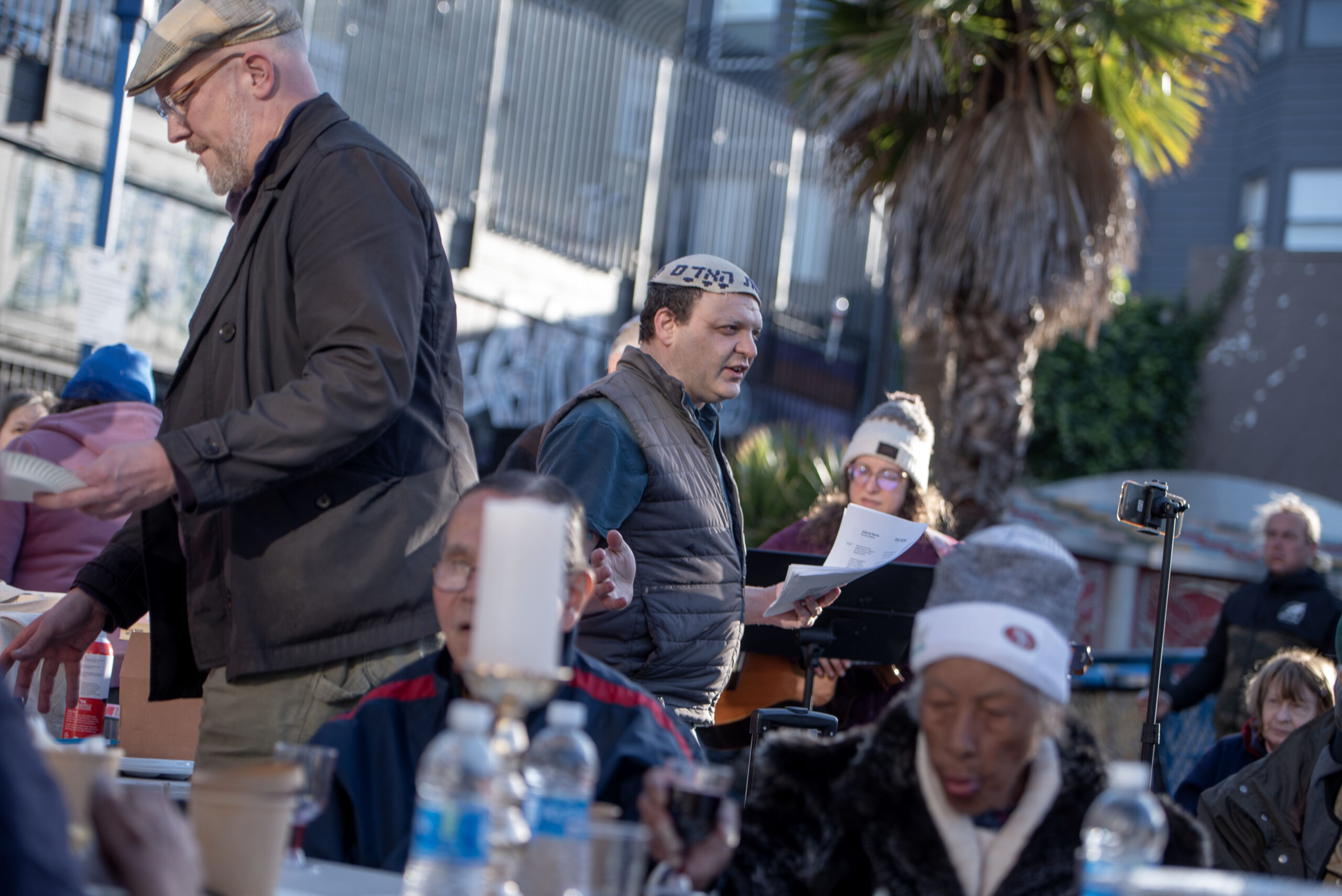
At 6 p.m. on the fourth Friday of every month, we host an Open Shabbat service at the 16th Street Mission BART plaza. With the help of our synagogue partners, we provide a free dinner for as many people in need as we can. We provide 60 to 125 meals each Open Shabbat, but the need in our city is bottomless. We welcome everyone: the unhoused, the marginally housed and the financially stable.

We’ve been hosting Open Shabbat for over two years, and a core of regulars from the Mission District community attend. We share the joy of Shabbat and break bread together as a community across differences of financial means. And we find out a lot about each other: Those of us who have stable housing, for example, learn what it’s like to have unstable housing or no housing.
Some people end up homeless after a financial setback such as losing a job. Untreated mental illness is another reason. After losing housing, it is impossible to stay on medication when your belongings with your medications get stolen every week. People cycle through our city’s mental hospitals. They get stabilized there and then are discharged back to the street, where they aren’t able to stay on their meds, and the cycle repeats.
This is a very expensive way to maximize human suffering.
San Francisco does not have enough shelter space to house everyone who needs it. Moreover, shelters may require couples to separate, are not designed to house families and often do not allow pets. Shelters, also, can be very noisy and can feel unsafe. So in addition to there not being nearly enough shelter beds, shelters are not enough.
The solution is housing — permanent, stable, affordable housing — where people can store their belongings without fear of theft, have relationships, marriages and pets, receive mail and create a place to call home. Building affordable housing and reducing market rents should be the top priority of this city. Property-owning corporations and landlords will complain, but San Francisco’s problems are the predictable result of policies that make the rich richer and the poor poorer. We need a change.
What we don’t need are more counterproductive and cruel encampment sweeps. These sweeps push the problem around while exacerbating the factors making it worse. Making poor people poorer by trashing their belongings will not solve homelessness.
San Francisco is a sinful city. I’m sorry to bear this prophecy, but look at our excesses and lack of caring. Look at our property values and our failure to support those in need. Look at our $100 nights out and 100 people waiting in line for food after Open Shabbat.
This is what we call a progressive city? I think not. This is a boom town where the rich get richer at the expense of the poor. High property values are a windfall for owners and a disaster for everyone else — and it is a sinful city that fails to reserve some of that windfall to benefit the poor.
The Talmud prohibits kicking a poor person out of housing without 12 months’ notice (Mishnah, Bava Metzia 8:6). And Ezekiel, who was told to proclaim Jerusalem’s abominations, said, “This was the sin of your sister Sodom … she did not support the poor.” (Ezekiel 16:49)
How much more sinful than Sodom are we if we make our poor poorer by taking from them what little they have.