

Books coverage is supported by a generous grant from The Milton and Sophie Meyer Fund.
“Jews are the People of the Book,” San Francisco author Michael Castleman told J. as a rationale for why his latest work should be reviewed in this publication. “Many Jews love to read — and many of them also write,” he said.
But that’s not the only reason.

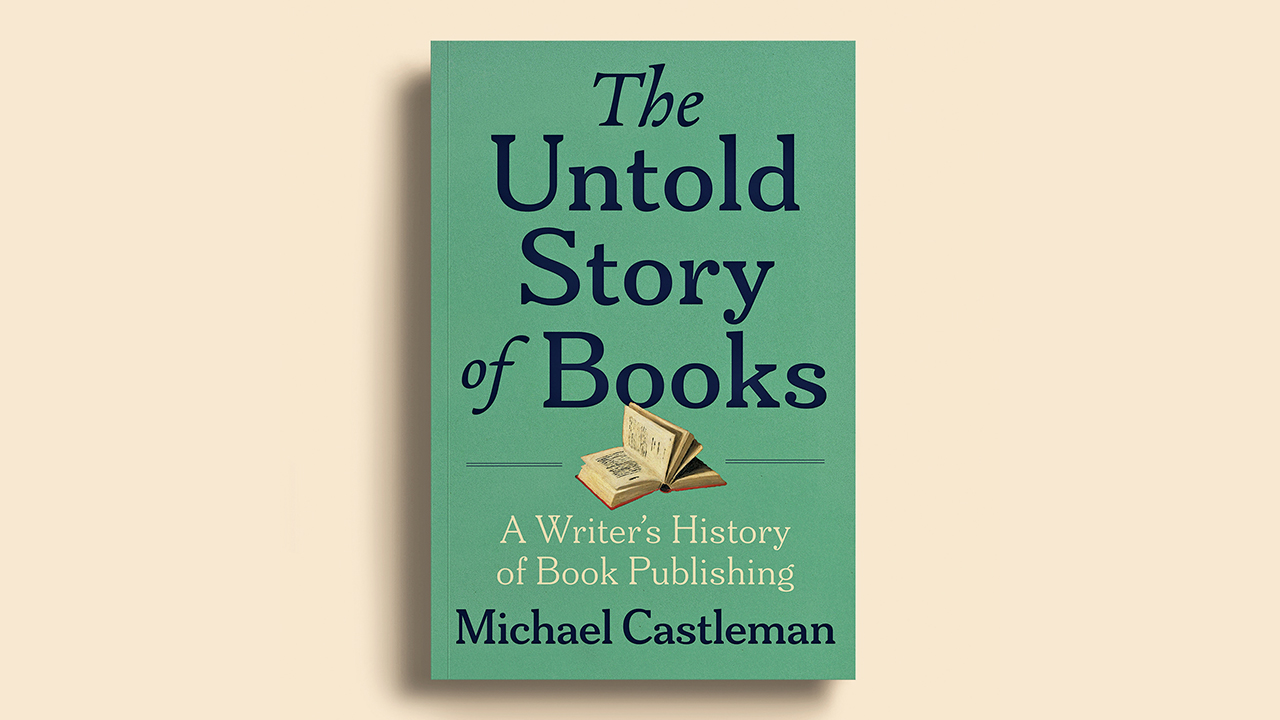
“Book people love books,” writes Castleman in his introduction to “The Untold Story of Books: A Writer’s History of Book Publishing,” his account of everything he’s learned about publishing in nearly five decades as an author and health writer.
And, he writes, “people who love books and reading are often curious about the publishing industry, which has been mythologized to the point where the truth often gets obscured. ‘The Untold Story’ fixes that.”
Castleman, a graduate of the UC Berkeley School of Journalism and member of San Francisco Congregation Am Tikvah, says he has sold more than 2.5 million copies of his 19 self-published books. “The Untold Story of Books” is his 20th.
Ergo, he might know a thing or two about the trade.
Writing in an affable, accessible style, he starts with a speed course in the history of books from handcrafted manuscripts to Gutenberg, mass production and the popularization of books in Europe and the Americas. Copyrights, the spread of revolutionary ideas, freedom of expression, censorship, the growth of the original big publishing houses, book piracy and exploitation duly followed the miracle of the printed word.
”Printer-publishers routinely underreported sales and underpaid royalties,” Castleman writes. “Authors railed about the unfairness and consoled themselves by focusing on personal satisfaction. They were published. They’d contributed to the culture, left tangible legacies.”
The principle of relevance made its mark early. In the mid-19th century, the schoolhouse primer known as the McGuffey Readers, credited for teaching America to read, satisfied the need for educational reading matter in rural areas across the country, and has sold at least 125 million copies.
“They’re still in print, a favorite of homeschoolers,” he writes.
And the first American novel to sell a million copies? None other than that abolitionist drama “Uncle Tom’s Cabin” by Harriet Beecher Stowe.
Part II speeds through the rise of public and home libraries, the debut of bestseller lists, the impact of movies, radio and television, and the rise of a new profession: book agents. The advent of advertising grew the industry, and then came the Great Depression, “which hammered publishing like nothing before or since,” he writes.
Enter Jason Epstein, who in the early 1950s “single-handedly transformed book publishing by inventing the trade paperback,” Castleman claims — not the penny pocket books of prior popularity, but quality paperbacks, which bridged the gap between the luxury hardbacks lining the personal libraries of elites, and editions affordable to the increasingly college-educated middle class.
Castleman rounds out his story with an exploration of publishing — and self-publishing — in the digital era. In the face of all the known issues facing writers today and the constant naysaying about whether people still like to read, guess what Castleman has to say about that?
There is still a future in it.
“Life unfolds like a good book,” he concludes. “We keep turning pages to see what happens next.”
Publishing wunderkind Jason Epstein shows up again in another new book, just out this month, which is an entirely different look at publishing from local legend Steve Wasserman, the Berkeley publisher since 2016 of the independent, nonprofit Heyday press. Heyday was founded by Malcolm Margolin in 1974.

Wasserman’s “Tell Me Something, Tell Me Anything, Even If It’s a Lie” is presented as “A Memoir in Essays” and comprises 30 previously published social and political essays.
Born in Oregon to left-wing, secular Jewish parents who moved to Berkeley in 1963, Wasserman was indisputably formed by the social and cultural movements of that place and time and, he writes, by the books he read and the writers who wrote them.
“Geography is fate,” he states in his introduction, then goes on to detail the numerous influences, from Moe’s Books on Telegraph Avenue (where its proprietor, Moe Moskowitz, mentored his reading choices), to the Free Speech Movement and Vietnam War, that led him from one chapter to the next in his eminently engagé life. “Moe was my strictest teacher and the one to whom I owe the most,” he writes.

The title quote is taken from his extensive piece about Cuba, which he has visited 10 times since 1970. In his 2010 visit, an aging Cuban writer-friend, whom he describes as something of a reluctant, state-sponsored intellectual, welcomes Wasserman’s return with that ambiguous line, wearily suggestive of compromise.
Other essays discuss the early imprint of a left-wing Jewish summer camp he attended as a kid, his development as a progressive activist, personal intersections with such literary luminaries as Susan Sontag, Gore Vidal, W. G. Sebald and Christopher Hitchens, and with activists Tom Hayden and Daniel Ellsberg.
Epstein, the Random House publisher and a friend of Wasserman’s, comes in through a delightful anecdote about how Epstein took on the years-long task of editing the late Benzion Netanyahu’s 2,000-page tome about the Spanish Inquisition, only to have the author, the father of Israeli Prime Minister Benjamin Netanyahu, reject his edits outright. I won’t spoil the story’s punchline, but it involves “the best four words in the English language,” Wasserman writes.
He also had occasion to meet film director Orson Welles and to interview Hans-Jurgen Syberberg, the director of the seven-hour 1977 film “Hitler: A Film from Germany.”
Wasserman concludes his autobiographical intro by labeling himself “a talker, not a writer.” He is “too lazy” to be a writer, he says, “not smart enough … or original enough.”
I found these protestations disingenuous, for aside from his excessive name-dropping, he is a fine writer, offering a wealth of context to every subject, and a vocabulary to die for.
Yet he is not sorry to have made his name as a publisher of other people’s work.
“I found joy in learning from the many authors I came to know,” he writes, “engaged in a mutual dialectic of discovery, shaping and sharpening ideas that matter.”
“The Untold Story of Books: A Writer’s History of Book Publishing”
By Michael Castleman, (The Unnamed Press, 270 pages).
“Tell Me Something, Tell Me Anything, Even If It’s a Lie: A Memoir in Essays”
By Steve Wasserman (Heyday Books, 384 pages).