
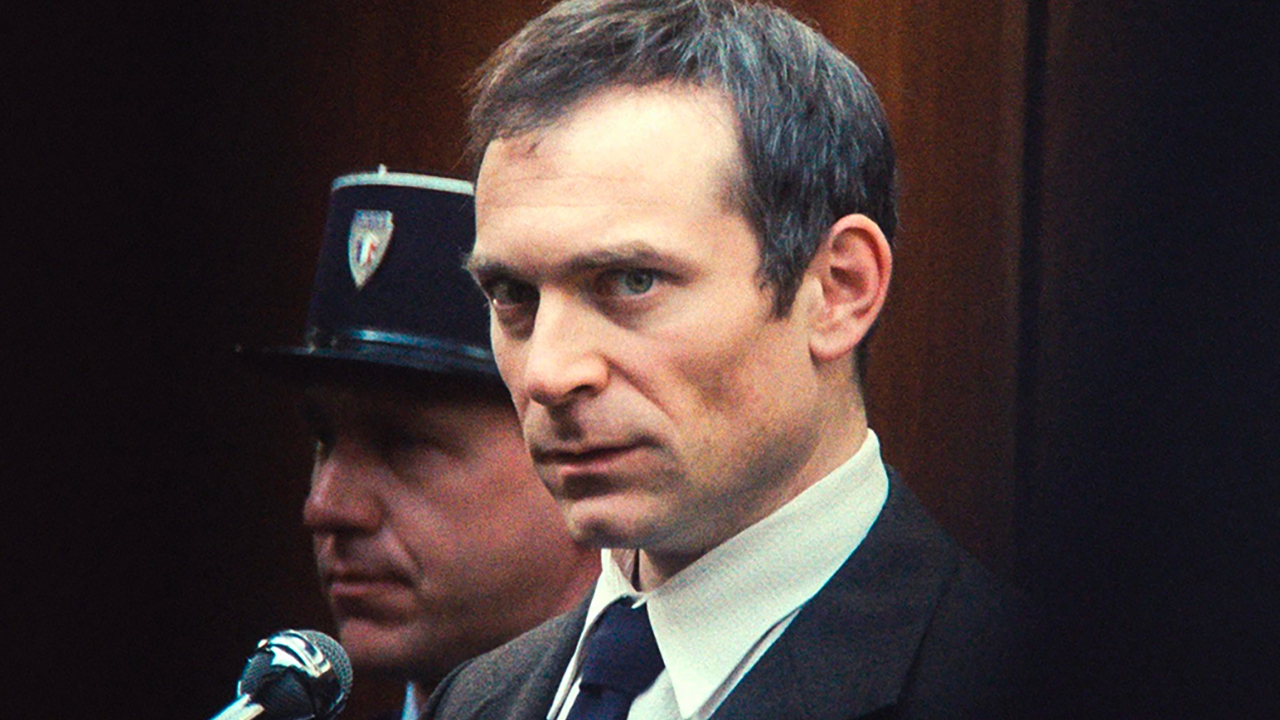
Before we meet the French Jewish defendant in “The Goldman Case,” we learn that he is a brilliant, articulate nightmare for his frustrated Jewish lawyers as they discuss how to save him from himself — and the death penalty.
The mesmerizing French courtroom drama, based on events that took place during the tumultuous France of the late 1960s and ’70s, premiered at Cannes in 2023 and screened at the San Diego International Jewish Film Festival eight months ago. It opens in San Francisco and San Rafael on Oct. 23.
In the spring of 1976, the notorious left-wing loner Pierre Goldman, a would-be revolutionary and actual petty criminal, has been granted a new trial. Previously convicted of the 1969 shooting of two Paris pharmacists in addition to three other armed robberies, Goldman copped to the latter crimes but proclaimed his absolute innocence in the murders.
His 1975 best-selling prison memoir, “Souvenirs obscurs d’un juif polonais né en France” (“Obscure Memories of a Polish Jew Born in France”), was embraced by philosopher-playwright Jean-Paul Sartre, actress Simone Signoret, various factions of the vocal left and French immigrants of color. They believed that prosecutors were politically motivated in their efforts to convict him.
Before the sensational retrial began, Goldman (Arieh Worthalter) wanted to dismiss his principal counsel. He rejects the redoubtable Georges Kiejman (Arthur Harari) as an “armchair Jew,” that is, someone who doesn’t publicly acknowledge his identity, especially since Goldman believes that antisemitism is pertinent to his case. Fortunately for Goldman, Kiejman doesn’t abandon him.
A guilty verdict means the death penalty (France only outlawed capital punishment in 1981), so Kiejman is deeply invested in — and the viewer is rooting for — Goldman’s innocence.
Veteran writer-director Cédric Kahn skillfully employs the familiar courtroom-movie approach of interrogating the credibility of the witnesses, from the cop shot trying to stop the killer to a young woman who was bumped into at the crime scene to Goldman’s erstwhile friend and alibi Joël Lautric.
Goldman proves charismatic but difficult to like. Impulsive and paranoid, he is single-minded in his demand that the judge and jury focus solely on the facts of the incident, rather than Goldman’s family background as heroes of the French Resistance, his psychologically unstable adolescence, and his efforts to join revolutionary movements in Venezuela and Cuba.
He is uncontrollable, arguing with the prosecutor and attacking the reputation of the police, unequivocally labeling them as fascists and racists. A contingent of the French Black community and white social dissidents attending the trial loudly vocalize their support for his views.
Except for the opening sequence in Kiejman’s office and a couple of scenes in Goldman’s holding cell, the film unfolds entirely in the courtroom. Fortunately, the French justice system allows a more intense, back-and-forth style of cross-examination and debate than do U.S. courts, infusing the film with anger, wit and pace.
As the trial progresses, we see the unfolding fate of one deeply troubled man in a much bigger context: lingering French guilt for collaborating with the Nazis in the Final Solution and respect for the Jews (such as Goldman’s father) who joined the Resistance.
“The Goldman Case” is a subtle commentary on the place and perception of Jews in postwar French society, as well as that of Africans and Arabs in the wake of the Algerian War.
To be sure, the film is not speaking solely about mid-1970s France. It isn’t a coincidence that Kahn made this impassioned movie during a period when antisemitism was (is) on the rise in France.
Nor is it mere chance that “The Goldman Case” follows “J’accuse” (“An Officer and a Spy” in English), Roman Polanski’s acclaimed 2019 film (unseen in any U.S. theater, to my knowledge) about the wrongfully convicted French Jewish officer Alfred Dreyfus.
Beautifully acted and stunningly written and edited, “The Goldman Case” succeeds completely as taut entertainment. The film’s probing of Jewish identity in France and the multigenerational impact of the 20th-century European Jewish experience is just as compelling.