
Food coverage is supported by a generous donation from Susan and Moses Libitzky.
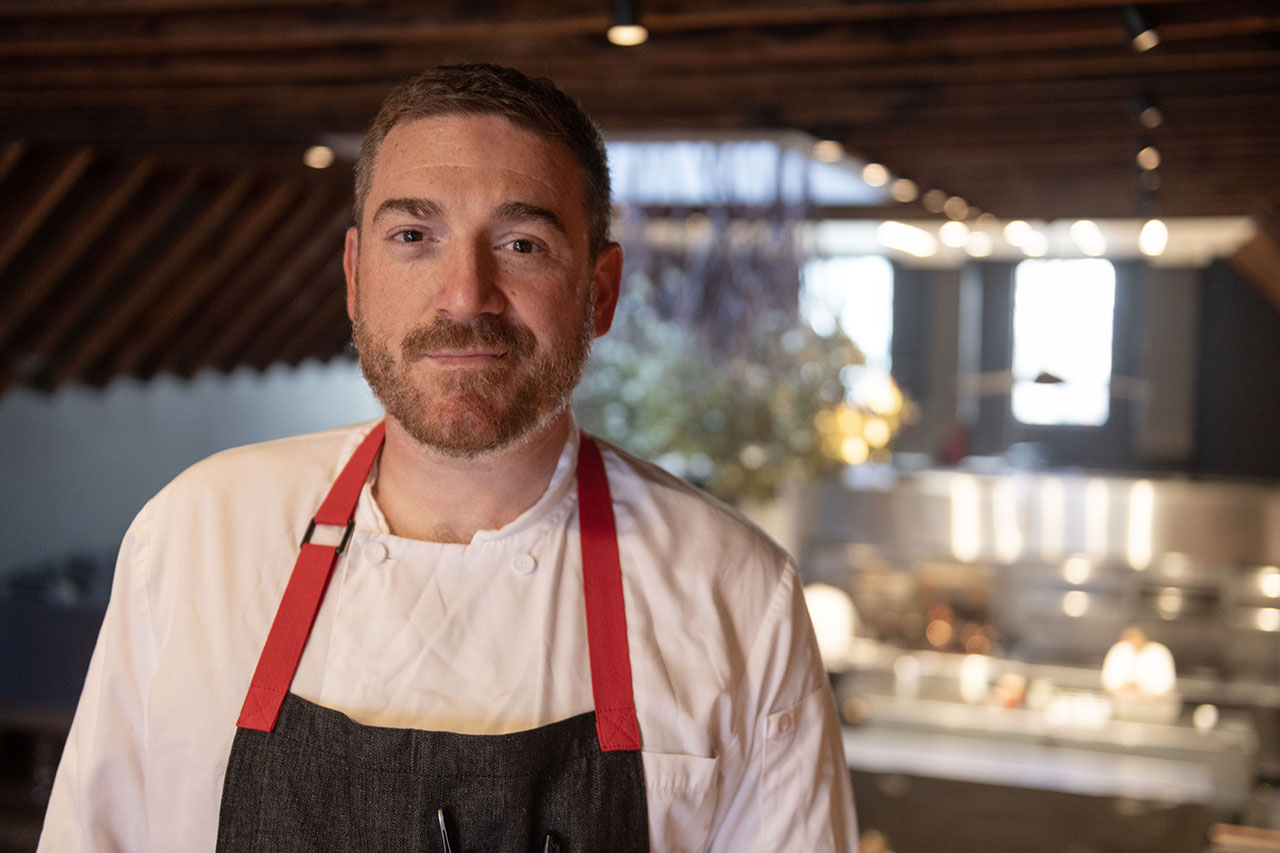
When you’re a Michelin-starred chef celebrating the 10th anniversary of your restaurant — which started when you were an out-of-work lawyer throwing underground dinner parties in your own apartment, with dirty dishes stacked in the bedroom and a dead goat on ice in the bathtub — one might think the story had already been told so many times that a reporter would have difficulty finding her angle.
Not this time.
Chef David Barzelay’s Jewish story is nearly as compelling as the story above, which is the origin story for his San Francisco restaurant Lazy Bear.
The main difference is that the Jewish backstory hasn’t been shared publicly … until now.
The Mission District restaurant — which earned one Michelin star the first year it was eligible and then got two the next year — has just reopened after an extensive renovation. Gone are the communal dining tables; Barzelay, who is also a woodworker, cut them away himself, transforming them into smaller tables. Most of the changes are in the kitchen, though, to make service more efficient.

While Barzelay said that he felt they had done the communal experience as well as it could be done — guests were encouraged to go into the kitchen and watch the chefs as they plated food — the redo “presented so many new opportunities to stretch our legs and learn and grow and push ourselves,” Barzelay said. “Maybe now, we are a bit more of a regular fine-dining restaurant.”
While all guests used to start upstairs with cocktails and appetizers, now some start upstairs for the pre-meal, while others go there later for dessert.
“It’s like you get a change of venue,” he said.
Barzelay, who has been on my radar for a long time, says Jews know his surname as a Jewish one; most non-Jews haven’t a clue. It was his wife who came up with the restaurant name Lazy Bear, an anagram of his name.
Barzelay grew up in Tampa, Florida. His paternal grandmother made blintzes and her own bagels. Grandma didn’t know much about working with yeast, though, so her bagels were pretty terrible, “rock hard,” he recalled — but those are the bagels he came to know and love.
He didn’t know them as Jewish food. He didn’t know he was Jewish at all.

“My grandparents were very typical Jews in so many ways,” he said. “I just didn’t know it because I didn’t grow up around other Jews.”
It was only when he was on his way to his freshman year at college that his grandmother said aloud for the first time that she attended synagogue as a child. As she aged, she wanted to reconnect with that side of herself, and uttering that sentence was the beginning of her own journey toward reclaiming it.
This was news to Barzelay, and propelled him on a journey of his own.
His paternal grandfather’s family was composed of Sephardic Jews from the Iberian Peninsula, and his paternal grandmother came from a family of diamond merchants in Antwerp. Her family fled Belgium on the eve of the Holocaust, but the rest of their family was wiped out. So traumatized were they that they decided that they would never tell anyone they were Jewish after reaching America.
“Both my grandparents were terrified until the day they died that it was going to happen again,” he said.
Learning his family’s story right before starting college was fortuitous timing. When he got to Vanderbilt University, he was curious enough that he started gravitating toward his Jewish peers.

Before the discovery, he had always felt a certain appreciation for Jewish comedians. Now that took form in his seeking out Jewish friends and professors.
“I was very into math and physics and philosophy,” he said, connecting those subjects to Jewish excellence. “Now it made sense why.”
He hung out at Hillel every now and then, and even went on a Birthright trip to Israel before graduating.
Today, the 41-year-old chef is married with three children. While he wasn’t specifically seeking a Jewish woman to marry, that’s who he fell in love with.
“For the most part, I don’t know the holidays, but I feel an affinity with it and am proud of being Jewish,” he said.
Hanukkah is his family’s favorite Jewish holiday, and latkes are among his favorite of Jewish holiday foods. They have even occasionally made it onto Lazy Bear’s menu — more likely served with trout roe or lamb bacon and a quail egg on top than with applesauce or sour cream.

Barzelay began cooking early with both his mother and grandmother. In Jewish cooking one can find “some real gems,” he said, mentioning smoked fish spread and brisket. He also lapsed into a discussion about tricks to make better latkes — such as frying them twice at two different temperatures — though most home chefs would have trouble following all of the steps.
When asked about whatever luck — or magic — it takes to make 10 years in the city’s ever-fickle restaurant business, Barzelay said he was simply following through with his plan.
“We started out with a 20-year lease,” he said. “I was always setting out for it to become a part of the fabric of San Francisco dining, and part of what makes the city unique.”
And as for ever getting a three-star Michelin rating? Is it something he hopes for?
“We’ve never done anything to try to get a Michelin star or two or three,” he said. “I don’t believe you can really do that, as you don’t know what they want.”
Emulating places with stars is a surefire way to “make your place less distinctive and less worthy of a star,” he said. All you can do is “make it better according to your own standards and hope they agree.”