

Shocked and disheartened by the result of the presidential election, Bay Area Jewish liberals are trying to come to terms with another Trump win and grieving the end of a once-promising campaign season. Meanwhile, Jewish supporters of the 45th president are celebrating his return to the White House and what it might promise for Israel.
Kamala Harris, who was born and raised in the East Bay and entered politics as San Francisco’s district attorney, came to symbolize a fresh start for Jewish liberals in California. Many of them grew excited about the prospect of electing the first woman and the first woman of color to the presidency, especially one they believed had shown strong support for Israel as vice president and whose husband, Doug Emhoff, is Jewish. Harris won broad support among American Jews in general and California Jews in particular.
What some predicted would be a Jewish flight from the Democratic Party over concerns about antisemitism or Israel didn’t exactly materialize, even as a solid minority supported Donald Trump. Many backers cited the belief that Trump proved himself a strong supporter of Israel; they linked Harris to anti-Israel sentiment within parts of the Democratic Party.

An NBC exit poll showed Jewish support for Harris at 78% vs. Trump at 22%. Another commissioned by liberal pro-Israel group J Street found that Harris won 71% of the Jewish vote compared with 26% for Trump, which is in line with national averages dating back to the 1960s, according to Haaretz. A Fox News voter analysis showed a lower percentage for Harris at 66% of Jewish voters, compared with 32% for Trump.
Yet her bid for the White House ended in convincing defeat on Nov. 5, leaving Bay Area liberal Jews dazed, shocked and ultimately concerned and uncertain about what Trump’s second presidency will mean for American Jews and for Israel, multiple people told J. over the past week.
Offir Gutelzon of Palo Alto, an Israeli American with dual citizenship, co-founded a group called Israeli-Americans for Kamala and voted for her. Prior to Oct. 7 of last year, he spearheaded pro-democracy, anti-Benjamin Netanyahu protests worldwide through a group of Israeli expats he co-founded called UnXeptable.

Even though Trump enjoys broad support among the Israeli public, Gutelzon said, he views a future Trump presidency as rife with uncertainty when it comes to the U.S.-Israel relationship because Trump has flirted with both isolationism and support for bad actors on the world stage.
“America First, to me, means Israel Later,” Gutelzon told J. on Nov. 6. “America First means that he works with Russia, he works with Iran.”
Gutelzon acknowledged that Trump, because of his track record dealing with Saudi Arabia, may be able to “force Netanyahu to do something” that would increase the chances of peace in the region. But overall Gutelzon pointed to an unpredictable element of Trump’s foreign policy that he felt makes Trump a much more wobbly choice for Israel than Harris.
“If he doesn’t help Ukraine, why would he help Israel?” Gutelzon said, noting that Vice President-elect J.D. Vance represents an isolationist strain of the Republican Party.
Among the Bay Area’s Jewish Trump supporters is Zvi Alon, a Los Altos Hills venture capitalist and philanthropist. Alon said he was “ecstatic” on election night, telling J. that he has strongly opposed, for example, the Biden administration’s pressure on Israel during the Israel-Hamas war, such as pressuring the IDF not to enter Rafah.

“The change is very good and positive,” Alon said of Trump’s victory. “Not only for Israel. For the U.S. and for the world.”
The Bay Area is a liberal stronghold in which Trump-supporting Jews have at times felt the need to hide their political preferences. By contrast, liberals have shared their strong reactions to the election result publicly. Some synagogues, for example, held community gathering sessions to process what had just happened.
At Chochmat HaLev, a Renewal synagogue in Berkeley, almost 200 people gathered the night after Election Day “to hold each other in song, prayer, meditation, ancestral wisdom, and sharing,” according to an email from Zvika Krieger, the synagogue’s spiritual leader.

“It’s been a hard week,” Krieger’s Nov. 7 email began. Referencing the month of the Hebrew calendar, “MarCheshvan is not a time for naive optimism,” Krieger wrote. “It’s the reminder that the arc of history is long, and that today’s tears may be the water for tomorrow’s possibilities.”
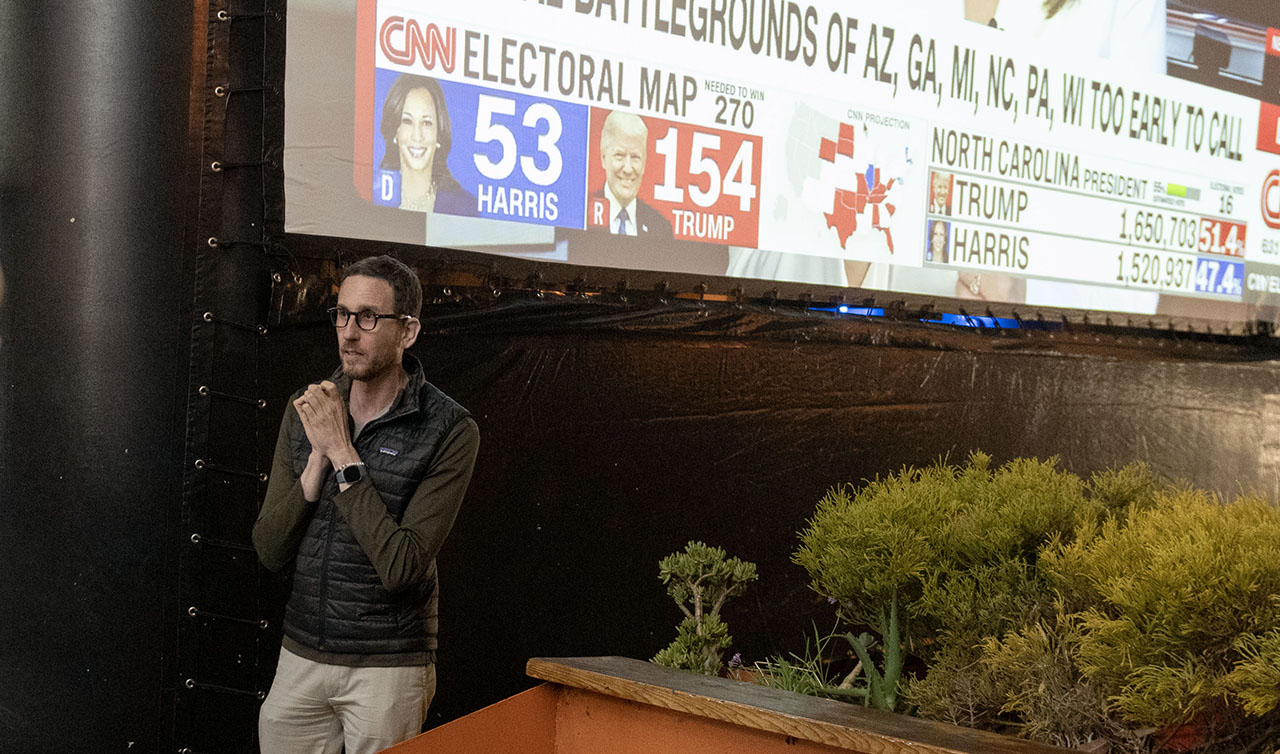
Democratic state Sen. Scott Wiener of San Francisco, who won his re-election bid with 78% of the vote against a Republican challenger, told J. that he was “devastated” by the result of the presidential election.
“So many core values that I and others hold dear — around democracy and reproductive health and LGBQ equality and health care access and climate action — he’s going to be a disaster for so many of these things,” Wiener said.
He added that the election result should push the Democratic Party to do some soul-searching.
“The strength of the Democratic Party, for so many years, was that it was a big tent party,” he said. Wiener pointed to weakness with working-class and non-college-educated voters and to the party’s loss of the popular vote. “We’re at risk of losing that,” he said of the Democrats’ “big tent” appeal. “And we must never lose it.”
Jan Reicher, board president of the Jewish Community Relations Council Bay Area, volunteered and donated to the Harris campaign. She said the election result left her feeling “numb.” Reicher is also still processing all of the challenges that the U.S. and the Jewish community will be facing all at once, she said.

“There is so much to hold right now between the rise in antisemitism, what’s going on in Israel,” and an election result that she found disappointing and concerning.
“I felt like yesterday was a day of mourning,” she said on Nov. 7, adding that “today, we go back and continue our work.”
On Israel, Reicher said she felt confident that Harris would have been a “good friend” of the Jewish state. With Trump, she isn’t sure.
“There was a track record from his last presidency, but things have changed dramatically since then. … We hope that he’ll be great,” she said, but “we don’t know.”