

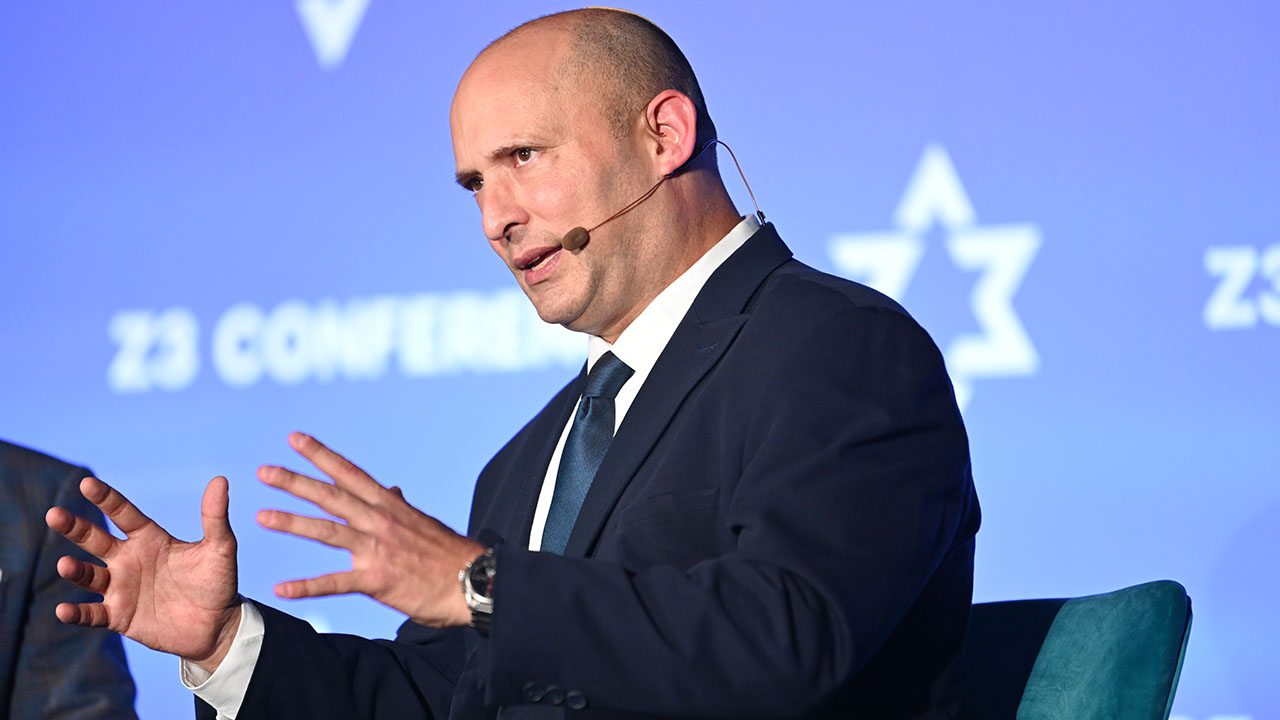
Former Israeli Prime Minister Naftali Bennett was speaking to a hometown crowd at Sunday’s Z3 Conference: Born in Haifa to American parents who made aliyah from San Francisco, he spent his boyhood summers in the Bay Area.
Bennett’s fluency in English and American culture puts him at ease with U.S. audiences. That was true in Palo Alto, where the standing-room-only crowd at the closing session of the annual diaspora-Israel conference at the Oshman Family JCC welcomed him warmly, laughing at his jokes and giving him a standing ovation at the end.
Bennett, 52, who served as prime minister for slightly over a year in 2021 and 2022, retired from politics to return to the high-tech world where he made his fortune, but this fall was reported to be considering a return to politics — something he floated, if fleetingly, at Z3.
Responding to JCC CEO Zack Bodner’s idea of a joint gap-year program for Israeli and American Jews, he said with a broad grin, “I love it. I’ll recommend it to the next prime minister.”
Bennett lost no time before attacking the current government led by longtime rival Benjamin Netanyahu.
The Oct. 7, 2023, Hamas massacre in Israel represented a “colossal, epic failure of the State of Israel” that Bennett called “unacceptable.”
What we need in Israel is a Zionist, liberal unity government, religious and secular, for the next 10 years. Naftali Bennett, former Israeli prime minister
“We failed in our fundamental mission, to protect Jews from pogroms,” he said. “It was a failure of intelligence and operations, then a total meltdown” of critical infrastructure. “We need to be clear-eyed about our failure in order to fix it.”
He has ideas about how to do that.
“What we need in Israel is a Zionist, liberal unity government, religious and secular, for the next 10 years,” he said.
Although Bennett didn’t directly answer the question about running for prime minister, he did say he had “learned his lesson” last time about the importance of keeping coalition partners happy in order to stay in power. Quoting former U.S. President Lyndon B. Johnson on that score, he said, “Better to have everyone in the tent, pissing out, than outside….” He trailed off, to great laughter.
Bennett reiterated his public position that Israel’s ultra-Orthodox Jews, or haredim, should hold jobs and serve in the army, calling their longtime exemption from either role a “crazy business model that can’t sustain itself.”
A million haredim entering the workforce would have the same galvanizing effect that the immigration of a million Russian-speaking Jews had in the early 1990s, he said. Just as that aliyah “fueled 30 years of Israel’s growth,” so the “internal aliyah” of the ultra-Orthodox will accomplish the same for the next 30.

Calling Donald Trump’s return to the presidency an “opportunity” because of his “unexpectedness,” Bennett praised the Abraham Accords — mediated and signed during Trump’s first presidency — for opening Israel’s path to a new position in the Middle East. He called for doubling down on efforts to bring Saudi Arabia into the fold, even as he maintained that it’s time for Israel to hit Iran hard.
Noting that Israel took out all five of Iran’s air defense systems in its latest attack in October, he said, “They will regroup, so we need to knock them out now — hit the regime with ongoing, persistent strikes on their nuclear program to topple the regime before they acquire a nuclear weapon.”
Bennett spent much of his talk praising young Israelis for showing courage and selflessness in the wake of Oct. 7. He told the story of a 21-year-old female tank commander who drove her tank 30 miles to the Gaza border and blocked a breach in the border fence, saving two kibbutzim from attack.
“On Oct. 7, thousands of reservists got in their cars and drove to the Gaza envelope, before they knew what they were getting into,” he said. Some had rifles, some had nothing. “Together with some soldiers and police, they went into battle and prevented a much bigger catastrophe. Many lost their lives.”
“Before Oct. 7, a lot of us, myself included, wrote off the younger generation as softies. But this is our greatest generation,” he said, using the term that describes Americans who fought in World War II.
“That’s Israel,” he stated. “Lousy leadership, amazing people.”
And if Israel were a company, he asked rhetorically, what would someone do?
“Change the leadership,” he concluded.