

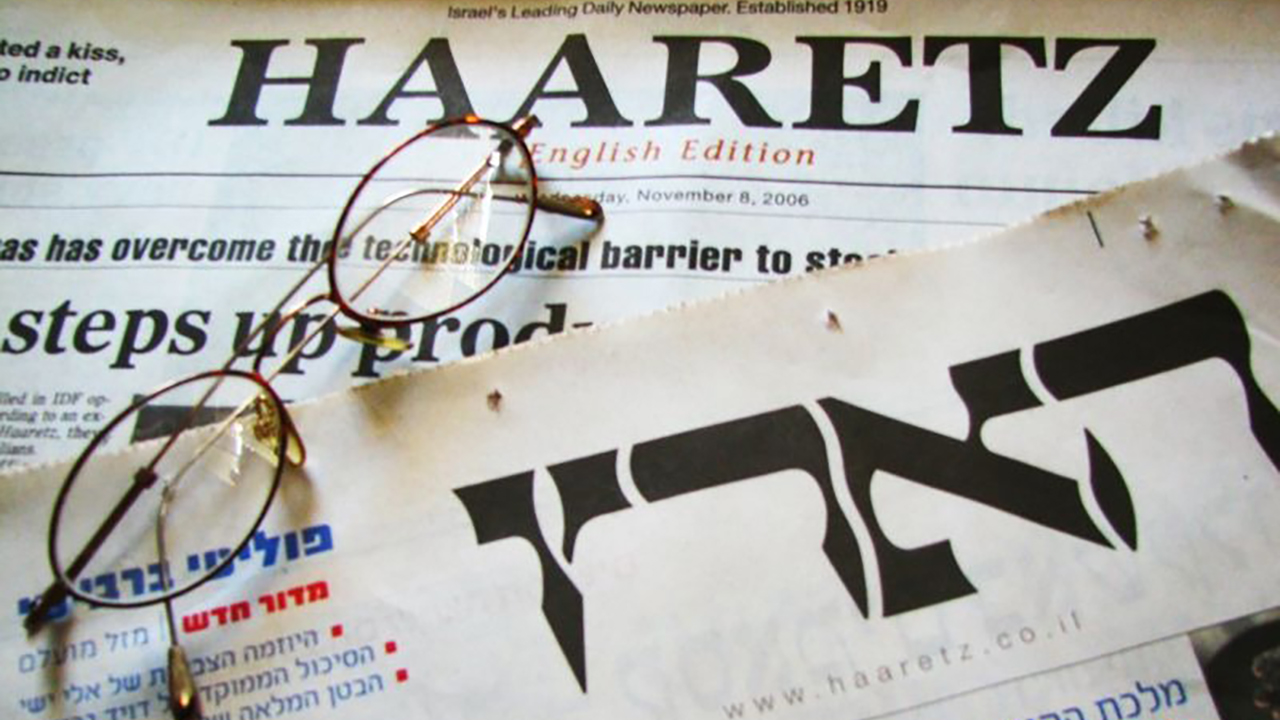
Israel’s cabinet unanimously approved a proposal on Nov. 24 to sanction the Israeli daily newspaper Haaretz. Under the resolution, no government body may communicate with Haaretz or place advertisements in the paper.
These sanctions provide a warning to all of us who care about democratic freedoms — and a lesson for those few of us who lead news organizations.
First, the lesson.
For years, Prime Minister Benjamin Netanyahu’s government has objected to Haaretz’s coverage. Investigations by Haaretz into the charges of corruption against Netanyahu himself were cited by the prosecutor in the case as recently as this week. Opinion pieces in the newspaper have been critical of the conduct of the war in Gaza. Haaretz is generally understood to come from a left-leaning perspective.
So why did the Israeli government sanction Haaretz now?
On Oct. 30, Amos Schocken, the publisher of Haaretz, made a set of extraordinarily controversial statements at a Haaretz event in London. He claimed that the Netanyahu government was “imposing a cruel apartheid regime on the Palestinian population.” He called the war in Gaza a “second Nakba” — Arabic for “Catastrophe” and a reference to Israel’s War of Independence. And Schocken called for countries to apply sanctions against Israel.
Most shockingly, he said that the government “dismissed the costs of both sides for defending the settlements while fighting the Palestinian freedom fighters, [the people] that Israel calls terrorists.”
Schocken later clarified that he did not include Hamas in this sweeping statement. “As for Hamas,” he said, “they are not freedom fighters.” Then he reiterated that he is a Zionist who believes Israel will only be secure once a Palestinian state is established.
It is beyond me how he could make a reference to “freedom fighters” when Israel has primarily been fighting Hamas, a terrorist organization that clearly does not care one whit about the Palestinian people. Schocken’s words go far beyond the mainstream understanding of this war in either Israel or the United States. But let’s set aside what Schocken actually thinks.
The trust a journalism organization builds with its community is based on trust in the accuracy and dedication to truth of its editorial staff. The job of a journalism organization is to ensure that whenever a controversy within the community arises — whether it is something relatively small, like the firing of a rabbi, or something of global importance, like the conduct of a war — that the journalists reporting on the news can be trusted to be open, transparent and accurate in what they report.
As the CEO of J., I know that in conducting the business of a journalism organization, the first principle of a news executive must be to preserve the community’s trust. This is where Schocken went wrong. News executives make news at their own peril, because one consequence is that the community will then question the accuracy and honesty of the reporting. Great news executives understand this.
I call on my peers in the Israeli and Jewish American press to join me in speaking out against the Israeli government’s sanctions of Haaretz.
Most of the time, as a news executive, it’s important that I stay silent, even on issues I care very much about. That is because the most important job I have is to protect the integrity of our journalism. This is the lesson that Schocken needs to learn.
That said, there are times when news executives should speak out. This is one of them. As a journalism leader, one of my roles is to protect the freedom of the press so our journalists can do their work.
I call on my peers in the Israeli and Jewish American press to join me in speaking out against the Israeli government’s sanctions of Haaretz.
So that’s the lesson. Here’s the warning.
I work in journalism because I believe passionately that a free, independent press is essential for democracy. Among the essential functions of the press in a democracy is to provide all of us with accurate and transparent information about what our government does. Reporters uncover truths a government may not wish to be known. Journalists hold power accountable.
As the Israeli investigative journalist Ilana Dayan said in a speech when she recently received a Weizmann Institute prize, “Our real job is not just to cover demonstrations or press conferences but it’s to go to the places that no one wants us to go, to go to the places that are dark and hidden, and light a torch to make sure that people see.”
As an advertiser, the Israeli government is free to pull its ads from Haaretz if officials don’t like the news coverage. They can criticize Haaretz. But by banning government officials from communicating with Haaretz journalists, the Israeli government is trying to prevent reporters from doing their job.
This ban crosses personal and professional lines for me. In full disclosure, my second cousin, David B. Green, is a Haaretz columnist and longtime senior editor there. Haaretz is also a J. partner. Our newsroom trusts Haaretz’s reporting, and Haaretz trusts ours. We have run Haaretz stories, and Haaretz has run ours. We’re proud of that relationship. Haaretz is recognized in Israel and outside it as a top journalism publication. Haaretz reporters have won all of the top Israeli press awards, including the Israel Press Institute Prize, as well as awards from international journalism organizations.
Most importantly, as a Jewish American, I’ve taken pride in the fact that Israel is the only democracy in the Middle East. Democracies are values-based governments. Often, leaders in democracies must do what is right rather than what would offer them the most power. This is hard.
Cutting press freedom is often one of the first breaches of a democracy. I was in Turkey in 2014 for the Internet Governance Forum and talked with journalists who would soon be arrested for reporting on government crackdowns. That was the start of Turkey’s slide from a robust democracy into what Chatham House generously calls a “flawed democracy” and Freedom House categorizes as a political system that is “not free.”
While preventing Haaretz reporters from speaking with the government may not immediately impact Israel’s democracy — Israel, thankfully, has a robust media ecosystem and other outlets will continue to cover the government — censoring the press is a warning sign that a country is ready to buck democratic values. We need to take that seriously, in Israel and here at home. In the U.S., we too have begun to see how tenuous preserving a democracy can be.
If Schocken’s outburst is a lesson for news executives, Israel’s action is a warning to us all. The muted response to Israel’s sanctions — and, in essence, censorship — of Haaretz shows what a chilling effect a state’s actions can have on journalism. It’s a warning about the fragility of democracy that we should all heed.
Jo Ellen Green Kaiser is the CEO of J. The Jewish News of Northern California.