

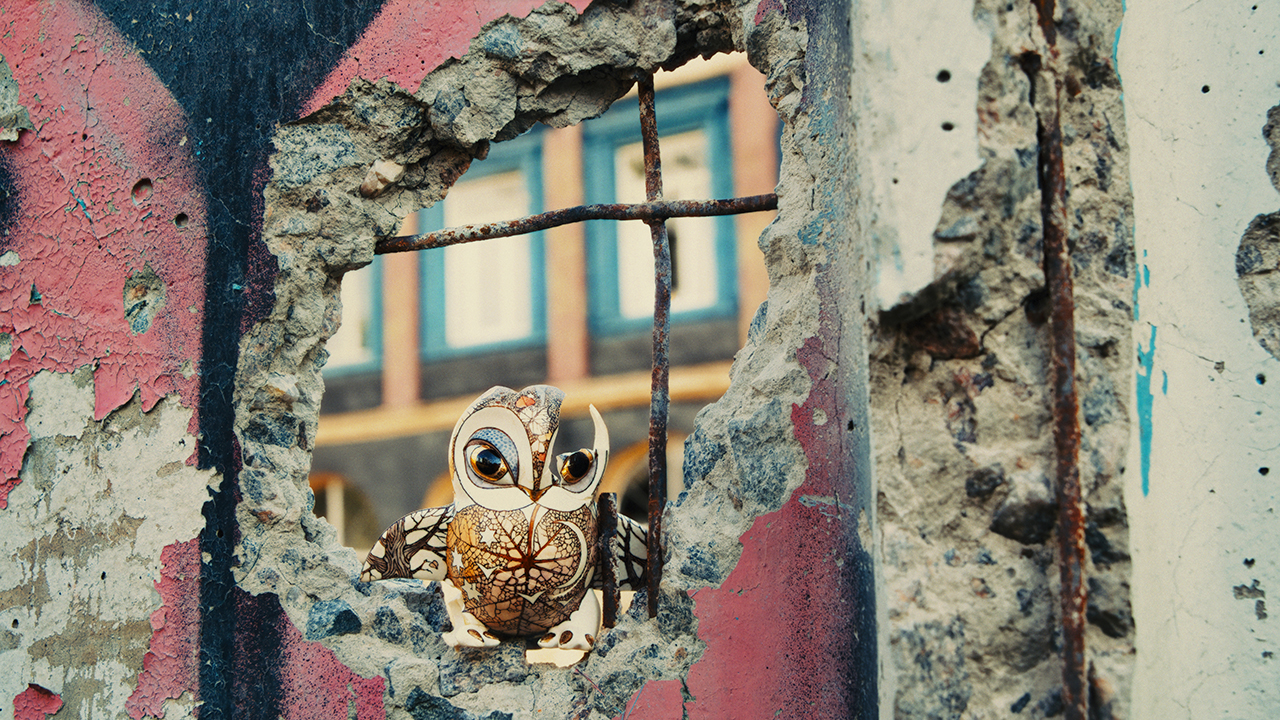
“Porcelain War,” a new documentary about Ukrainians who use guns and art to resist the 2022 Russian invasion of their homeland, opens with a likable middle-aged couple strolling in the fields on the outskirts of Kharkiv.
They converse, or are silent. They sit, or walk holding hands. They observe nature and capture with their cameras what they observe: wildflowers, butterflies, dragonflies. Their little terrier romps around them, poking its head up out of the tall grass.
The next thing you know, they are navigating the rubble of a Kharkiv neighborhood demolished by Russian missiles, gunfire and tanks.
The couple still lives there, in a small house not yet destroyed, and holds out in the incalculable hope that Ukrainian autonomy will prevail. The word “yet” is ever present in their minds, as they reveal.
The couple, Slava Leontyev and Anya Stasenko, are childhood sweethearts, co-creators of original porcelain art and — by force of circumstance — resistance fighters.
By day, Leontyev, a former member of the Ukrainian Special Forces, trains civilian recruits in weaponry. Then he goes home to his wife and sits down beside her to fabricate whimsical figurines that she paints with exquisite skill. They might be snails, baby owls or appealing little dragons that fit in your palm. Each also bears vibrant scenes of life in intricate detail.
“We’re ordinary people,” Leontyev explains, “in an extraordinary situation.”
Later we meet their friend Andrey Stefanov, a painter and fine art photographer from a town in Crimea, the former Ukrainian region overtaken by Russia in 2014 in a precursor to the current war.
Due to the entreaties of a Los Angeles filmmaking couple, Brendan Bellomo and Polish-born Aniela Sidorska, the Ukrainian couple and their friend became the subjects as well as co-creators of this 90-minute film.
The documentary, which is garnering Oscar attention, won the 2024 Sundance Festival Grand Jury Prize. It also earned the Audience Award for Best Documentary Feature at the 2024 San Francisco Jewish Film Festival — even though it doesn’t feature a single Jewish character.
“Our festival has a long history of showing films that demonstrate Jewish values and the social impact of people who follow the principles of tikkun olam,” Jewish Film Institute spokesperson Nate Gellman told J. “We thought that ‘Porcelain War’ was a very powerful and artful film about resistance to an assault on human rights in a war setting. Its message allied with our mission. And the audience agreed.”
“Porcelain War” is set to open Friday, Jan. 3 at the AMC Metreon in downtown San Francisco as well as at the Smith Rafael Film Center in San Rafael.

The story of how the film was made is part and parcel of its content. As the Russian army advanced inside Ukraine in 2022, Bellomo and Sidorska reached out to the Ukrainian artists and were astonished to learn they did not intend to leave their country, unlike the more than 8 million Ukrainians who have escaped in the 1,000-plus days since the war began.
The artists have continued to make art, despite the acute disruption of normal life, including shortages of food, power, internet and medical services.
At first, Leontyev doubted that they could work on a film under wartime conditions.
“We were already under so much stress. But Brendan (Bellomo) and Aniela (Sidorska) convinced me that if we succeeded in making this film, my work could save more lives than I could save as a soldier,” Leontyev said in the film’s press materials. “I saw that we could do something for Ukraine and for the people that are suffering from brutal aggression, that are facing genocide.”
Leontyev was convinced to pick up his camera, which he had previously used for nature photography, and to start shooting what he saw around him. By the time the Bellomo-Sidorska team was able to get the equipment they needed into Ukraine and assemble a crew, Leontyev had convinced his friend Stefanov to step in as cinematographer, and Leontyev took over as a first-time co-director with Bellomo.
“Andrey (Stefanov) was hesitant,” Leontyev said. “But he knew the war left him no choice.”
As visual artists immersed in the realities on the ground, Leontyev and Stefanov obtained intimate, authentic footage over the course of about a year. They interviewed civilians-turned-combatants — a farmer, a contractor, a tech worker — as well as their own families and one another, yielding sober reflections.

Over and over, the subjects find ways to assert that continuing to make art is as much a part of their resistance as the guns they fire.
“This is how we avoid erasure,” Leontyev says in the film.
And yet: “It’s perfectly clear that each of us who is still doing art in this country, it is because someone is holding an umbrella over us,” Stasenko says, as she sustains, with every stroke of her paintbrush, the artful life that defines her.
“It is our soldiers who are holding the umbrella,” she clarifies.
For the film’s segments that capture how Ukrainians resist incursions from Russian tank units or air attacks, Leontyev trained members of his Special Forces unit to become additional camera operators. They learned to adapt their drone-piloting skills for cinematic drone shots and to use GoPro cameras to record their combat missions.
In one heart-stopping scene, a young female soldier who was an IT specialist in her former civilian life calmly attaches a small bomb to a drone and programs it to target Russian soldiers who emerge from their tank. The drone lifts off and releases its bomb. An aerial shot next shows their distant bodies lying like dark hyphens on the road. She calmly reports the 92nd Brigade’s accomplishment to her military command via field radio.
A filmgoer could easily picture this same woman tapping away on her laptop in a cafe. It’s a masterful moment of cognitive dissonance.
Importantly, at no time in the film do the Ukrainian combatants come off as bloodthirsty or vengeful. Kharkiv is less than 20 miles from the border and was one of Russia’s first targets in its invasion. The Russians expected to occupy the city in three days, but three months of fierce fighting resulted in their withdrawal. Regardless, Russian aerial bombardments and other incursions continue. Under this relentless pressure, the Ukrainians view their acts of killing as baldly necessary.
“We send out reconnaissance drones, and they [the Russians] send their doomed soldiers toward our positions. When their soldiers die, Russia knows we are there,” Leontyev says. “They are not only killing us. They’re burning through their own people like fuel. It’s a horrible waste of life.”
Scripted by Bellomo, Sidorska and the award-winning co-producer Paula Dupree Pesmen, “Porcelain War” makes a compelling case that Russian aggression has forced ordinary Ukrainians to mold themselves as soldiers to fight a war they never wanted.
More significantly, it serves as a testimony to resilient people who simply will not accept the loss of their freedom.
“It’s not that difficult to scare people,” Leontyev says. “But it’s hard to forbid them to live.”