

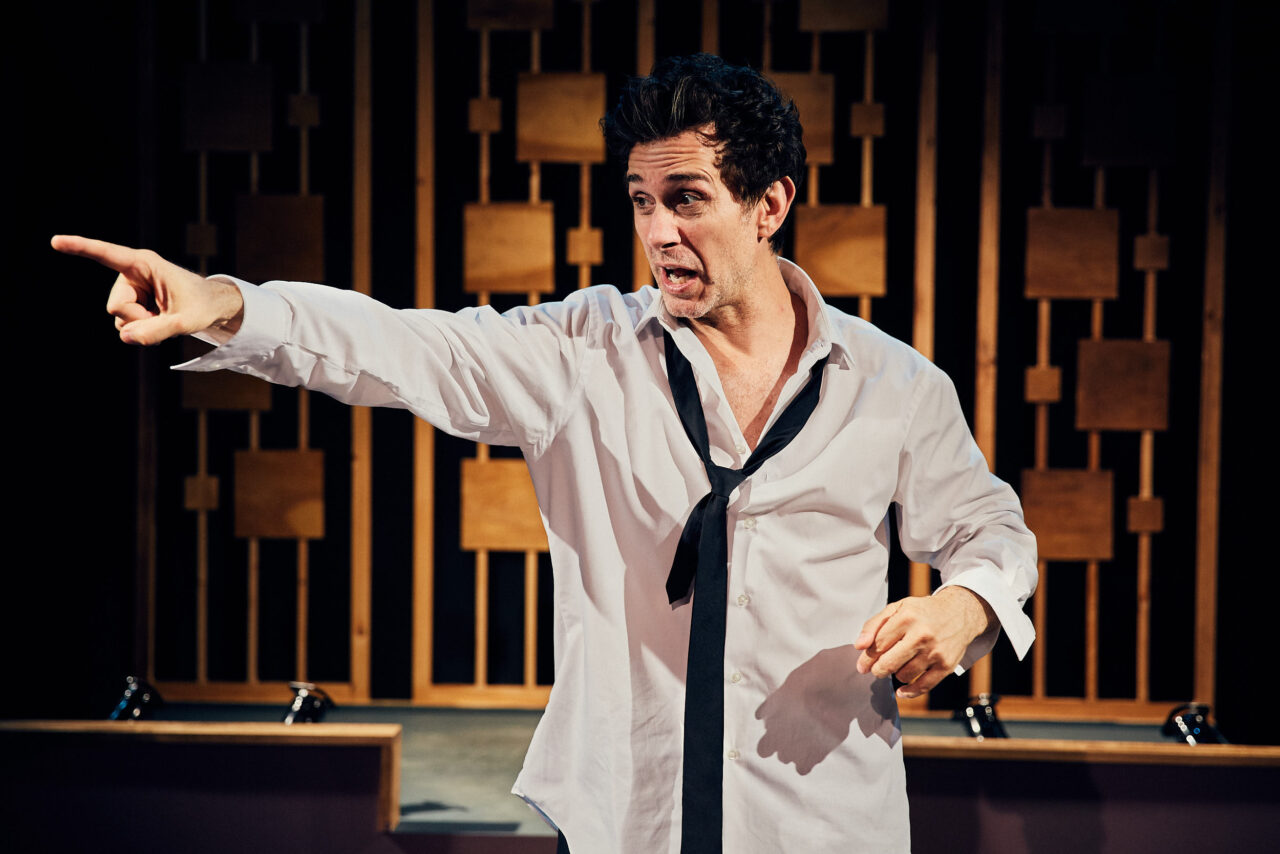
Before George Carlin named the “seven words you can never say on TV,” fellow comedian Lenny Bruce exposed inconvenient truths about sex, drugs, discrimination and hypocrisy that no one else dared mention onstage.
His edgy topics and racy language also repeatedly led to his arrest on obscenity charges.
Six weeks after what became his final performance — at San Francisco’s Fillmore Auditorium in 1966 — Bruce died of a morphine overdose while sitting on a toilet in his Los Angeles home. That unglamorous end was also the beginning of Bruce’s posthumous road to canonization as a free-speech pioneer and comedy legend.
Today, Bruce has more fans than ever.
They include Los Angeles actor Ronnie Marmo, who has been portraying Bruce for close to a decade in his self-penned, one-man show called “I’m Not a Comedian… I’m Lenny Bruce.”
The play recounts Bruce’s New York Jewish origins, his legal torments and his ugly death. It’s a comedy.
Marmo will perform the show at the Oshman Family JCC in Palo Alto on Jan. 25.
“He really put his neck out there,” Marmo said of Bruce. “If you care about free speech, the First Amendment, if you care about comedy, he was the guy who was willing to put it all on the line so people can do what they do today. He was the last person to be arrested and charged with word crimes in this country.”
To bring his portrayal to life, Marmo — who was born in Brooklyn a decade after Bruce died — studied his comedy albums and video clips of his performances. Marmo read everything he could, including Bruce’s autobiography, “How to Talk Dirty and Influence People,” published posthumously. He also had the assistance of renowned actor Joe Mantegna, who directs the show.
One key aspect of Bruce’s comedy was his unabashed Jewish roots. Born Leonard Schneider in 1925, Bruce peppered his stand-up with Yiddishisms and New York Jewish flavor. To nail Bruce’s Jewish flair, Marmo, an Italian American Catholic, had some homework to do, but not much.
“Different savior, same behavior,” Marmo jokes regarding the similar cultural personalities of Italian and Jewish Americans. “Lenny had this joke: ‘If you’re from New York, even if you’re Catholic, you’re Jewish.’ It was important for me to capture Lenny’s Jewishness and how he approached it.”
After serving in the Navy during World War II, Bruce slowly built a career in stand-up. By the late 1950s, he had earned a reputation for “blue humor,” salty language and then-unmentionable topics, especially regarding sex. He was branded a sick comic.
Bruce refused to soften his material, and by the early ’60s, the arrests piled up. Often busted on a stage, he had more and more trouble booking gigs. Eventually his act was dominated with rage about his legal predicaments. Bruce was convicted of obscenity in New York in 1966 and sentenced to four months in jail, but he died while out on appeal. He was pardoned in 2003 by George Pataki, New York’s governor at the time.
These days, Bruce would have landed a Netflix comedy special.
“He was very funny,” Marmo said. “The great comics are like this: They can look at a table and see something funny. But what made him very special — and dangerous to some — he also was trying to make a point. He used comedy as a means to hold a mirror up to society. You will see in the third act [of the play], even in his darkest moments, Lenny had a funny mind.”
He was the last person to be arrested and charged with word crimes in this country. Ronnie Marmo, actor
Marmo’s own career has included dozens of roles on TV shows such as “Criminal Minds,” “Lethal Weapon,” and “General Hospital, where he played Detective Ronnie Dimestico for 150 episodes. He also founded Theatre 68 in L.A. and has served as artistic director for more than 20 years.
This play isn’t Marmo’s first go-round playing Bruce. About 16 years ago, a friend and fellow comedian Charlie Brill told Marmo about a play titled “Lenny Bruce is Back and Boy is He Pissed.”
Marmo eventually starred in the play and brought it to Theatre 68, where it had a long run. Five years later, Marmo couldn’t get Bruce off his mind and set out to write a different sort of show — one that showcased more of Bruce’s routines and didn’t shy away from the darker elements of his life.
But first he needed permission from Kitty Bruce, Lenny Bruce’s only child and the executor of his estate and material. Marmo met with her, got her blessing and went on to finish the play under Mantegna’s direction. More than 400 performances later, it’s still going strong.
And no surprise, interest in Bruce has never let up. Dustin Hoffman starred in Bob Fosse’s 1974 film, “Lenny,” and Bruce was a major character in the Emmy-winning series “The Marvelous Mrs. Maisel.”
Marmo said Bruce’s work remains timely, nearly 60 years after his death.
“The country is so divided,” he told J. “People don’t want to hear the other side’s opinion. We have regressed in this country. But If you care about the freedoms in America, Lenny Bruce has touched on all of them. His voice, sadly, is more relevant than ever.”