

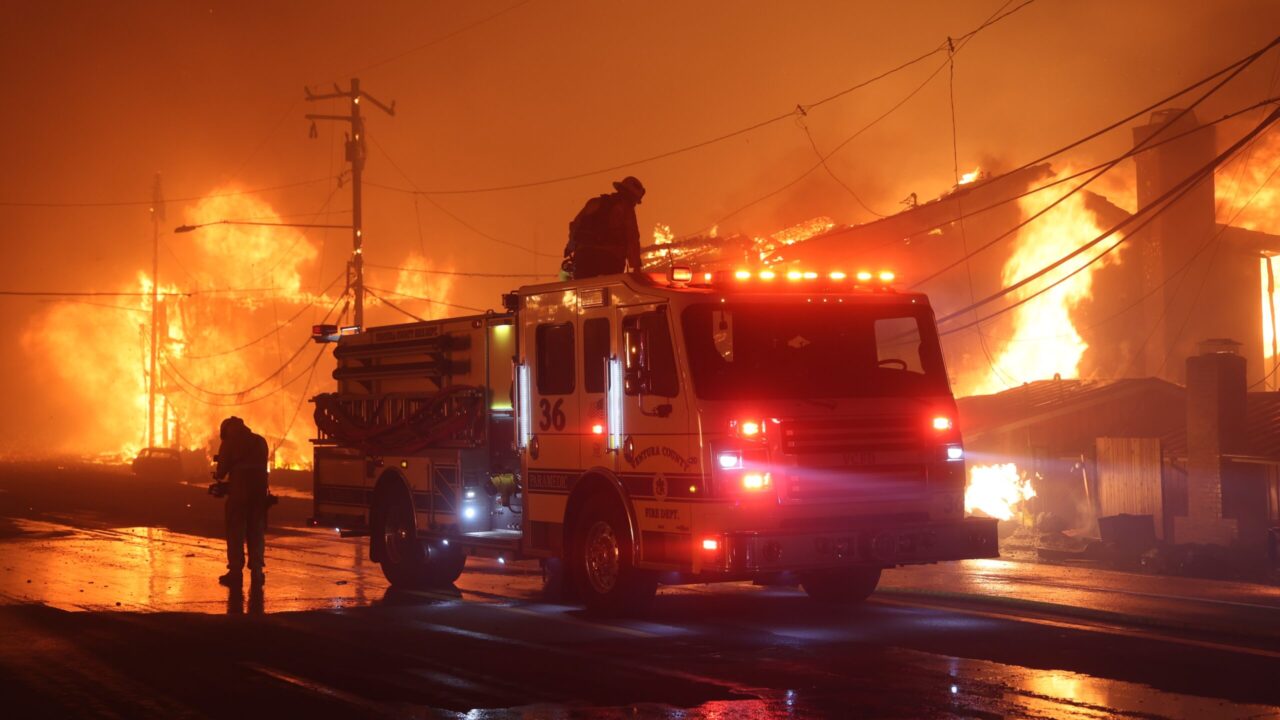
The fires that ripped through Los Angeles over the past week have killed at least 25 people, destroyed thousands of homes and consumed 38,000 acres. Many people have asked if any of it was preventable.
Climate change, including unpredictable weather and drought, means that fire danger in the West has never been higher. Stopping that kind of destructive spread is what an Israeli startup called FireDome seeks to tackle with its monitor and suppression system, which it will test in Northern California in 2025.
“Almost every year there’s a huge fire — two, three fires — that create havoc in California,” Gadi Benjamini, co-founder and CEO of FireDome, told J.
FireDome is named after Israel’s Iron Dome, the missile defense system that relies on precisely targeted launchers intercepting airborne threats from neighboring enemies.
The technology behind FireDome isn’t quite that ambitious, but the concept is similar — both use airborne defense. For FireDome, cameras are set up on a property to detect fire lines or spot fires caused by flying embers. Once identified, a launcher sends a capsule of fire retardant where needed.
“The concept was creating kind of a peripheral protection around the property, any property,” Benjamini said. “It could be an agricultural property, it could be utilities, could be a neighborhood, could be historical landmarks.”
Seth Schalet is CEO of the Santa Clara FireSafe Council, a nonprofit that works on wildfire risk reduction projects, sells fire detection tech and runs evacuation and fire safety workshops in Santa Clara County. Schalet, who is also on the advisory board for FireDome, sees potential in the technology.
“There really isn’t anything on the market today that goes after what’s known as spot fires,” Schalet said. Those are the fires that pop up when embers are carried by the wind and end up starting fires elsewhere.
Winds were the major driver behind the quick spread of the Palisades and Eaton fires in the Los Angeles area.

Wade White, a former assistant chief of the Los Angeles Fire Department, is a consultant to FireDome, advising the company on ways to promote its use by fire departments as well as property owners. He said the technology’s potential to put out spot fires could be especially valuable.
“You usually get spot fires with a wind-driven fire that could be a quarter to half mile downrange from the fire itself. And if we could hit those spot fires, this might be pretty beneficial,” he said.
White also sees promise in the mobile version, where cameras can monitor fire triggers like lightning strikes.
“If you’ve got technology that’s monitoring these lightning strikes that take place, it’s going to really give us good situational awareness on what’s going on in a massive forest, and maybe be able to stop these fires, or at least slow them down, before they turn into these mega-fires,” White said.
The system will be tested later this year in Northern California, which Benjamini said was a perfect location because of the variety of terrain that’s under threat.
“We have two vineyards, one in Napa and one in Sonoma, that we’re partnering with,” Benjamini said. The company has also been in talks with utilities in Southern California and resorts in Lake Tahoe, he said.
“I think California is really interesting in many ways for FireDome because it’s a state with many different markets,” Schalet said. “Each of them has different climatic challenges, different topography challenges.”
In the Bay Area, the 2017 Tubbs Fire in Napa and Sonoma counties killed 22, destroyed 5,600 structures and wiped out URJ Camp Newman. The 2020 LNU Lightning Complex in the same counties killed five and destroyed 1,500 structures.

Benjamini, who served more than a decade in the Israel Defense Forces, started FireDome last year. He and co-founder Adi Naor Pomerantz, a materials engineer, decided to create the company after hearing about the need for better solutions in the fire industry as climate change increases risk factors. Benjamini said there’s crossover between his work in the IDF and at FireDome.
“I think there are a lot of similarities between how you plan defense and protection strategy and how you plan a strategy to defend yourself or the community from catastrophic disasters such as wildfires,” he said.
The next step for FireDome is to move its headquarters from Tel Aviv to Santa Clara County, which Benjamini is prepping for right now, and to start testing in the field at some of the state’s most vulnerable properties. There will be challenges along the way, he said. Flying capsules, even if biodegradable, could face regulatory issues. The launcher must still be perfected. And people need to be convinced it’s safe, effective and worth the cost. But Benjamini is confident, especially when he looks at fires that have already pummeled California in past years.
“We could have been there and helped prevent some of the damages,” he said.