

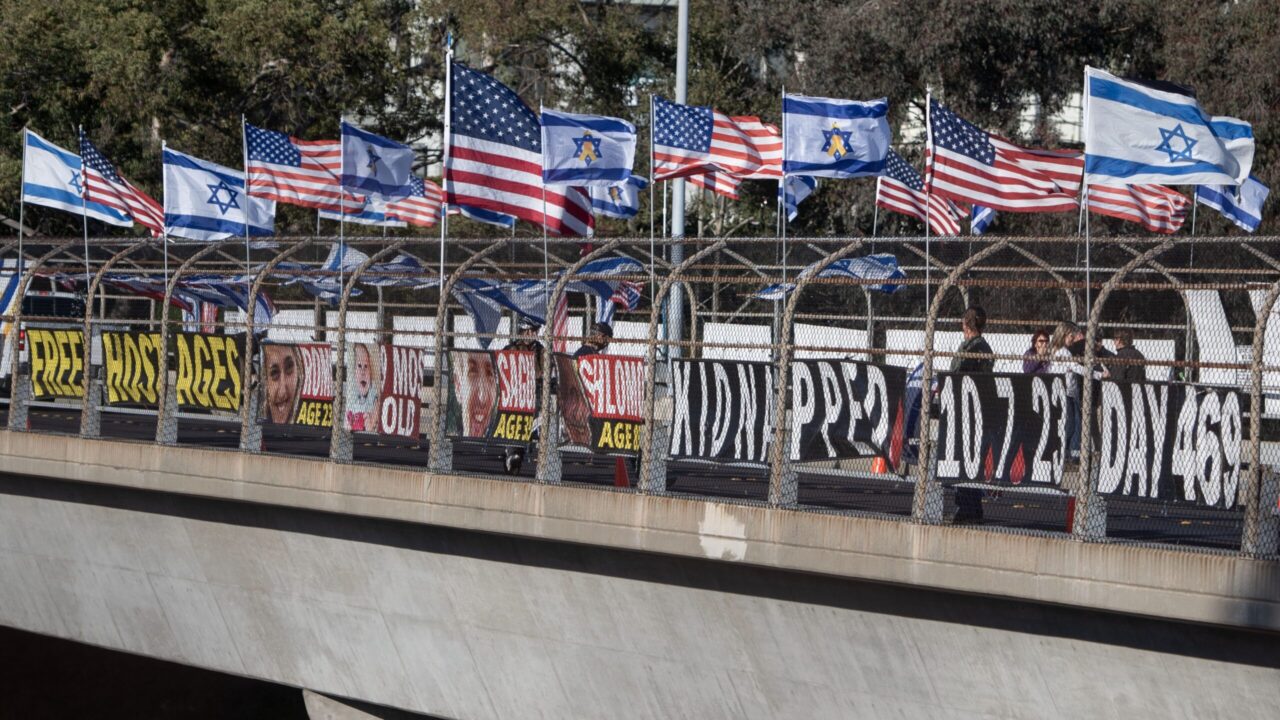
On Friday afternoon, dozens of Israeli and American flags fluttered along the El Curtola Boulevard overpass above Highway 24 near Lafayette, as they have regularly for the past 14 months.
Those flags, and the folks standing next to them, are a visual reminder of the more than 250 hostages abducted in southern Israel by Hamas terrorists on Oct. 7, 2023. Altogether, 98 hostages are still held in Gaza.
This past week, Israel and Hamas agreed to a deal that, over six weeks, will see 33 of those hostages released in exchange for Palestinian prisoners. The first release is set to take place Sunday, along with the start of a six-week cease-fire.
To those standing on the Lafayette overpass, the struggle is far from over.
“Sunday is just the beginning,” said Lafayette resident Itzhik Goldberger, one of the vigil’s organizers. “There are 65 who will still be there in Gaza. Our job will be finished when the last one is returned home.”
It’s been more than 15 months since the Hamas attacks. During that entire time, hostages have been languishing in Gaza.
“We have to keep that in mind, our own and everyone else’s,” Goldberger said. “When we sit comfortably in our armchairs and around the dinner table, we have to remember there are still people in the dungeons of Hamas, going through hell.”

At Friday’s gathering, Dublin resident Lindsay Levin was handing out stickers bearing the number “469” — representing the number of days the hostages had been in captivity. The stickers also showed images of two balloons representing the two Bibas children, Ariel and Kfir, who were abducted, as were their parents, on Oct. 7 from Kibbutz Nir Oz.
Kfir, 9 months old when he was taken, and Ariel, who was 4 years old, are the only children still held in Gaza. They and their parents are on the list of those to be released in this first wave, although Hamas claimed long ago that the mother and boys are dead.
Saturday, Jan. 18, marked Kfir’s second birthday.
The Lafayette vigil was launched on Nov. 11, 2023, by Goldberger and his friend, Yoav Harlev, both of them Israelis who grew up on kibbutzim. That first day it was just the two of them, with flags and banners showing the faces of the hostages. They were quickly joined by others, and the daily vigils swelled to dozens, sometimes hundreds of participants.
But it’s hard to sustain that kind of momentum, said Orinda resident Lior Rubin, another former kibbutznik who has been a core member of the organizing team from the beginning. Currently the vigils are held twice a week, on Friday afternoon and Sunday morning.
“We don’t fool ourselves that we here are hastening their release,” said Rubin. “We are here to remind the tens of thousands of drivers in the cars passing by that people are being held, decimated, raped, whatever. We cannot let them be forgotten.”
Even if Americans care nothing for Israel, they should be up in arms because there are Americans among the remaining hostages, Goldberger said.
“They should tell their representatives it’s not acceptable,” Goldberger said. “We have to do everything.”
Three of the seven remaining American hostages are believed to be alive: Edan Alexander, Sagui Dekel-Chen and Keith Siegel. The latter two are on the list of the 33 hostages set for release over the next six weeks.
The usual crowd on the overpass includes regulars as well as first-timers and is about “50-50 Israeli and American Jews, with some non-Jews as well,” said Jeff Goodfriend, a retired attorney from Lafayette. “It’s a real community up here.”
Most of those there on Friday seemed to know one another. One woman brought a challah she baked, and the group paused for a quick Kabbalat Shabbat, which included kiddush and a shofar blowing.
Giovanna Blackston of Walnut Creek used to be a regular, she said, but stopped coming. She showed up this time because of the hostage and cease-fire deal and brought her two children, Liiv, 7, and Oliver, 11.
“It feels like an important teaching moment,” she said. “It’s only been bad news for so long. When there’s even a glimmer of something to feel good about, I want to grab it.”
Blackston said that when she first heard of the impending deal, “I thought, ‘That’s not going to happen.’” Now she is “cautiously optimistic,” adding, “It has to happen. It’s an imperative.”
Her reticence was shared by others in the crowd.
“We are very hopeful, but it’s a deal with the devil,” said Rubin.
Goodfriend said he mostly felt sad.
“I’m saddened because we failed them,” he said of the hostages. “Our first sticker said 30 days. Now it’s 469.”
Nevertheless, the vigils will continue.
“People need to be educated,” said Julia Babka-Kurzrock, another longtime regular.
Babka-Kurzrock, a board member of Congregation B’nai Tikvah in Walnut Creek and a teacher at the Contra Costa Midrasha, speaks about the war to her students and to other groups, as well as on her LinkedIn page. She was floored when one woman, whom she describes as a “non-Jew, a professional person,” responded to a post by writing: “I’m embarrassed to say I didn’t realize there were still hostages being held.”
That, Babka-Kurzrock said, highlights the ongoing importance of the vigils.
Harlev agreed.
“As far as I’m concerned, there’s nothing to celebrate until the last hostage comes home,” Harlev said. “Even if there’s just one hostage there, we have to keep going.”