
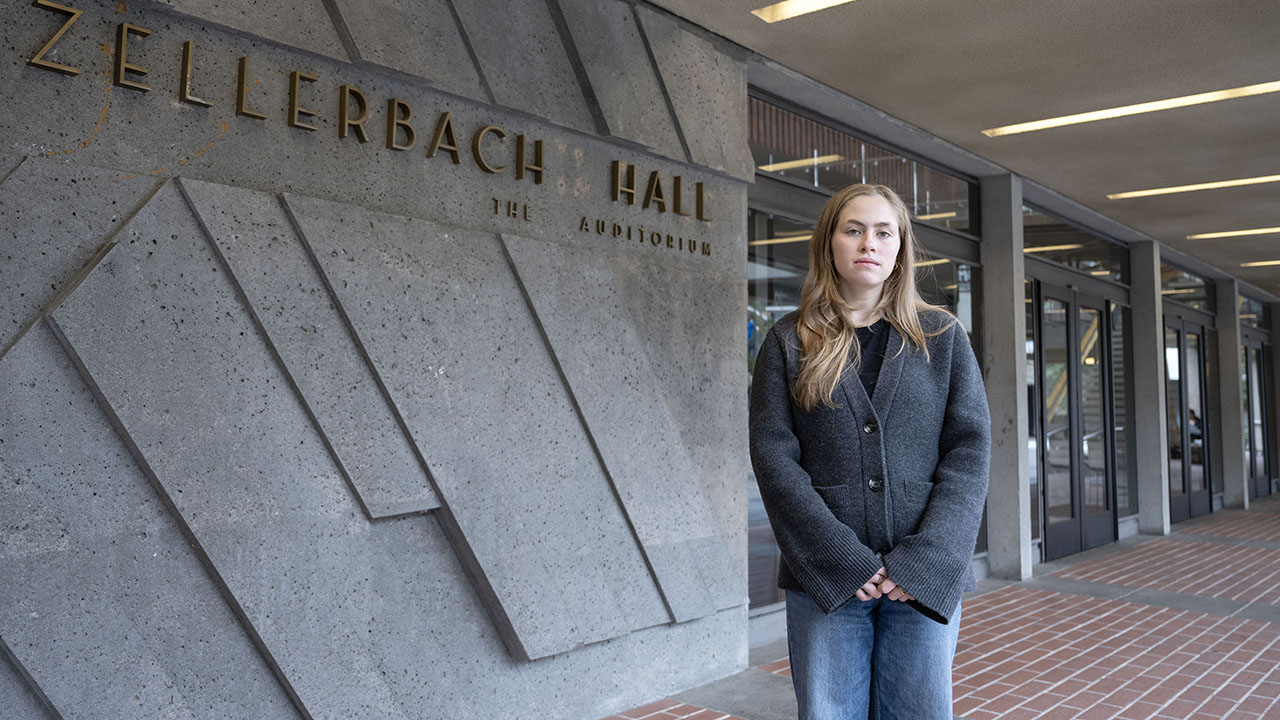
Zellerbach Playhouse shows no trace today of the battering it took a year ago when a violent mob attacked the UC Berkeley performing arts venue.
A glass door and large window were broken the night of Feb. 26, 2024, when many of the 200 protesters forcefully banged against Zellerbach’s entrance and eventually stormed the theater. The protest shut down a planned speech by Ran Bar-Yoshafat, an Israeli attorney and combat reservist who had recently served in Gaza, and then forced him and attendees to flee through an underground tunnel. Several Jewish students who were at the event were injured in the chaos. One left with bruises around her neck.
“It was just hands being thrown, spit flying out of the corners of masks. It was slurs being thrown all over the place. It was really, really mortifying and terrifying,” recalled Vida Keyvanfar, a student leader who helped organize the event.
Keyvanfar was stationed by the front doors of the venue. She wrestled to keep the doors shut as protesters tried to enter by force. They eventually swung the doors open, spraining her thumb and wrist in the process. She couldn’t see protesters’ faces because they wore masks and kaffiyehs.
“If you were standing in that mob … you could barely see eyes,” she told J.
Since that night one year ago, the campus has invested millions of dollars to address Jewish student safety and has mandated antisemitism training for all incoming students. Ron Hassner, the UC Berkeley professor who famously slept in his office for two weeks to protest administrative inaction after the Zellerbach disturbance, now applauds campus leadership for “setting things right.”
But it may not be enough. A new federal investigation, announced Feb. 3, alleges that Cal’s progress in addressing the climate for Jewish students has fallen short. The prestigious university also faces a federal lawsuit over its handling of anti-Jewish discrimination and harassment. And last month, an Israeli postdoc at Cal filed a separate lawsuit alleging discrimination by her union.

The campus has been under intense public scrutiny since the Oct. 7, 2023, Hamas massacre. Anti-Israel protests repeatedly erupted on campus during that academic year, along with violent language calling for “intifada” and supporting Palestinian “resistance.” In the spring, two pro-Israel demonstrators were attacked in two separate incidents at a pro-Palestinian tent encampment on campus.
Regarding the Zellerbach incident itself, no one was ever arrested.
UC police opened a criminal investigation, interviewing people who had witnessed the violence and vandalism outside and inside Zellerbach, Dan Mogulof, assistant vice chancellor of communications, wrote last month in an email to J.
Cal police also publicly posted and distributed photos of five suspects, “most of whom were masked to one extent or another,” Mogulof wrote. The photos were circulated widely across local news outlets in late March 2024 and were emailed to all students, staff and faculty, according to Mogulof.
“They almost never do that,” Ethan Katz, a professor and the faculty director for the university’s Center of Jewish Studies, said about the release of such photos. “It reflects a serious level of commitment.”
None of those suspects was ever identified, and the case is cold. However, the investigation remains open, Mogulof said.
“It’s unfortunate, it’s frustrating, but I also understand,” Keyvanfar said of the inability to identify the suspects given that most protesters covered their faces. “I really think that even the police officers themselves were really afraid and didn’t expect that [level of violence]. It makes sense to me that they would never be able to track down those people.”

The memories of what happened at Zellerbach Playhouse still haunt Keyvanfar, who graduated last spring and moved home to Southern California.
“I didn’t realize that would follow me, even to another city where I’m used to feeling safe,” said Keyvanfar, 22. “But it did, and my parents made me do trauma therapy and things like that.”
Keyvanfar said she doesn’t identify as a victim. She credits the events of that night, as well as subsequent conversations with attorneys from the Anti-Defamation League and the Jewish advocacy group StandWithUs, for inspiring her to apply to law school.
“The environment at Berkeley made me really strong and made me prepared for the worst situations, and also made me understand how hate forms,” she said.
Current students and faculty said that what occurred at Zellerbach showed UC Berkeley at its worst and that administrators have taken noticeable steps over the past year to support Jewish student safety.
In the wake of the Zellerbach incident, the university invested $8 million in more robust campus security measures, mostly toward staffing, Mogulof said. The reservation process for booking student-sponsored events on campus has also changed, giving administrators a heads-up on all scheduled events.
In March 2024, three weeks after the Zellerbach protest, Bar-Yoshafat was welcomed back to campus and spoke to a room of 150 people with no interference. Campus police and private security helped to ensure that the event went smoothly.

Anti-Zionist campus rage is no longer a staple of daily life, but rather “comes in waves,” said Keyvanfar’s sister Shaya, who is a sophomore and a campus senator representing Jewish students. She, too, was inside Zellerbach the night of Bar-Yoshafat’s canceled speech and witnessed a friend get “strangled” as she tried to stop the protesters from entering. Shortly after, she saw her sister Vida crying in pain.
“When I saw what happened to my sister, I was trying to hold in my cries because I didn’t want to scare the other Jewish participants in there, my friends, who I’d asked to come to the event,” she said.
Now, as a campus senator, Shaya Keyvanfar leads a team of some 20 students who help keep a record of antisemitic incidents on campus.
For instance, she noted that a group of students from Berkeley Law invited Simcha Rothman, a right-wing member of Israel’s Knesset, to speak last fall. He was driven off the stage within minutes by a mix of pro-Palestinian protesters and anti-Netanyahu Israeli demonstrators.
“There was a protest happening inside of the event, and people were being verbally harassed,” Keyvanfar told J.
Rothman delivered the rest of his remarks over Zoom.
Two weeks later, for the one-year anniversary of the Oct. 7 Hamas massacre in Israel, pro-Palestinian students and faculty participated in a “week of rage,” which included a walkout that triggered a standoff with pro-Israel counterprotesters.

“There was lots of graffiti around campus, and people were saying mean things and antisemitic things to students,” Keyvanfar said. In violation of campus rules, protesters hung a banner from the Campanile, the iconic clock tower, with the words “glory to the resistance.”
Cal’s new chancellor, Richard Lyons, who stepped into the role in July, “was tested early,” said Katz.
Sather Gate, the main entrance to campus, was blocked twice in October by pro-Palestinian protesters. In both cases, the university intervened. The first time, staff got protesters to disperse after an hour. The second time, university staff took down an unauthorized structure overnight. Last month, administrators removed an online description for a Feb. 11 anti-Zionist event that explicitly denied the rapes and sexual violence committed by Hamas on Oct. 7, 2023.

Lyons emailed a statement to J. in late January that described Cal’s efforts to turn the page from last year’s violence.
“I believe the university’s review of security procedures and the reservation process for student events, conducted after the terrible incident at Zellerbach Playhouse, was a needed and essential step,” Lyons said in the statement. “Subsequent to that review we have seen nothing similar occur on campus, and it is my intention to maintain our commitment to enforce campus rules and policies, and ensure appropriate consequences are imposed when rules and policies are violated.”
Lyons also made a point to engage directly with Jewish students by attending Shabbat dinners last semester, one hosted at Berkeley’s Hillel and the other at Chabad.
“On those Friday nights I was deeply moved by the warm welcome I received, and by the powerful sense of community, connection, and commitment that was evident at both of the gatherings,” Lyons wrote to J.
“He’s made a really demonstrable effort,” Katz said.
Shaya Keyvanfar concurred.
“So far, I only have really good things to say about him,” she said. “I feel really hopeful about the rest of the year too. He has not hesitated, and it’s not about taking the side of Jews over the side of anti-Israel people. It’s about the fact that he’s there to enforce the rules, and he’s been doing that to a much greater extent than our last chancellor was. As a result, it’s led to much more order on campus, and it sends a message to those people that your behavior isn’t welcome here, and you can’t treat Jews like they’re a chew toy.”
To mark the anniversary of the Zellerbach incident, Keyvanfar plans to introduce a bill this month to the Associated UC Student Senate condemning the violence of that night. Coincidentally, days ahead of the Feb. 26 anniversary, the Batsheva Dance Company from Israel is scheduled to perform at the adjacent auditorium inside Zellerbach Hall.