

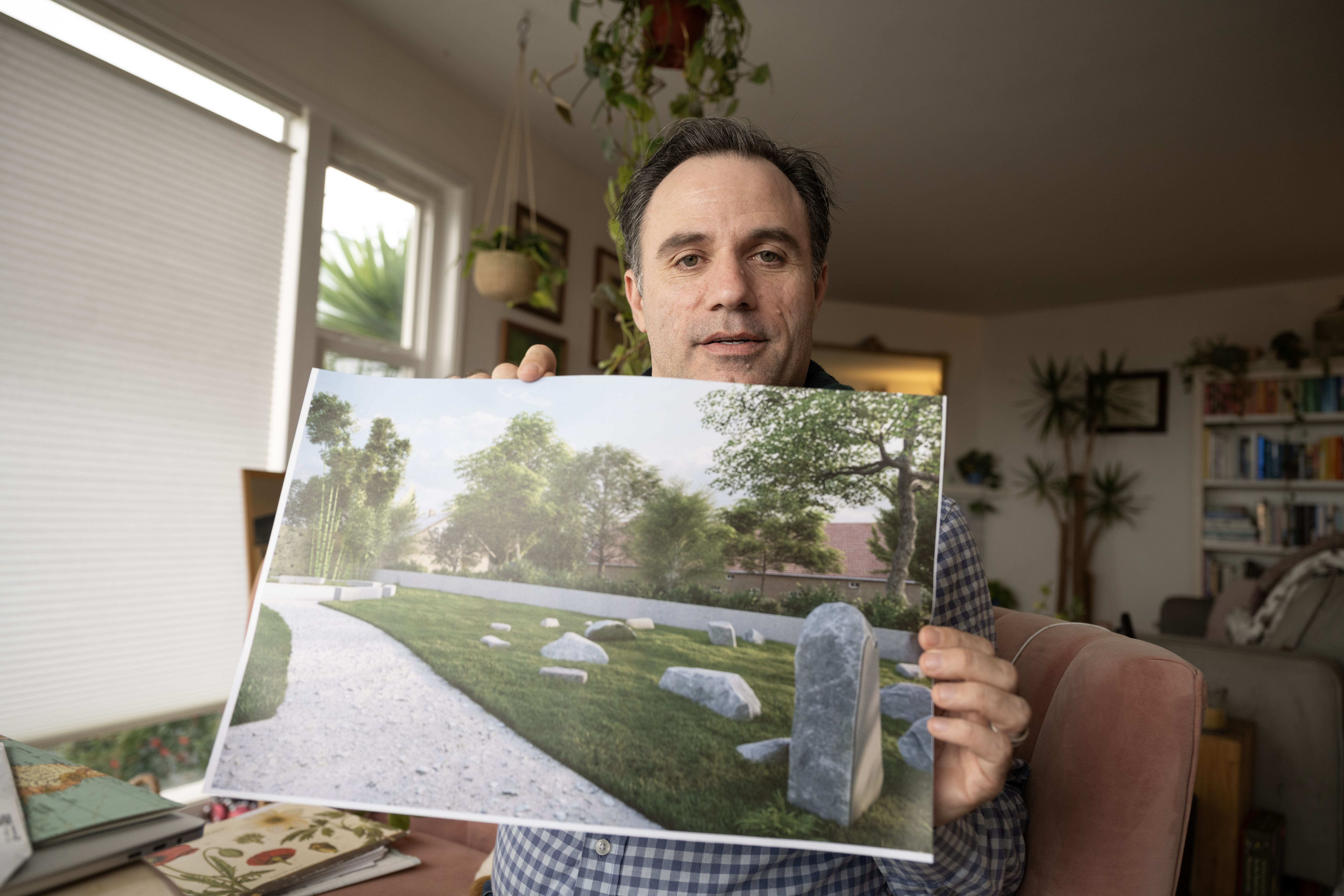
What does it mean to visit a building that no longer exists?
To honor the memory of his relatives killed in the Holocaust, and the places where they once lived, San Francisco visual artist Ben Wood decided he would bring back those memories in art.
Through dreamlike yet highly detailed animation videos of his grandparents’ homes in Germany — buildings that were destroyed after his family members were forced to leave — Wood has re-created a vision of the past.
The two homes once had real walls and real doors, and real people lived there. Today, they exist only in his imagination and in his three-dimensional animations.
“I re-created these actually based on drawings, real drawings, that I found in an archive,” Wood said earlier this month. “But they’re somewhere between history and a dream, or history or memory and a dream.”

Wood made the two videos in 2024 by poring over maps and photographs, then using software to create animated videos that loop through an exterior tour. The six-minute videos are accompanied by Wood’s voiceovers in German (with subtitles in English) that describe the properties and the people who lived there. The animations are realistic, except that the windows have been replaced with photographs of the one-time inhabitants.
“I’m telling their story,” said Wood, who has a master’s degree in visual studies from MIT and specializes in public art. “My idea was to bring back their faces and, in some ways, their voices.”
The first video, titled “Grosse Strasse 73, Strausberg,” brings to life the shop and home owned by Albert Levy, a clothing and textile seller, and his wife, Helene Levy.
In 1939, the property was commandeered by a local Nazi agent who forced the Levys to sell it for a nominal sum. Then the site was demolished. The couple moved to the Jüdisches Altersheim, the Jewish Home for the Aged, in Berlin.
Helene died in 1940 in a sanatorium. Albert, then 82, was sent to Theresienstadt then to Treblinka, where he was killed. Their couple’s adult daughter Friederike and her husband were also killed, but Friederike’s stepdaughter, Ruth, was saved by the Kindertransport mission that brought her to England.
Ruth was Wood’s maternal grandmother.
Wood’s second video is titled “Berliner Strasse 46, Seelow,” a Berlin suburb. It was the home — now razed — of Max and Adelheid Philippsborn, Wood’s great-grandparents. Adelheid’s given surname was Reissner; the property was the Reissner home and workshop, where they traded in furs and hides.
Under the Nazi regime, Max was sent to the Sachsenhausen concentration camp and later released, but then died from an unknown “accident” at the hands of the Nazis in 1940, according to documents. Adelheid was sent to the Warsaw Ghetto and did not survive. However, the couple’s son did make it out: Heinz and two cousins fled to England.
Heinz was Wood’s maternal grandfather.
Wood, 44, was born and raised in England, the country where his maternal grandparents found refuge, and has lived in the Bay Area since he was 19. Wood is also a triplet; one of his brothers is an Orthodox rabbi, and the other brother runs a Jewish deli.
He is known for his site-specific work, projecting photos onto San Francisco’s Congregation Emanu-El and onto city landmarks and historic sites such as Coit Tower, the Cliff House and Fort Point. In a 2017 exhibit at the Haas-Lilienthal House in San Francisco, he filled the windows with projected photos of the prominent Jewish family — similar to how he projects photos of his own family members in his personal videos.
The videos about his heritage are part of a bigger project tied to the past. Last year, he and other family members participated in the installation of Solpersteine, or “stumbling blocks,” the bronze memorials set into the sidewalks in front of homes of Shoah victims — now including his family’s homes.
Nils Weigt, a Ph.D. student in Germany, studies Holocaust history and is a member of an antifascist organization (“Vereinigung der Verfolgten des Naziregimes – Bund der Antifaschistinnen und Antifaschisten”) that helped organize and pay for the Solpersteine in Strausberg, Wood said.
Weigt, a resident of Strausberg, describes Wood’s videos as “immersive.”
“The viewer goes on a journey back in time to a past that doesn’t want to go away,” Weigt said in an email to J. “We still live in a post-Shoah society here in Germany. I would describe what we see with the word ‘haunting.’”

Wood said his family has looked into reclaiming the properties but doesn’t expect to pursue that effort. Instead, he said, he has been inspired by what Native American artists have done in the U.S., which he describes as “cultural repair” or “cultural restitution.”
“If you can’t legally reclaim property, then you can culturally try to reclaim it, at least by telling the story,” he said.
Wood’s videos are not the only virtual renderings of Holocaust-related locations. The Holocaust Museum LA features a virtual replica of the Sobibor concentration camp for teachers to use in class. In addition, museums have considered hologram testimony as survivors continue to pass away.
Wood hopes to show his videos at sites in Germany.
“I found a creative solution, which is to somehow tell the story through a different medium, bring back the memory through art, which is very empowering also for me as an artist,” he said. “That’s what I do.”