


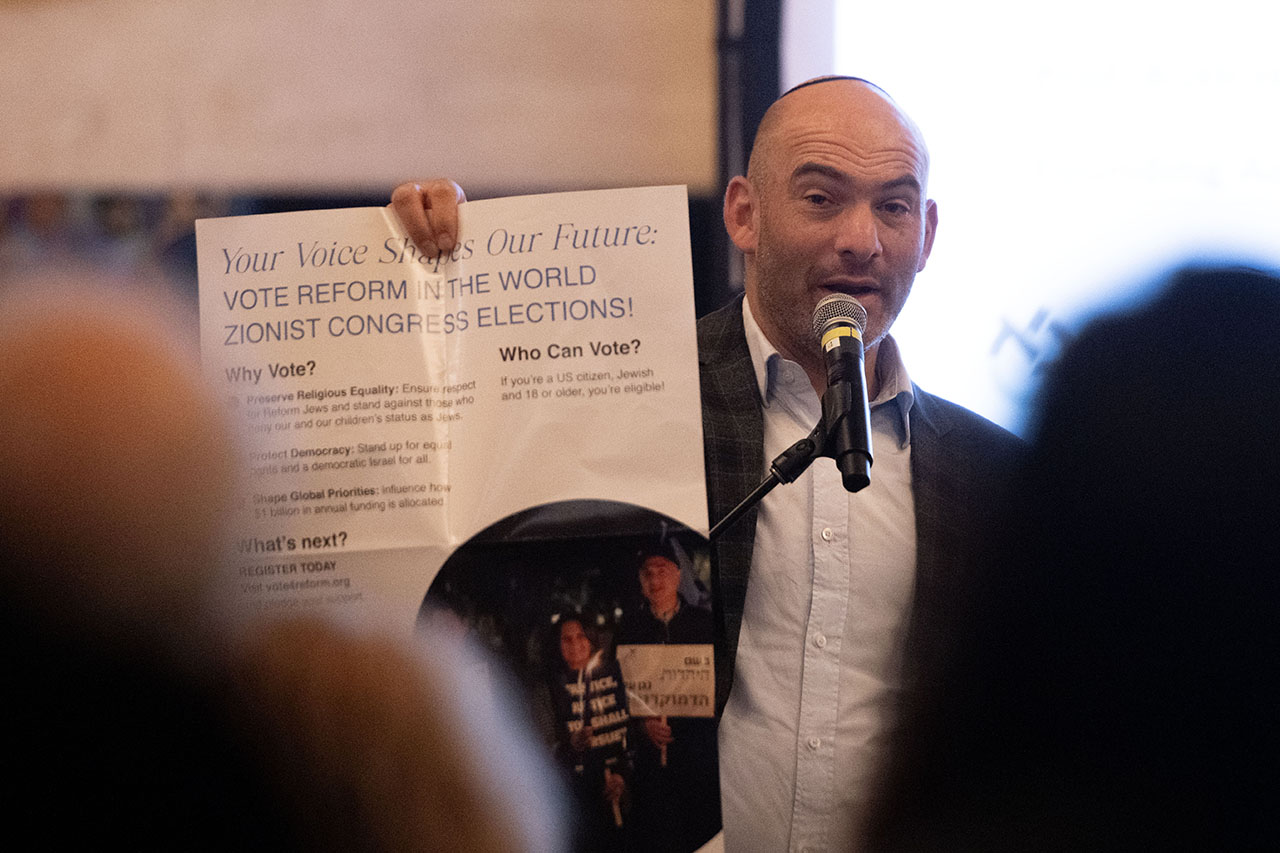
More than $1 billion a year and the power to sway critical decisions on Jewish causes are at stake in the 2025 election for the World Zionist Congress, which represents Jews around the globe and sets funding priorities for major programs in Israel and across the diaspora.
It’s a lot of money and influence. Yet this is an election that many Jews have barely heard of or pay little attention to.
“I think that the majority of American Jews are unaware of the elections, unaware of the amount of money that’s at stake in terms of how it’s allocated, and don’t realize what a huge impact this has on Israel-diaspora relations,” said Rabbi Mona Alfi of Congregation B’nai Israel in Sacramento, who is a candidate with the Vote Reform slate.
The 525-member parliament-style congress allots 152 seats for U.S. representatives. This year, about 60 people from Northern California are among the 2,900 running for the U.S. slots. Another 200 seats are for Israelis, with the remainder for other Jewish communities.
Winners will make real-world decisions for the next five years about the funding priorities of major organizations, including the World Zionist Organization, the Jewish National Fund (which owns 13% of Israeli land) and the Jewish Agency for Israel, which supports aliyah and social-welfare programs.
“Israel is very unique in that it enables the Jews of the diaspora to have a real say in what goes on in Israel and how certain resources are allocated,” said Rabbi Jacqueline Mates-Muchin of Temple Sinai in Oakland, who is also running as a Vote Reform candidate.

Most Northern California candidates live in San Francisco, the Peninsula, South Bay and East Bay, but also come from Chico, Bodega Bay and Napa and represent a broad swath of views. Voting began Monday and continues through May 4.
There are 21 slates in all. The two slates with the most representation from Northern California, with 16 candidates each, are Vote Reform and AID Coalition (America-Israel Democracy).
Vote Reform represents the Reform Jewish movement in the U.S. and generally represents liberal, pluralistic views. That’s why Alfi joined it.
“If I want to see women having equality, if I want minorities having equality in Israel, if I want there to be religious pluralism, then it’s critical that we have a seat at the table,” she said.
The AID Coalition primarily represents Israeli expats in the U.S. — many of whom vociferously protested Israeli Prime Minister Benjamin Netanyahu’s judicial overhaul plans before the Oct. 7, 2023, Hamas attack. They considered his proposals and policies as illiberal and undemocratic.
Elena Itskovich of Palo Alto, who is running with AID, was approached by a friend to put her name on the ballot.

She said AID stood out to her because it doesn’t represent any denomination of Judaism and it isn’t too right-wing. She wants the World Jewish Congress to focus on reconstruction in Israel following the Hamas invasion and the multifront war.
“A lot of the rebuilding can be by building stronger infrastructures for high tech, for biotech, for different sorts of strong economy drivers,” said Itskovich, who helps scientists find commercial markets for their research.
She noted that her slate’s candidates included researchers and tech and business leaders with practical experience.
“I want that money to be allocated according to these people’s judgments, how they see the ecosystem in Israel,” she said.
Efraim Lubliner of Napa is also running as an AID candidate.
“It’s simply to give more voice to people in the middle, in the center, and even people in the left,” he said. He added that the WZC has been moving to the right, “which I don’t believe most American Jews are.”
There are slates with smaller numbers of local representatives, too.
Former El Cerrito Mayor Tessa Rudnick told J. that she is running on the ANU: A New Union slate “because it’s the only way diaspora Jews can help shape policy in Israel. I’m both inspired by the social movements against the judicial overhaul and for democracy in Israel, and frightened by the far-right interpretation of Jewish peoplehood in Israel, which among many things denies viable pathways for long-term peace.”

Benjamin Sarnovskiy is a junior at Arizona State University studying finance and global health. He grew up in Daly City and lives in San Francisco when he’s not in school. He attended Jewish Community High School of the Bay.
Sarnovskiy is running on the Israeli American Council slate. It’s affiliated with the eponymous advocacy group, which created a slate for the first time this year.
“The reason the IAC stands out to me is because it’s a community-based organization that takes care of the Jewish community in the United States. And they do that because a strong community in the States makes for a stronger Israel,” Sarnovskiy said. “They also focus on the Jewish community especially on campus, and I believe that’s something that I can really relate to as a college student who has experienced antisemitism.”
Danielle Sobkin graduated from UC Berkeley last year and now lives in Manhattan. She is running on the Aish Ha’am slate, which is part of Aish, an outreach organization for Orthodox Judaism. She said the slate represents her core values and has the right perspective: a “Zionism-first emphasis, the importance of the State of Israel, campus security, college security and really the prosperity of the Jewish people going forward.”
Each World Zionist Congress serves for five years. The organizations under its umbrella run programs as diverse as environmental preservation in Israel, Birthright trips to Israel for diaspora Jews and security grants for European synagogues, so whoever sets funding priorities can make a real difference.
“I think Israel recognizes to some degree at least that whatever they do impacts the rest of us. And so for us to have a say in at least some aspects of what is going to be happening over the next five years I think is really significant,” said Mates-Muchin.
To vote in the U.S., you must be a Jewish adult (18 years old by June 30), be a citizen or green card holder and not have voted in Knesset elections between November 2022 and July 2025. Voters must also support the Jerusalem Program’s statement of values, which “views a Jewish, Zionist, democratic and secure State of Israel to be the expression of the common responsibility of the Jewish people for its continuity and future.” If you meet the qualifications, you can pay the $5 registration fee and vote by May 4.