
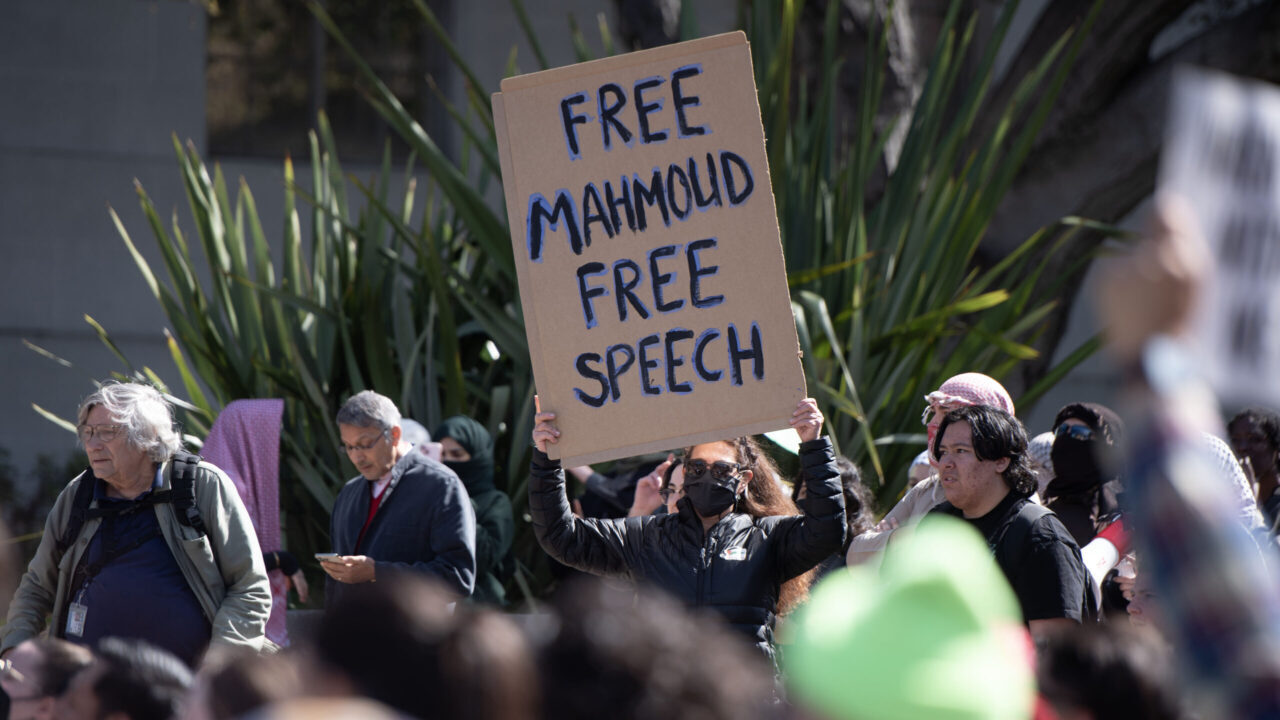
With Donald Trump back in the White House, the long-running effort to conflate criticism of the Israeli government with antisemitism as a way to stifle demands for Palestinian human rights and sovereignty is accelerating. On March 9, he made good on his pledge with the arrest and planned deportation of Columbia University protest leader Mahmoud Khalil.
Andrea Brower, an assistant professor of sociology at Gonzaga University, has compiled a long list of examples of the suppression of both free speech and academic freedom on American campuses over the past year. For example, New York University students were suspended for flyer distribution and a sit-in; Swarthmore College students have faced expulsion for using a bullhorn; Duke University students and faculty have faced termination for participating in a protest; and professors at several universities have been fired or forced out for advocating for Palestinian rights.
Trump has upped the ante. In late January, he made clear that he plans to prosecute and deport foreign students and others who participate in pro-Palestinian protests by canceling student visas of “Hamas sympathizers on college campuses, which have been infested with radicalism like never before.”
To implement these draconian threats, Trump issued an executive order entitled “Additional Measures to Combat Anti-Semitism.” It requires all executive departments and agencies charged with enforcing anti-discrimination laws to consider the controversial “working definition” of antisemitism adopted in 2016 by the International Holocaust Remembrance Alliance. The IHRA was founded in 1998 to promote Holocaust education, with 34 member countries, including Israel and the United States.
The working definition includes 11 “examples of anti-semitism,” some of which are certainly antisemitic. But several are also clearly speech protected in the U.S. by the First Amendment, such as “claiming that the existence of a State of Israel is a racist endeavor,” “applying double standards by requiring of [the State of Israel] a behavior not expected or demanded of any other democratic nation” and “drawing comparisons of contemporary Israeli policy to that of the Nazis.”
One can disagree with these statements or find them offensive. But in this country, they are all legal criticisms of the State of Israel.
Last May, the House of Representatives passed the Antisemitism Awareness Act on a 320-91 vote. It would enshrine the IHRA definition in federal law. The bill was introduced in the Senate on Feb. 13.
The idea of giving the IHRA definition the force of law has drawn criticism in Europe and the U.S. for years.
It will punish and purge students and faculty — including Jewish students and faculty — on a scale not seen since the blacklists of the McCarthy era.
Rebecca Ruth Gould, a University of Birmingham professor, noted in 2018 that since the adoption of the IHRA definition by several European countries, “at least five universities [in the U.K.], and likely many more, have had planned events cancelled or otherwise censored due to a perceived need to comply with this definition.” Gould pointed to the “many ways in which the IHRA definition has been used to censor speech, particularly on university campuses” and how the “definition’s proponents have not paid enough attention to the harms of censoring Israel-critical speech.”
More than 60 Israeli academics working in the U.K. wrote in 2021 that the IHRA definition “inhibits free speech and academic freedom; it deprives Palestinians of their own legitimate voice within the UK public space; and, finally, it inhibits us, as Israeli nationals, from exercising our democratic right to challenge our own government.”
Proponents of the IHRA definition ignore the fact that Kenneth Stern, who helped draft the definition and its examples, opposes its enactment into law. He has objected to its use in attempts to “restrict academic freedom and punish political speech” and has warned members of Congress that giving the definition legal status would be “unconstitutional and unwise.” He has also explained that the definition “was created primarily so that European data collectors could know what to include and exclude” in lists of antisemitic incidents, but it “was never intended to be a campus hate speech code.”
Seventy Democrats in the House voted against the Antisemitism Awareness Act, along with 21 Republicans. Rep. Jerry Nadler of New York, a Jewish lawmaker who describes himself as a “deeply committed Zionist,” called the bill “misguided” because it “threatens to chill constitutionally protected speech.” He also said speech that is “critical of Israel — alone — does not constitute unlawful discrimination.”
In May, some 1,200 Jewish professors, including Harvard Law professor Lawrence Tribe, journalist and professor Peter Beinart and Yale professor Samuel Moyn, urged politicians to “reject any effort to codify into federal law” a definition of antisemitism that conflates anti-Jewish hate with criticism of Israel. They warned that the “IHRA definition will delegitimize and silence Jewish Americans — among others — who advocate for Palestinian human rights or otherwise criticize Israeli policies.” The IHRA definition “hardens the dangerous notion that Jewish identity is inextricably linked to every decision of Israel’s government,” they said.
Harvard set a dangerous precedent in January by agreeing to adopt the IHRA definition as part of a settlement of two federal lawsuits accusing the school of failing to prevent antisemitic discrimination.
If the IHRA definition becomes the law of the land and is also adopted on America’s campuses, it will be a green light to launch a witch hunt against critics of the Israeli government. And it will punish and purge students and faculty — including Jewish students and faculty — on a scale not seen since the blacklists of the McCarthy era.
To prevent such divisiveness and to uphold fundamental principles of free speech and academic freedom, we need to oppose the IHRA definition becoming U.S. law. We can — and must — fight the scourge of antisemitism without sacrificing the First Amendment.