

I grew up in a house of books. In my family’s suburban home in the 1970s, nearly every room had a bookcase or built-in shelves. But it was a librarian’s nightmare. Fiction and nonfiction mingled indiscriminately. An E.L. Doctorow novel sat between Leo Rosten’s “The Joys of Yiddish” and the pop-psych classic “I’m OK, You’re OK.”
There was lots of fiction — Dickens, Roth, Austen, Bellow — and a smattering of science, history, psychology and philosophy. But as far as I can remember, on all those shelves, we didn’t have a single copy of the Hebrew Bible, or any Bible for that matter.
In my mother’s eyes, the two most important books in the house were the Random House Dictionary of the English Language, Unabridged Edition, and The Complete Works of William Shakespeare. Those were the sacred texts she looked to for enlightenment, edification and solace.
My parents were non-believing Jews, and I was raised to be a religious skeptic. My father, the son of a kosher butcher, was brought up in an Orthodox household. He told me he gave up on religion as a young man after he “found science.” My mother was of the firm belief that “God didn’t create man, man created God.”
When I was 7 or 8, they joined the Ethical Culture Society, a humanist fellowship where they attended weekly lectures about politics and philosophy, and I attended its ethics-based Sunday school. There was no talk of synagogues, Hebrew school or a bat mitzvah for me.
I remember being a little jealous in junior high as one by one, my friends had bar and bat mitzvahs — even though it all seemed to be more about the parties than the ceremonies. Had I become a bat mitzvah then, though, I would have had to confront one of my greatest fears: the G-word.
While I have long believed that some unknowable cosmic force created this world, I’ve struggled with the concept of God for as long as I can remember. As a child, I would pause in the Pledge of Allegiance so I didn’t have to say “under God.”
On the rare occasions as a child or teen that I was exposed to Torah, I found the text alienating, obtuse, unintelligible, perplexing. And, of course, it was jam-packed with God.
Yet for all these years, I’ve been curious. Why has this scroll, inked with a feather quill on an animal’s skin, captivated people for thousands of years? Why have Jews — and Christians, too — found so much to talk about in these Five Books of Moses? What meaning do they find in this often violent, sometimes misogynistic, endlessly problematic text? And what meaning could I find in it for me?
In summer 2023, I decided to attend the first meeting of an adult bat mitzvah program at Kehilla Community Synagogue, where I’d been a member for more than 20 years and had raised my two sons.
Then 62, I was the oldest student, but not by much. There were a couple of women a few years younger than me, another in her early 50s and a high school student who had decided to explore his Jewish roots.
As I began to study Torah, I sought out my younger son’s bar mitzvah teacher, one of the sages of our community, to help me navigate the text. During our first meeting in her cozy kitchen, I asked her what the Torah is.
“The Torah,” she said, “is the mythology of the Jewish people.”
“Mythology” — that word resonated with me. Even my non-believing mother was a sucker for Greek mythology. Torah is our mythology. Hmmm.
But, as I came to learn, Torah is so much more than that. It’s law. It’s philosophy. It’s history. It’s literature. It’s language. It’s like a whole college of humanities rolled up in one.
Over the next 18 months, it was at times hard to fit my studies into my demanding schedule as a professor. I thought about giving up or putting off my bat mitzvah until I retired. But then it was suddenly time to pick a date for our ceremony. There were two choices, and one happened to be the Shabbat associated with my birthday.
The parashah for that week — my birthright! — was Yitro, which contained the story of the revelation at Mount Sinai and the giving of the Torah to the Israelites. It seemed like more than a coincidence. I felt that some force, Divine or otherwise, was directing me to dive into this text that I had found so alienating and mysterious.
And so, over the course of about six months, I studied Yitro in depth. I pored over numerous translations, as well as ancient and modern commentaries. I read Zora Neale Hurston’s “Moses, Man of the Mountain,” discovered poems about the revelation and listened to rabbis of various denominations discuss it on YouTube.
Through this journey, I came to see that the value of Torah lies not so much in the text itself but in the process of reading it — how study of Torah forces us to get outside our mundane lives and contemplate deeper, timeless questions. Torah study connects us to an eternal conversation. When we engage with the text, we are not just reading words on a page; we are entering into dialogue with generations of rabbis and thinkers who have wrestled with these same passages.
Torah study provides a sacred pause. Whether it’s parsing a single verse, comparing translations or unraveling a complex Talmudic argument, the act of study demands our full attention. It can even be a form of meditation as it pulls us out of the rush of daily life and grounds us in something eternal. And in that act of study, I began to get glimpses of the Divine.
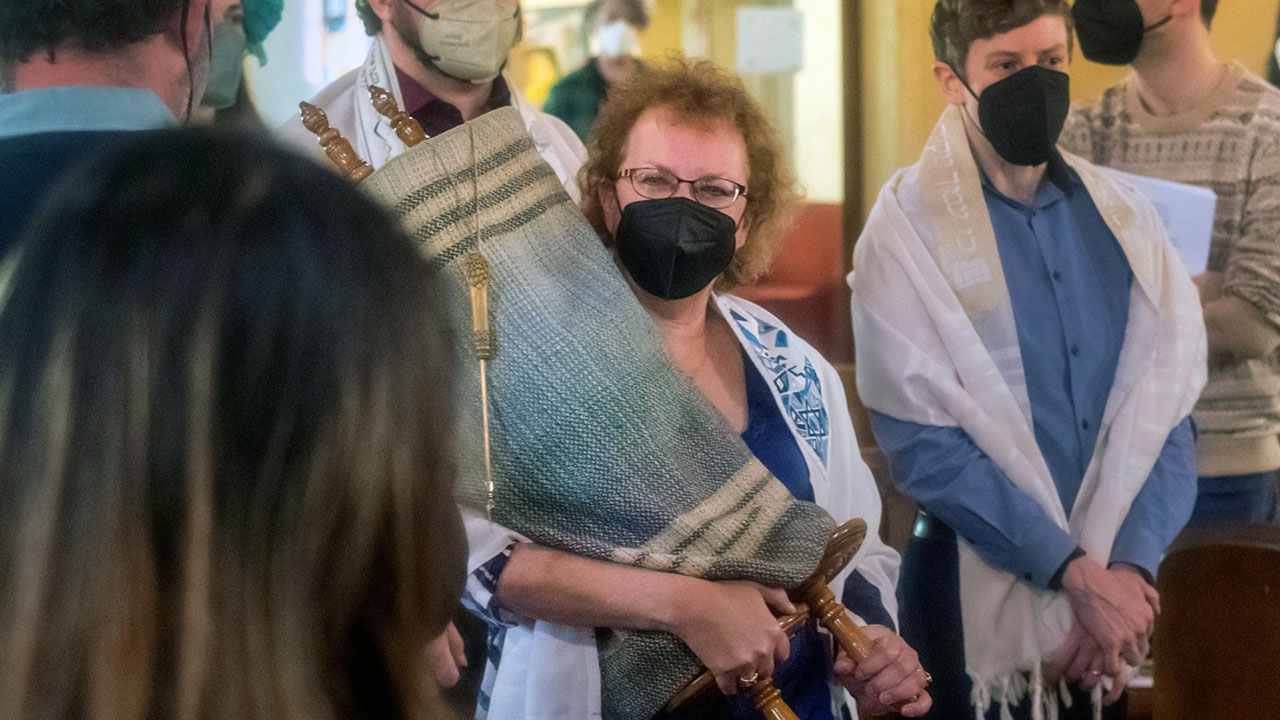
As I stood on the bimah on Feb. 15 looking out at my fellow congregants, my family, my friends and my co-workers, I was able to say these words, without ambivalence or hesitation: Adonai. Hashem. Elohim.
And, yes, I could even say “God.”