

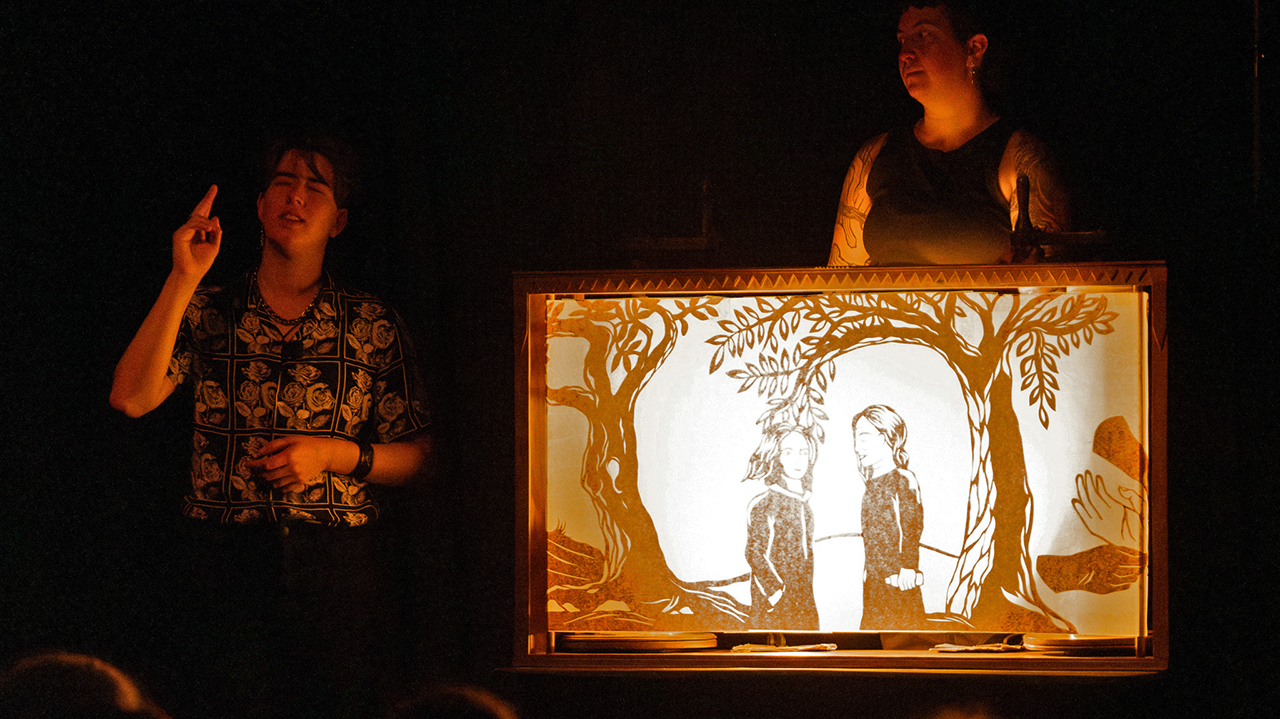
“Shterna & The Lost Voice,” a new Jewish folktale coming this month to Northern California, is brought to life with original klezmer music and a crankie.
If you’ve never heard a crankie, you’re not alone.
A crankie, a popular 19th-century device also known as a “moving panorama,” consists of an open box with an illustrated screen held on two dowels — not unlike a Torah scroll — that is slowly rolled along to provide visuals for a performance.
The Magid Ensemble, a group of young adults mostly from the East Coast, will perform “Shterna,” with a crankie and live music, over three days in Santa Cruz, San Francisco and Oakland in late May.
While the illustration style used in crankies differs, this one is inspired by the art of papercutting and was created by Kiah Raymond, a visual artist in Portland. Papercutting has a long history in Jewish art, flourishing from the medieval era through the 19th century.
Weaver, a Massachusetts theater artist who goes by one name, dreamed up “Shterna” during the Covid-19 pandemic. The isolation during lockdowns gave Weaver both the idea for the story and the time to work on it.
In the story, which Weaver wrote and narrates, the titular character undertakes a journey to help a friend who has lost his voice. It’s a hero’s journey that takes Shterna through the living world, the underworld and the immortal world.
“I wanted to talk about changing ability and disability,” said Weaver, who is 27. “‘Shterna’ is about the way you engage in the world and when the parts of yourself, your body and your skills that you really value and care about, are suddenly no longer able to serve you.”
While “Shterna” is an original story, it is inspired by Yiddish folklore. Weaver, who also works as a Yiddish-to-English translator, describes “Shterna” as an “Elijah story,” noting that the prophet Elijah is present in Jewish folklore in many contexts beyond the Passover seder.
“Elijah is often this trickster figure,” said Weaver. “Elijah can be very helpful to people who prove themselves worthy of help through their actions.” Weaver also took cues from other Ashkenazi folklore and the ethnographic work of S. Ansky, who wrote the play “The Dybbuk.”

Rachel Leader, 30, a violinist and the group’s production manager, lives in Northampton, Massachusetts, the same town as Weaver. She and fellow musicians, accordionist Mattias Kaufmann and cellist Raffi Boden, composed and arranged the score.
It was Leader who came up with the idea of using a crankie — a remnant of visual entertainment before the birth of movies — to help tell the story. Her father, Emmett Leader, who is a woodworker, crafted the crankie’s box.
“There are a lot of crankies in the folk music world,” she said. “They’re often used for storytelling for a song or ballad that tells a story. Usually, they are a couple minutes long, but ours is cranked for the full 50-minute performance.”
Just as crankies can feature different artwork styles, their actual design can vary too.
“Ours plays with light and shadow,” Leader said, adding that it shares similarities with shadow puppetry. “It’s this illuminated box that provides this really magical setting.”
The viewing screen is about 4 feet wide and 2 feet tall, Weaver said. And Raymond’s scroll, which Weaver estimates is at least 200 feet long, is constructed of basic materials: butcher paper, tracing paper and packing tape.
Weaver has worked on elaborate theater productions and written plays with up to 30 characters, but noted that there’s something to be said for a simple, low-tech production.
“Shterna,” which for both adults and children, premiered last year on the East Coast. The ensemble is currently working on a version that will incorporate Yiddish for a performance at the Yiddish Book Center in Amherst, Massachusetts.
As with many folktales, Weaver expects that audience members will each “find their own meanings in it.”