

A version of this essay first appeared in “Your Sunday J.,” our weekly email newsletter hosted by David A.M. Wilensky. Sign up here.
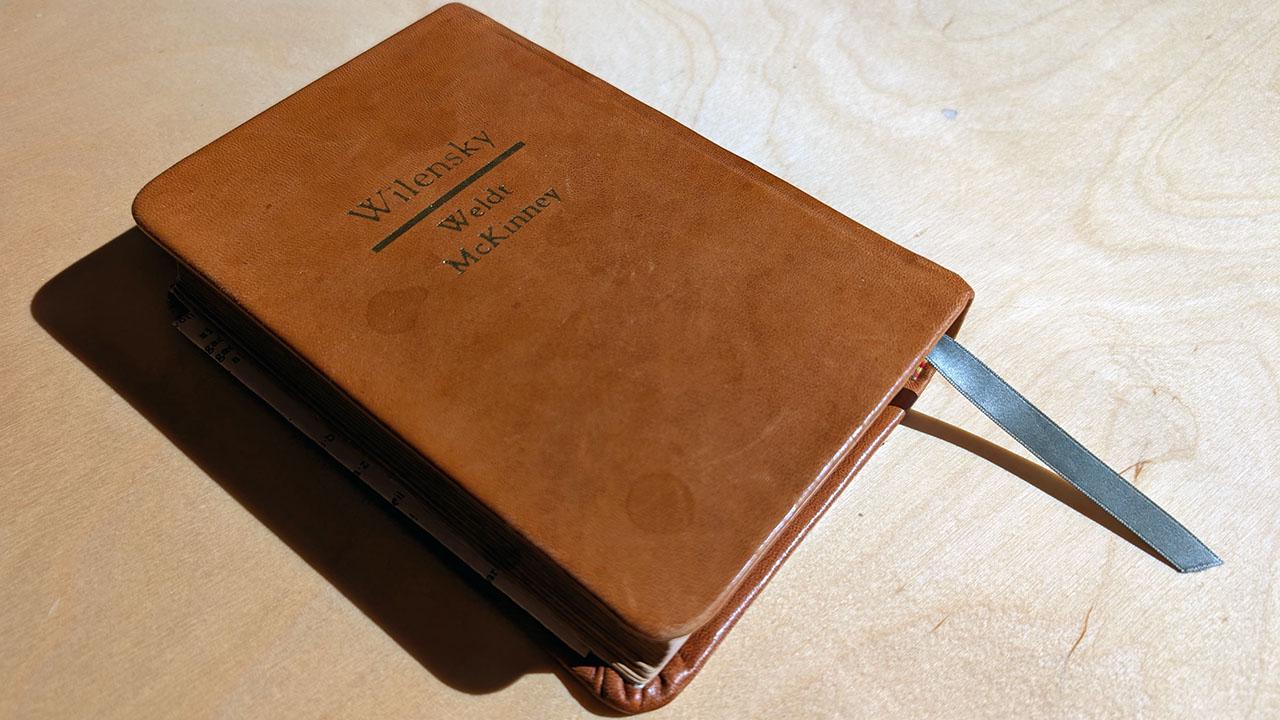
My grandfather’s siddur, which is sitting here on my desk as I type, turned 100 last year.
It is a common, unremarkable Hebrew-English edition published in 1924 by the Hebrew Publishing Company of New York. But it’s funny — sometimes, after an unremarkable mass-produced item takes on sentimental value, we take steps to preserve it and, in so doing, we turn it into a one-of-a-kind heirloom.
In 2020, early during the Covid lockdown, I began having dinner over Zoom with my friend Rachel every Friday night, and I was usually the one to say Kiddush. There are many different siddurs in my collection (a long story for another time), but one time during that weekly dinner, the one I reached for was my grandpa’s.
To that point, it had been a curiosity on my shelf — but it felt right in my hands that week. So I used it again the next week. And the next. And the next.

The Friday night and Rosh Hashanah Kiddush pages were paper-clipped unknown decades ago, so they’re easy to find. (I’m terrified that if I were ever to remove these paper clips, the whole thing would just disintegrate.) On the endpapers, handwritten by my grandpa, Sol Wilensky, and his mother, Sarah Wilensky, are recorded birthdates and yahrzeits for a number of relatives — some I can identify, others I can’t. (My dad suspects a third set of handwriting belongs to my great-grandfather, Sam Wilensky, who died young.)
I believe the siddur was still in its original binding, though it had degraded significantly. At some point it was covered in that plastic wrapping that libraries put around hardcover books — I assume by my grandma, Ann Wilensky, who was for decades the volunteer assistant librarian at Shearith Israel, her shul in Dallas.
As I went on using the siddur, I fell in love with it — while it fell apart. Most of the pages were in good condition, but the cover was crumbling and separating from the pages.
It was still 2020 when I Googled “San Francisco bookbinders.” I found Cardoza James Binders (which has since closed) and gave them a call. A man called Gabi Hanoun answered. After I described my project, he proudly told me he had a regular Jewish client: Had I heard of that local Jewish newspaper? I had by chance called the guy who for years bound print copies of J. into hardcover volumes for our physical archive once a year. “Say hello to Diane for me,” he said, referring to our now-retired longtime office manager.

As best as my dad and I can tell, this siddur was purchased by (or given to) my great-grandfather Sam Wilensky late in his unfortunately brief life. It was then passed to his widow, Sarah, my great-grandmother. And then to my grandfather, Sol, the relative I’m sometimes said to be most similar to. Sol used it, perhaps as his parents had, around the house, for kiddush and keeping track of important family dates.
That’s how I use it now. I’ve even begun adding more birthdates and yahrzeits to it — a lot of life has happened in the decades that this siddur mostly sat on a shelf.
Now, when I stand at the head of a table saying Kiddush from that siddur, I think of a particular photo of my grandpa holding my dad in one hand and this siddur in another, glancing down at the Hanukkah blessings. I don’t believe in ghosts or anything like that, but time does seem to dilate and stretch, as if I can reach out and touch another time and place.

The siddur was mass-produced in 1920s New York, but it has become an heirloom in 2020s San Francisco, with decades of Texas in between. Now rebound in beautiful new leather, with pleated corners that advertise its handcrafted nature, it feels like it’s from the Old World — even though I know it was owned and used primarily in rural and suburban Texas and acquired its current luxurious cover in 21st-century San Francisco.
I think often of the way objects and meanings are carried forward by the march of history, peoples and cultures. A sacrificial cult that ended nearly 2,000 years ago transformed into a written and spoken liturgy, which evolved over time and was slowly codified in endless variety. Then came the advent of the printing press, which enabled Jews in early 20th century New York to typeset and mass-produce standardized liturgies mutually intelligible to most Jews in America. One copy came into the possession of my great-grandfather, a Jewish immigrant living in Brady, Texas, who left it to his widow, who left it to her son in Dallas, who left it to his son in Austin; who gave it to his son in San Francisco (me), who had it rebound and restored. It all feels like part of one big story.
Do you have any prized family heirlooms? (Or perhaps a burdensome family albatross you can’t bring yourself to get rid of?) How did you come to have them? What do they mean to you? Do they mean something different to you than they did to the relatives who came before you? I want to hear about them! Email me with photos and descriptions of your treasured family heirlooms at [email protected].