
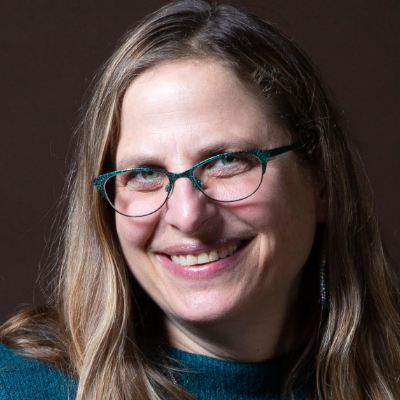
Of the 30 rabbis in Ukraine, 29 of them are Orthodox and 29 of them are foreign-born. Kiev-based Alexander Dukhovny is the exception.
Born on local soil, he is the only Reform rabbi in all of Ukraine, serving some 40 congregations. Dukhovny will visit the Bay Area the weekend of March 30 though April 1.
Last year, Rabbi Josh Zweiback of Congregation Beth Am went to Kiev and met Dukhovny. Zweiback was impressed with what he saw, and wanted to continue the relationship.
Dukhovny, 50, is one of three Reform rabbis born in the former Soviet Union now serving there; his colleagues are in Moscow and Minsk.
Because his mother was the daughter of a Chassidic rabbi, Dukhovny was raised knowing more about Judaism than most Jews in the former Soviet Union. His mother and her sister were the only ones in their family to survive the Holocaust.
His mother taught Dukhovny and his brother to observe Shabbat.
He also remembered waiting for Chanukah gelt as well as receiving matzah sent by train from relatives in Moscow.
But unfortunately, while growing up in the communist era, he said his positive memories of Judaism stopped there.
“When I graduated from high school, I had the highest marks,” he said. “I should have received a golden medal, but I didn’t receive it because I was Jewish.”
He was rejected from the university in Kiev, also, he presumes, because he was a Jew.
After the fall of the Soviet Union, he visited Holland and there, he met a rabbi who was not Orthodox. When he returned home, he joined the Kiev congregation.
After spending his entire career in the sciences at the International Academy of Science, Dukhovny made a career shift in the late ’80s, working as a tour guide for missions largely sponsored by Jewish organizations. Later, he was asked by the American Jewish Joint Distribution Committee to be its director of cultural and educational projects. He also began teaching Sunday school.
“This is where I learned more about the potential we have within Judaism,” he said, “and how Jews are considered to be one family.” But at the same time, he realized how little about Judaism he actually knew.
At 44, he decided to become a rabbi, and applied to the Leo Baeck College in London. He was accepted, although he knew next to no English and no Hebrew.
After being ordained and married on the same day in 1999, Dukhovny returned to Ukraine, where he has served as the rabbi at Hatikvah, the Kiev Reform congregation, as well as the other 39 Reform congregations in Ukraine. “I travel a lot,” he explained. He also travels to London once every six weeks to visit his wife, a South African-born rabbi who has a Reform congregation there. While he hopes they will eventually be able to live in the same country, Dukhovny said he is committed to furthering progressive Judaism in his homeland. Hatikvah, the name of his synagogue, means hope, and to him, is representative of the hope of Ukrainian Jewry.
Dukhovny often finds himself up against the Orthodox establishment. When he first returned to Kiev in his rabbinical capacity, he made contact with the chief rabbi of Kiev and suggested working together on some programs. The rabbi agreed, but each time Dukhovny proposed something, the other rabbi turned it down.
In one instance, an Orthodox rabbi wrote to the governor of Crimea after the Jews applied for a building permit, saying, “Don’t give the Jews a building there, because they are not Jewish, they are progressive.”
“This is how my Orthodox colleagues operate,” he contended, “trying to spread rumors about us, saying we are not proper Jews, or not Jews at all.”
Dukhovny believes that given a choice, the majority of the estimated 500,000 Jews remaining in Ukraine — 80,000 in Kiev alone — will choose progressive Judaism.
“The more Jews that leave, the more appear,” he said. “Eighty percent of Ukrainian Jews are in mixed marriages, but they’re discovering their Jewish roots and they are our target.”
Unlike the Orthodox rabbis, who only accept halachic Jews, he said, “We say, ‘If you think you are Jewish, this is the place for you.” This approach explains why the number of progressive synagogues has grown from 14 when he arrived in 1999 to the 40 in existence today.
“There is a big desire for Ukrainian Jews to learn more about Judaism,” he said. “They are searching for their identity.”