

Norm Weil knew his father had borrowed money from the Hebrew Free Loan Association in 1940, but for many years he didn’t know exactly why.
Then, a year and a half ago, development director Rabbi Jamie Hyams emailed Weil. She had come across his father’s documents in the archives and realized they told a poignant story, one that shed new light for Weil on his own family’s history.
The records showed that Weil’s father, at only age 19, had asked for and been given a loan to save his parents and other relatives from the horrors of war, using it to ensure that “parents, an aunt, and an uncle now in concentration camp” would be allowed into this country by U.S. immigration.
The loan was for $450.
“It was sort of chilling at first, when I first saw it,” said Weil, 73, of Hillsborough. “It really put meat on the story of all the things that had to come together” to get most of his family out safely.

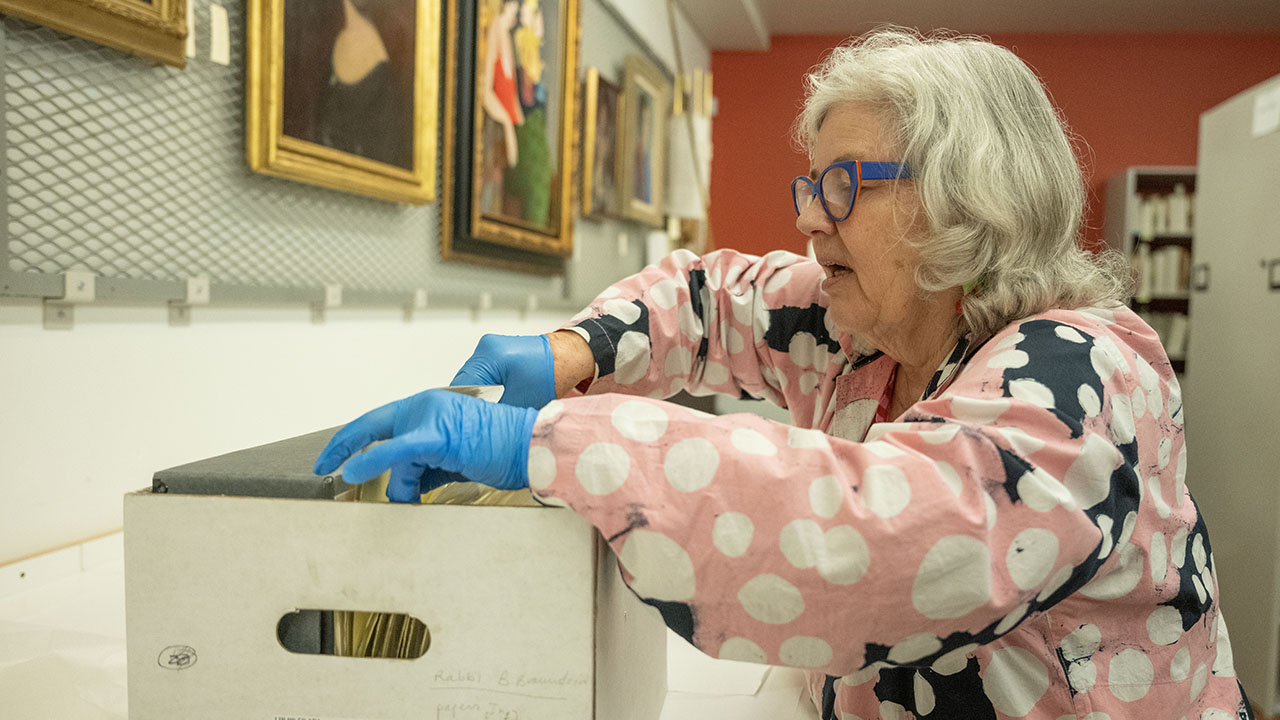
As many Northern California Jewish institutions are ticking past the century mark or beyond, they’ve become increasingly aware of the treasures tucked into dusty file cabinets and bankers boxes. Preserving these scraps of Jewish history — whether hand-scrawled index cards, hastily wrapped ledgers or hard drives full of emails — is a monumental but imperative task.
“Establishing and augmenting an archive is like planting a tree,” said Francesco Spagnolo, curator at the Magnes Collection of Jewish Art and Life. “We do not necessarily see the benefits ourselves, but we’re guaranteed that those benefits will be felt in the future.”
With the Gold Rush of 1849, San Francisco and the surrounding area boomed with promise, attracting people from all over the world seeking adventure and fortune. Many of the immigrants who came to the area were Jewish.
Where there were Jews, soon there were Jewish organizations, from chevra kadishas to “Hebrew” immigrant aid societies. Naturally many have disappeared over time, but plenty of others reinvented themselves and are still around today — including J., founded 130 years ago as The Emanu-El. With so many organizations hitting milestones now, more attention is being paid to historical preservation.
It’s one thing to possess a rich trove of documents. It’s another to know what to do with disorganized files, fading photographs and yellowing stacks of forms. How do you know what’s worth keeping? And if it’s worth keeping, where should it go? And who is going to pay for it?
“I’m not surprised that it’s coming up now, as a lot of institutions are hitting milestones,” said Eitan Kensky, the Judaica and Hebraica curator at Stanford University Libraries. “It really is a moment to think about what is it that we, as a community, value.”
The coffin room
Hebrew Free Loan, for example, was founded in 1897 (it dropped “Association” from its name in recent years) and has thousands of documents, from loan applications to internal memos.
“When you’re in the moment, you don’t realize that these things are going to be important historically,” said executive director Cindy Rogoway. “But over time, you start to recognize the narrative that is built from these documents.”
For many years, the papers were stored at Sinai Memorial Chapel. Hyams said there were “160 boxes of materials down in the basement — through the coffin room into the crawl space, where they built the building, with one creepy light bulb at the end.”
When Sinai said it needed the space back, the Hebrew Free Loan boxes had to go somewhere. Rogoway said it became clear that to preserve the records, they would have to be archived properly at a museum or library.

“There were several we considered, five or six museums or institutions,” Rogoway said. Eventually they chose Stanford, partly because it’s a California institution.
“We felt so committed that it should end up on the West Coast,” Hyams said.
Old, scrawled office notes may seem mundane, but their value is undeniable, said Rogoway.
“It tells the story of the migration west for the whole Jewish population,” she said. “So there’s some really big-picture stories that could be gleaned from all the paperwork.”
Material from Hebrew Free Loan was moved to Stanford University Libraries in 2020 and now takes up 300 feet of shelf space in the special collections department. The records are not public, however: The organization included in its bequest an 80-year mandated privacy policy — meaning the records, which include sensitive financial information, are sealed for 80 years.
Is it actually important?
Having an eye trained to see what others may overlook is part of running an archive, said Ari Y. Kelman, a professor of education and religious studies at Stanford. He describes conversations he has with individuals or institutions this way:
“I’ve had people tell me, ‘Oh, no, that’s not important.’ I’m in their house with a box of stuff, and they’re like, ‘No, no, you don’t want that.’ I’m like, ‘Actually that’s exactly what I want,’” Kelman recounted.
Kelman is not only a professor, he’s also the director of the Stanford-hosted Berman Archive, an online compendium of documents from Jewish American communal life. The archive takes digitized material like emails, or it digitizes documents itself.
“It was meant to be an online archive, freely and publicly accessible to anybody — so no firewall, no paywall — of Jewish communal documents of the sort that would have fallen between, say, newspapers and academic journals,” he said.

Notably, after Oct. 7, 2023, the Berman Archive began collecting statements on the Hamas attack from American institutions, including schools, camps and nonprofits, Jewish or otherwise.
The Berman Archive specializes in the sorts of items that might not easily find a home elsewhere, like the scholarly journal “HUC-JIR School of Jewish Nonprofit Management” or “The Jewish Social Service Quarterly.” Some of the titles are of limited interest to the general population. But that’s not the way to think about it, said Kelman.
“I would rather that we maintained them and made them accessible and let people who need them decide whether they’re important, instead of me saying, ‘Oh, that’s not important, or that’s not representative,’” he said. “Because it’s those kinds of decisions made on the front end of archiving that have historically kept marginalized and minoritized voices out of the archives.”
Kensky, the Stanford curator, agreed.
“By having access to the full variety of it, you’re able to see the factors that are influencing particular decisions, and also the roads not taken and how they would have gone,” he said.
To scan or not to scan
The Berman Archive is all online. But the question of whether to digitize history is one that organizations must work through as they think about preservation.
Digitization naturally makes access easier. But Spagnolo of the Magnes argues for the value of physical originals as well.
“I teach [my students] that you cannot just trust digital sources, that you need to see things,” he said. “If you’re a scholar doing research, you need to see things with your own eyes and hold them in your own hands, if possible. And sometimes that experience can really change your understanding.”
Digitizing is not a simple process. Delicate historical records must be handled with care using overhead scanners, while some fragile papers are scanned on specialized glass flatbed scanners. There are also devices to scan bound books that cannot be opened flat.
None of this is cheap. Digitizing the J. archives from microfiche in 2022 cost $75,000, funded by a $50,000 grant from the Lisa and Douglas Goldman Fund and $25,000 from the Shenson Foundation. The average cost to scan a standard cardboard box of documents, also known as a bankers box, is around $250, although it varies based on the condition of the materials.

Leaders who want to archive their organization’s history must be ready to make the case to potential donors to support preservation, something that might not seem like a funding priority in tough times.
“We knew it would take some donors who cared about not just our agency, but also the bigger picture of what stories could be told,” Rogoway said.
It also takes money to keep up a collection, including expenses for the acid-free files or for an archivist to collate and curate such files.
Stanford purchases some collections, and some are donated, but the school doesn’t require organizations or donors to pay for storage or upkeep, Kensky said, although donations for care and maintenance are always appreciated. “There’s not going to be a financial gift required, never,” he said.
Who decides whether to purchase or accept a collection? Kensky said at Stanford they consider different facets of the material’s value, posing such questions as “Is this the best use of my resources? Is this going to help the Stanford researchers?’” he said. There are also practical considerations, such as the space the documents would require versus their importance.
Spagnolo said working with people who have archival material to donate — in the case of the Magnes Collection, that’s likely to be art or objects, not just papers — is a conversation. The Magnes, founded in 1962, was acquired by UC Berkeley in 2010 and became the Magnes Collection of Jewish Art and Life.
“Not every conversation about an acquisition ends with an acquisition. Quite the opposite sometimes,” Spagnolo said.
“Part of the whole conversation is that the institution, the collecting institution, makes a ‘forever’ commitment toward the objects,” he said. “So we want to be very careful in what we add to a collection, because it’s a commitment.”
The value of helping hands
San Francisco’s Congregation Emanu-El was founded in 1850. According to Judi Leff, who was director of operations at the synagogue for almost 17 years, archiving began around the 100-year mark under Rabbi Alvin Fine. The collection now includes papers, bound synagogue journals, audio tapes and microfilm.
“The archives had their own room. The museum had its own room. And then as the temple started to increase staff, they had to move some stuff around, so the museum and the archives ended up in the old organ loft,” Leff said.
For many years the synagogue had a volunteer committee that worked to create exhibits from the archives, Leff said.

“Sometimes the exhibits reflected objects in the collection, and other times the exhibits were historical. And so of course they would pull a lot of things out of the archives,” she said. But volunteers don’t usually stay for years and years. “At a certain point, all those nice museum and archives ladies kind of decided they were retired.”
Things started looking up in the 2000s when the synagogue got a grant from the John & Lisa Pritzker Family Fund and was able to hire former curator Paula Freedman as temple archivist.
“The museum committee decided that they wanted to spin the archives off and have them organized, and so they hired me,” Freedman said.
She did her best to catalog as much material as possible over 10 years of work at Emanu-El.
“Paula did a great job with things like acid-proof folders and acid-proof boxes, and there is a dehumidifier in there, and the maintenance guys are trying to stay on top of that, so we try to make the conditions as good as possible,” Leff said about the synagogue, which is in the midst of a $91 million renovation and seismic retrofit.
“I think the overarching thing is if you don’t have the money to pay an archivist, then you need a dedicated volunteer, or volunteers, to keep the stuff up,” Leff said. “That’s the key.”
Even though she hasn’t worked at the temple for about 10 years, Freedman said she gets calls all the time from people looking for records.
“If someone were to contact the temple and say, ‘My great-grandfather, Bernard Schwartz, do you have any information about him there at Emanu-El?’ I can go into my database,” she said.
It’s proof to her of the value of the archives. And Emanu-El is fortunate to still have tangible elements of its history in hand, Freedman added.
“It was far-sighted in collecting its archival material and caring for it and trying to make it available,” she said. “But as time went on, that kind of closed down. The museum committee doesn’t exist anymore. The archival position doesn’t exist anymore.”
Looking to the future
Mount Zion Hospital was founded in 1897, around the same time as The Emanu-El (J.), the Hebrew Free Loan Association (HFL), the Federation of Jewish Charities (today’s Jewish Community Federation), multiple synagogues and several cemeteries across the Bay Area.
“A good portion of the Jewish charities all got established at that same time, and a lot of them are still intact today,” said Elyse Kaye, executive director of the Mount Zion Health Fund, a grant-giving foundation that supports underserved populations, guided explicitly by Jewish values.
The hospital was founded by the Jewish community as a place where Jewish patients and poor patients of any faith could find treatment. In J.’s own online archives, you can read about the work done behind the scenes to open the hospital and the community’s pride in the result.
“Since the first day of January Mount Zion Hospital has been open and ready for its work of mercy,” J.’s predecessor The Emanu-El wrote in 1897. “Some very remarkable surgical operations have been performed in this modest place, and some patients elsewhere deemed incurable have been made whole and sent on their way rejoicing.”

The health fund has documents that go back to the very founding, Kaye said.
“We’ve got all of the original documentation there of donor intent and some of the celebrations that happened at that time,” she said. “We have also all the newspaper articles, all of the photographs. We’ve got, in some cases, recognition from some of the original grant recipients.”
Quite a bit of Mount Zion’s history is already archived; many of the documents reside at UC Berkeley’s Bancroft Library. But the health fund has its own trove, too.
“As we look at archiving, it’s not just necessarily about photographs, etc., but it’s really about documenting the whole history of why we exist and looking forward to future generations,” Kaye said. “They may have questions as to why we exist and what we’re doing to keep the legacy moving forward.”
Kaye said the health fund is still in the early stages of thinking how best to preserve the past for the benefit of the future.
“It is my goal to take the time to archive and then determine the best place for some of the history to be displayed,” she said.
Rogoway agreed with Kaye that while archiving is in literal terms about preserving the past, it’s actually about the future.
“It’s really important to be able to have future generations understand why we did this work and what was being done, and how the whole community was able to flourish as a result,” Rogoway said.
That’s true, even though no one can predict what the next centuries hold for the Jewish people.
“We’re learning how to appreciate things and make them relevant for people that we don’t even know, and for agendas that we can’t even fathom,” Spanolo said.